Siljanovska-Davkova: Poets have changed the world and can still do so
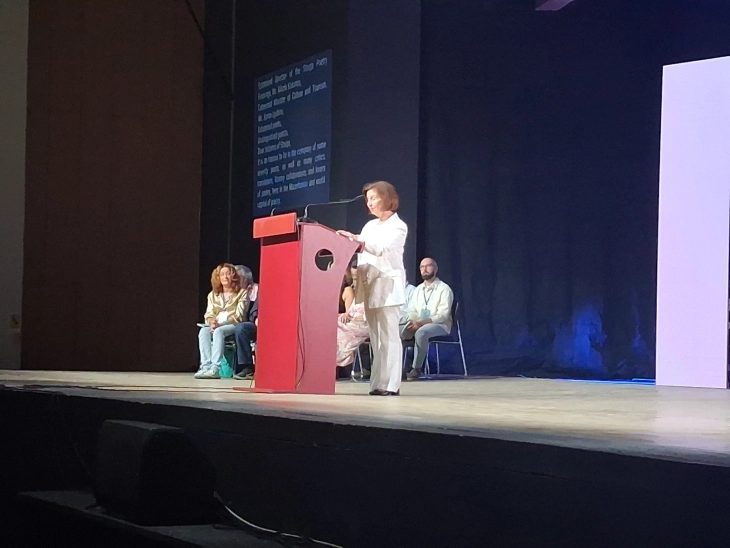
Skopje, 21 August 2025 (MIA) - Poets have changed the world and can still do so by building eternal poetic bridges from indestructible materials: the thought and the word, woven with intellect and emotion, said President Gordana Siljanovska-Davkova on Thursday evening, as she declared open the 64th Struga Poetry Evenings.
In her address at the event, before poets as well as numerous critics, translators, literary collaborators, and poetry enthusiasts, from what she called the Macedonian and global capital of poetry, the President expressed hope that after the 64th edition of the Struga Poetry Evenings, both Struga and the world will be different.
According to Siljanovska-Davkova, the spoken word was and remains a powerful and effective weapon.
“Words can confront us with truth, awaken our conscience, inspire our humanity, heal our wounds, free our imagination, and by encouraging action, change reality. The spoken word, the poetic word, teaches and transforms. Within it lies and from it springs the strength of the poetic republic, of the Struga Poetry Evenings,” the country’s President stressed.
Addressing those “who do not believe in the power of the word”, Siljanovska-Davkova said “in the beginning was the word and then came the banned books”.
“Among them is the Abecedar, published in 1925, a hundred years ago, in Athens, under pressure from the League of Nations, which was immediately confiscated and destroyed precisely because of the power of words to revive the Macedonian language and identity among children – Macedonians. Or, remember the Miladinov brothers, as well as other revivalists, who tirelessly collected and recorded folk words, songs, customs, riddles, and stories to preserve them from oblivion and disappearance. If words have no power, why have those in power in every historical era tried to control them and their creators, from Ovid to Lorca,” Siljanovska-Davkova emphasized.
According to the President, Struga's story of poetry is the best example and model of Goce Delchev’s cultural competition among nations, especially, as she emphasized, relevant in this conflict-ridden and war-torn time.
The President reflected on the history of the creation of the Struga Poetry Evenings back in 1961, when a group of Macedonian poets gathered in Struga to mark the 100th anniversary of the publication of the Miladinov brothers’ "Zbornik". In addition to the traditional events, she welcomed the return of the most important features of the Struga Poetry Evenings: the reading at the monument of “Saint Clement” in Ohrid, the poetic sailing and recitation in Saint Naum, and the poetic matinée in the courtyard of the church “Holy Mother of God Peribleptos.”
Struga and the Struga Poetry Evenings, according to Minister of Culture and Tourism Zoran Ljutkov, are a place where time calms, and the past and present merge in the rhythm of the poetic word.
“It is the heart that beats through sentences, the voice of the world that echoes in all languages, regardless of color, faith, language, or origin. Here, by the [river] Drim, poets are not guests but hosts, and verses are not strangers but brothers who recognize each other. Each year, the festival bears witness that poetry is eternal, and that the word is the most powerful bridge between people, cultures, and eras,” Ljutkov said.
“This edition of the festival,” he noted, “is illuminated by the symbol of Glagolitic script, the script that gifted us the light of the word.”
“It is our cultural soul, a testimony to our history and our connection to the future. And so, in the year when we mark 80 years since the codification of the Macedonian standard language, we return with special pride to the first spark, to the letters that became root, identity, and eternity,” added the Minister.
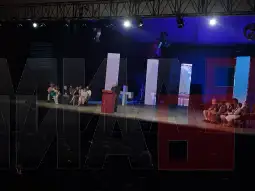
Festival director Nikola Kukunesh said it is no coincidence the visual focus of this year’s edition is placed on the Glagolitic script, and that the emphasis is on the letter “G,” which in that script is named “glagoli” – meaning to speak.
“Before our eyes, with all its defiance, appears the pictorial side of the Old Church Slavonic language – the language spoken by Macedonians from the Thessaloniki region, i.e., the language of pan-Slavic literacy. A language for which the Slavs in Moravia and Pannonia yearned as if for a ray of light or nourishment for the soul,” Kukunesh said.
He stressed that the linguistic and cultural connection between Macedonia and Slovakia has been unbreakable for 1,162 years, and proof of this, he said, is this year’s laureate – Slovak poet Ivan Štrpka.
The Struga Poetry Evenings began on Thursday with the lighting of the festival flame and a reading of Konstantin Miladinov’s poem “Longing for the South”. It is set to continue with the International Poetry Reading “Meridians,” featuring poets from various meridians and cultures, sharing their poetic visions.
Earlier on Thursday, as part of the festival’s traditional tree planting ceremony in the Park of Poetry, this year’s Golden Wreath recipient, Ivan Štrpka, planted a tree next to a plaque bearing his name, placed among those of other poets.
Photo: MIA