Siljanovska-Davkova in UN: We want to be integrated in EU, but without additional conditions and with national dignity preserved
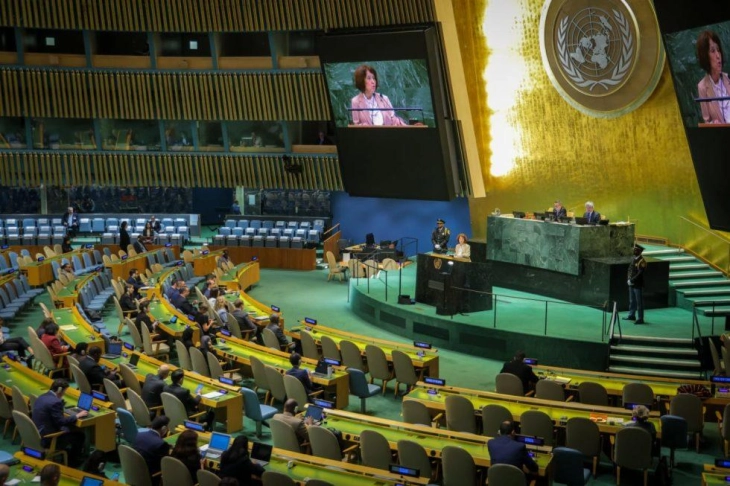
New York, 25 September 2025 (MIA) - We are standing in front of a great test: either we will guarantee an international order based on visionary principles or we will rush towards a catastrophe of unimaginable proportions for humanity, President Gordana Siljanovska-Davkova said addressing the 80th session of the United Nations General Assembly in New York on Thursday.
"A new geopolitical era is emerging before our eyes. Instead of acting together on the urgent challenges, such as peace and security, climate change and environmental destruction, AI and growing inequalities, we seem to be heading towards a post-Hobbesian state of war of everyone against themselves. Instead of a single international order, parallel orders seem to be emerging, each with its own rules, values and interests, often directly against one another," Siljanovska-Davkova said.
According to her, the United Nations today face a geopolitical and geoeconomic earthquake that is shaking the foundations of the post-World War II order, and today’s crises stem from deep tectonic shifts undermining the principles that shaped the world for the past 80 years.
"Instead of creating a sense of shared future, humanity is facing wars and loss of humanness. With international humanitarian law increasingly ignored, hunger is weaponized, and humanitarian workers are targeted. The tremors of the international order have opened deep geopolitical fault lines. One of the most active is in Ukraine, where war has been raging for three and a half years. Russia’s aggression is a fragrant violation of the Charter of the United Nations and a direct threat to international peace and security," said Siljanovska-Davkova.
She called for immediate de-escalation, full respect for international law, and use of preventive diplomacy to reduce tensions and preserve peace.
The geopolitical fault line, she added, also runs through the Western Balkans region. "The Macedonian accession process to the European Union has been continuously obstructed for 20 years, but not on the basis of objective Copenhagen criteria, but for subjective nationalistic reasons. The latest EU condition to start our negotiations is a new imposed amendment to the Constitution," the President said.
She pointed out that conditioning the start of negotiations to new constitutional amendments once again reopens issues of history, culture and language, "questions we have been assured were settled by the Prespa Agreement with Greece".
"We are constantly reminded that agreements must be respected: Pacta sunt servanda. We note that the Treaty on Friendship, Good-Neighbourly Relations and Cooperation with Bulgaria contains no provisions for constitutional amendments. Finally, through the constitutive acts, the EU defines itself as a "unity of diversity" and commits to respecting "culture and linguistic diversity", "national and cultural identity" and "dignity and integrity". How then is it possible that we are asked to discuss and negotiate with a neighbour about our history, culture and language?," President Siljanovska-Davkova asked from the podium of the UN General Assembly.
She stressed that we perceive ourselves as Europeans and deeply believe in the European project that brought peace and economic prosperity after World War II.
"The European ideal remains our greatest inspiration and strategic aspiration. As a country dedicated to good neighbourly relations and regional cooperation, we do not seek dispute with our neighbours. What we desire is to be integrated in the Union, but without additional conditions and with national dignity preserved," Siljanovska-Davkova pointed out.
She warned that after the war in Ukraine, the blocked European integration of the Western Balkans is not only a political but also a security issue. "With the political door closed for the Western Balkan countries, and the door wide open for influences of third geopolitical centres of power, it is ironic that the Union calls for resilience towards them," the President said, adding that if the EU wants to be a geopolitical union, it must not leave the Western Balkans in a geopolitical vacuum.
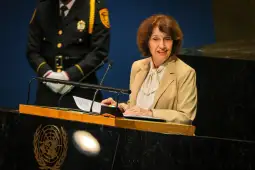
In her address, referring to the Middle East and Gaza, she expressed conviction that sustainable peace in the Middle East can only be achieved through dialogue and diplomacy in accord with international law. "In that spirit, we reaffirm our support for international efforts aimed at de-escalation, inclusive dialogue and direct negotiations. The alternative is to try to revitalize multilateralism and make its institutions more resilient to the systemic shocks," Siljanovska-Davkova said.
According to her, young generations have the right to a renewed Charter, to a reformed and strong United Nations that will enable them to live in peace among nations, and peace with nature.
"These reforms must not be cosmetic, but profound, to enable greater inclusiveness, harmonization between values and mechanisms, optimization of national and global interests, strong and functional institutions," said Siljanovska-Davkova.
She believes the UN reforms depend on whether they are seen as an opportunity to renew the rules-based international order, or as a challenge to the privileges of some member states. "Yet, what is the point of being a privileged member state of a dysfunctional, irrelevant, marginalized international organization," the President said, adding that reform is needed not only for old challenges, but also for new ones. "AI brings enormous opportunities, but also incalculable risks for our civilization. It is not just a technological leap, its impact may be greater than the industrial and digital revolutions. Aware of this, my country and I support the proposal to make AI a priority of the 80th session," Siljanovska-Davkova said.
As regards the election of a new UN Secretary-General next year, she pointed out that the next top diplomat of the world must possess knowledge, patience and tact. "After 80 years, it is high time for a woman to be a Secretary-General of the UN. In a world dominated by strong men, often with weapons, we need strong women with wisdom and empathy," said the President.
On climate change, she said Macedonian citizens are already experiencing the consequences of the climate crisis, such as extreme weather conditions, which is why the country supported the implementation of the Paris Agreement at COP29 held in Baku.
In addition, she noted among other that the country is making great efforts to promote women’s leadership and the implementation of the Women, Peace and Security Agenda, and signed the new 2026-2030 UN Cooperation Framework to ensure inclusive social and human development, sustainable economy and decent work, resilient and green societies and ecosystems, the rule of law and good governance.
"We should recognize the United Nations for what it is - an admittedly imperfect, but indispensable instrument of nations in working for peaceful evolution towards a more just and secure world order. Let’s give them that chance," President Gordana Siljanovska-Davkova said in her speech at the 80th session of the UN General Assembly in New York.
Photo: MIA


