Siljanovska-Davkova at Columbia University World Leaders Forum: Demands coming from our neighbours have nothing to do with Copenhagen criteria
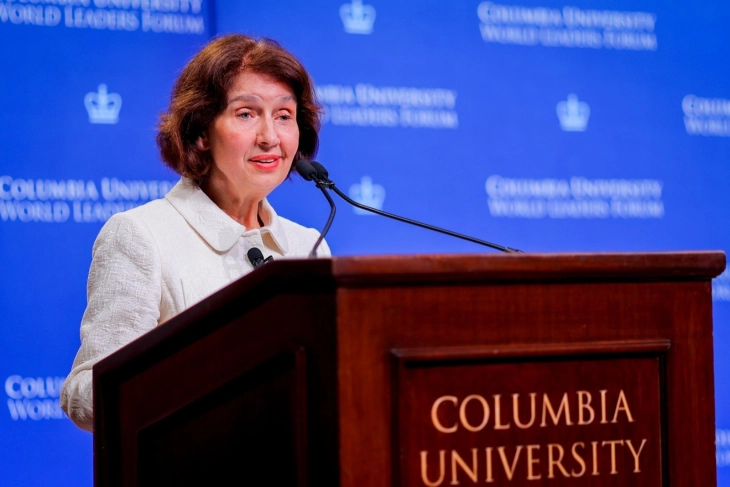
New York, 27 September 2025 (MIA) – Our path to Brussels resembles a marathon, a marathon, or maybe I can sometimes use the question "Are we waiting for Godot?". We started our marathon in 2005, officially, when we were given candidate status. Today, they often use the syntagma that the EU is an unfinished symphony without the Western Balkans, and the interest for us in the Western Balkans aroused three years ago when, unfortunately, the war in Ukraine started, President Gordana Siljanovska-Davkova said addressing students at Columbia University in New York as part of the World Leaders Forum.
As MIA's correspondent reports, she elaborated before the academic community the outcome of the endless delay of the promise of European integration of the Balkan countries.
"We, Balkanians, have also perceived ourselves as Europeans, because we have always been geographically, historically and especially culturally a part of Europe. At the moment, the EU enlargement process is again on the agenda, but not just a question of larger EU, but of stability, of security. This is a good chance for us, I don't know how many times, to be on the agenda and to catch the momentum. Because we have tried to catch the momentum many, many times, the result is 36 amendments to our Constitution, for 30 years," said Siljanovska-Davkova.
She pointed to the experience of the Baltic countries, which in the process of European integration received the greatest support from their neighbours - the Scandinavian countries, and became members of the EU, unlike the Western Balkan countries where the veto is appearing - "a member of the EU uses the status, being protected like a member of the family, to prevent the neighbour from advancement or walking towards Brussels".
"I think that the EU has to rethink its position because even the EU is in a crisis today. Previously it was synonymous for democracy, for rule of law, now it is not so. And we are facing such a crisis of leadership today. Maybe the relation between the members of the EU and the candidates, like us, is wrong, because it is simply "listen and do" because you intend to join us not we. The rules are clear, the rules are excellent, they are known as Copenhagen criteria, but veto is not a part of Copenhagen criteria," Siljanovska-Davkova pointed out.
She noted that the problem with the veto in our case is that it is not based on respect for the Copenhagen criteria, but on demands coming from our neighbours that have nothing to do with these criteria.
"In the Agreement on EU, in the Treaty of Lisbon, in the Charter of Fundamental Rights, you will read that the EU is proud of being "unity in diversity" and will respect the cultural and the national identity of the nations and of the states. The veto is only in this area. I would understand the veto if we are not pushing for rule of law, but not in the matters that are ad acta in a democratic society, such as identity, that is our right to self-determination. Our legitimacy derives from the citizens and belongs to them. If we continue to change the Constitution because of the will of some members of EU, then we have to put in our Preamble "we, the people, and the international community", and it is not good. I also believe that the EU has a Constitution, it is not codified, but the documents I have mentioned have constitutional meaning and force. That's why, if the EU is for democracy and for multilateralism, it is also obligated to respect its own constitutional documents. Otherwise, it is hypocrisy," said President Siljanovska-Davkova.
In the context of the United Nations, she reiterated that the first step in reforming the UN is to have, for the first time in 80 years, a woman Secretary-General.
Also, she added, there is a need for deep reforms within the UN, including the decision-making process.
"I still believe in the United Nations. They still enjoy legitimacy. But sometimes they remind me of the League of Nations, they finished in a very bad way. We mustn't allow that. Let's do something, really, to continue the way our founding fathers started, with respect to the Charter, with respect to the international law, with respect to the verdicts by the courts. Otherwise, we are wasting the time, we are losing the battle. Without peace, we cannot reconstruct the United Nations," Siljanovska-Davkova said in her address to the students at the Columbia University in New York.
The lecture was followed by a session of student questions for the President. The students expressed interest in the country's foreign policy, the Macedonian Constitution and internal order, as well as the situation in the wider region.
The President said she felt like a student, but also like a professor, noting that she missed her students and that she practiced the Socratic methods, which means that she taught the students, but was also ready to learn from them.
The World Leaders Forum is a year-round event series at Columbia University that has hosted over 300 heads of state and world leaders from over 85 countries since it was first established in 2003 by President Emeritus Lee C. Bollinger.
The goal of the World Leaders Forum is for students, professors, and the university community to hear the views of statesmen in person, to encourage interaction and mutual dialogue.
Before the lecture, President Siljanovska-Davkova met with the leadership of Columbia University.
Photo: President Gordana Siljanovska-Davkova's Office


