RSF ranks North Macedonia 42nd in 2025 World Press Freedom Index
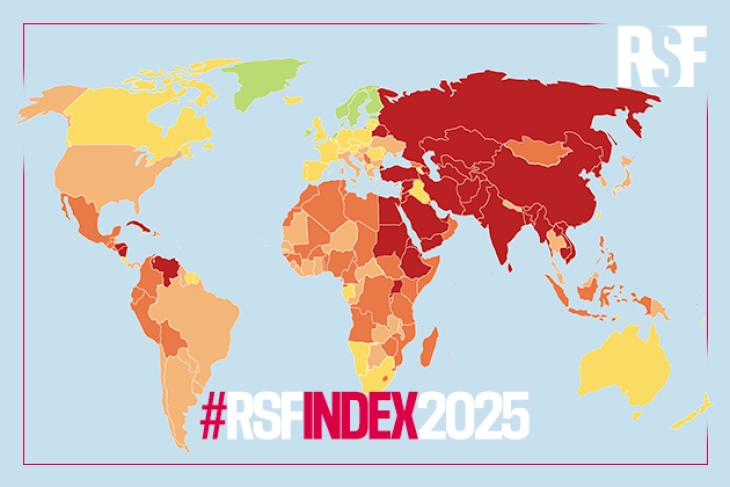
Skopje, 2 May 2025 (MIA) - North Macedonia is ranked 42nd out of 180 countries in the 2025 World Press Freedom Index, based on a report released by Reporters Without Borders (RSF), declining 6 spots compared to last year when it was ranked 36th.
Despite the noted decline, the country remains better ranked than other countries in the region, following Slovenia (33rd) and Montenegro (37th).
Croatia ranks 60th, Bulgaria 70th, Albania 80th, Bosnia and Herzegovina 86th, Greece 89th, Serbia 96th, and Kosovo 99th.
According to Reporters Without Borders, media freedom in the country is rated as “satisfactory.”
“Although journalists do not work in a hostile environment, widespread disinformation and a lack of professionalism contribute to the decline of society's trust in the media, which exposes independent outlets to threats and attacks. Furthermore, government officials tend to have poor and demeaning attitudes towards journalists,” it is stated in the overall assessment of Macedonia.
The organisation creates its national press freedom scores by assessing five “indicators”: media landscape, the political context, legal framework, sociocultural contexts in each nation as well as their safety situation.

Media landscape
Although television is the dominant source of information, online media play an important role. Yet, a distinction must be made between professional online newsrooms that employ journalists and publish original content, and individual portals that plagiarise and copy and paste content. There is also a big gap between usage and trust: the most watched TV stations – Alsat, Sitel, MTV1, Kanal 5 – have a low reliability index.
Political context
The overall environment remains favourable to press freedom but government agencies are not very transparent and critical journalism is increasingly subject to attack. Due to strong political polarisation, the media can come under pressure from the authorities, politicians and businessmen at both the national and local level. The two largest parties (in power and in opposition) have created parallel media systems over which they exert their political and economic influence. The public broadcaster lacks editorial and financial independence.
Legal framework
While the constitution guarantees freedom of speech and prohibits censorship, the country has been slow to harmonise media legislation with the standards of the European Union, which it intends to join. Strategic lawsuits against public participation (SLAPPs) serve as instruments of intimidation and pressure on independent media. A new law re-authorising national and local authorities to advertise in privately owned media has raised concerns about possible associated influence peddling.
Economic context
Although certain types of media concentration are prohibited by law, the editorial staff of some of the major TV channels are exposed to economic pressures from their owners. State funding is limited and non-transparent, and independent media rely heavily on donors. Project-based foreign grants contribute to mere survival, but not to further development. Journalism is a very precarious profession. Some media outlets are subjected to influence peddling by marketing agencies.
Sociocultural context
Although there are no clear constraints in the social and cultural environment that affect free journalism, social media and the digital sphere generally favour the spread of disinformation and cyberthreats. Combined with low professional standards, they contribute to the decline of public trust in the media and pave the way for attacks on journalists based on gender, ethnicity or religion.
Safety
Several incidents have diminished journalists’ sense of safety, including arson attacks on their property and cases of police harassment. On one hand, a special prosecutor was appointed to handle cases of attacks against journalists in the capital, and the opening of similar offices across the country is under consideration. On the other hand, journalists covering prosecutors face significant pressure.

The Reporters Without Borders World Press Freedom Index is a global annual ranking covering 180 countries.
Norway ranks first among 180 countries globally, followed by Estonia, the Netherlands, Sweden, and Finland in the top five.
At the very bottom of the list are Eritrea, North Korea, China, Syria, Iran, and Afghanistan.
Photo: screenshot


