Plakolm and Grašič: QMV at intermediary stages of accession will prevent further bilateral blockades
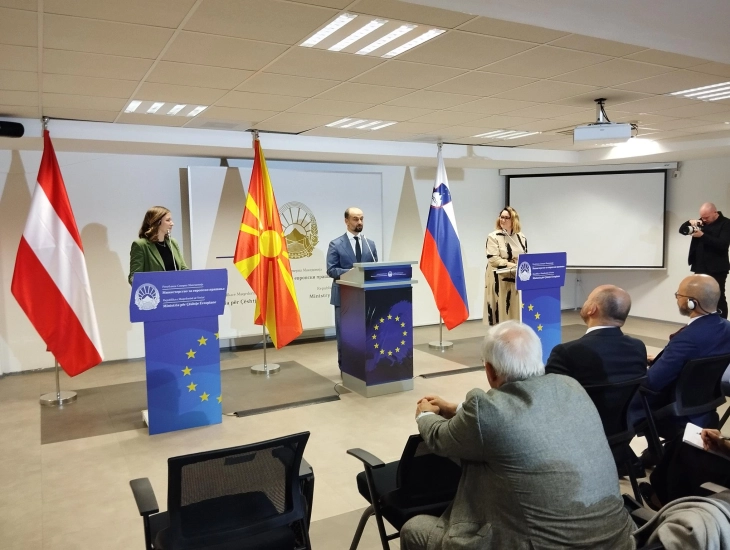
Skopje, 6 October 2025 (MIA) – Austria and Slovenia, together with Germany and Italy, have called on the European Commission to streamline the decision-making process for the accession of candidate countries by moving towards qualified majority voting (QMV) at intermediary stages of the accession process and unanimity for the opening and closing of negotiations.
The call to the European Commission has been backed by 16 member states, and as Austrian Minister of Europe, Integration and Family, Claudia Plakolm, and Slovenian State Secretary at the Ministry of Foreign and European Affairs, Neva Grašič, said in Skopje on Monday, the goal is to streamline the process and avoid bringing bilateral and internal political issues into the accession process.
Speaking at a joint press conference with Minister of European Affairs Orhan Murtezani, both Plakolm and Grašič pointed out that the goal of this initiative is to speed up the EU accession of the Western Balkan countries, as well as Ukraine and Moldova.
"We should try to close this gap in order to increase the security of the continent and connect what belongs to each other. The accession process has been going on for 20 years. For 20 years now, we have been promising that North Macedonia will join the EU. Today, I have news for you from Austria. Austria will support qualified majority voting in the accession process for new countries to the EU in order to reduce bureaucracy. This means that unanimity will not be necessary for every technical step for each candidate country... Unanimity will be required for the final accession process, but in the meantime, tense bilateral relations will be reduced and it will be possible to make more neutral decisions," said Plakolm.
She added that this means moving towards QMV at intermediary stages of the accession process, noting that political will is needed to bring this initiative to life.
"It is clear that major issues, such as the common security and foreign policy, require our unanimity, but in the accession talks there must be no obstacles at the intermediary steps with bilateral and domestic political issues. Of course, there should be unanimity for the opening and closing of the process," the Austrian Minister noted.
Grašić stressed that both Slovenia and Austria push for North Macedonia to join the EU as soon as possible.
"EU enlargement remains our priority, primarily due to geopolitical dynamics. We also push for North Macedonia to join the EU by 2030, and we understand the disappointment," Grašić said.
She added that Slovenia is among the countries that have launched the initiative to move towards QMV on technical issues.
"Slovenia and Germany recently proposed qualified majority voting on technical issues related to enlargement, and we want to see the countries from the Western Balkans, but also others from the East, progress as quickly as possible. This is our contribution. When Slovenia joined, the process was more straightforward in terms of the acquis, now it is more difficult in terms of aligning with EU legislation. The Union is now stronger with more concrete laws," she added.
She noted that Slovenia, Germany, Austria, and Italy have sent a letter to European Council President António Costa, calling for streamlining the decision-making process, and the initiative has been backed by 16 members.
Grašić added that the rest are invited to join in, expressing satisfaction that Costa and the leaders are discussing it.
Minister Murtezani said the enlargement methodology should undergo certain changes, not only because the country has experienced the issues firsthand, but also because, unfortunately, it is becoming a practice and is not only damaging the interests of the candidate countries, but also the strategic interest of the EU.
"This is especially due to the fact that it makes accession more difficult and leaves room for, so to speak, bilateralization of the process. Geopolitics has changed, and a methodology must be established that will enable completing the process sooner under these conditions of uncertainty," said Murtezani.
Photo: MIA


