Pacific tsunami risk eases after magnitude-8.8 quake hits off Russia
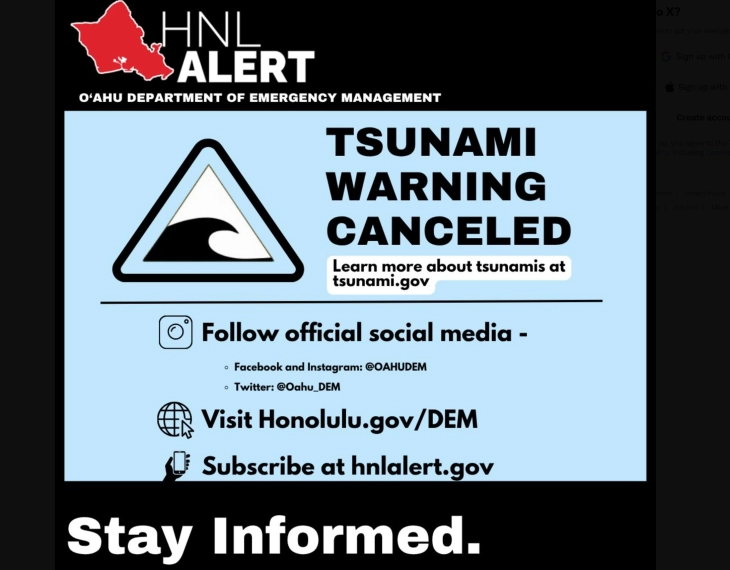
Moscow/Tokyo, 30 July 2025 (dpa/MIA) - A massive earthquake off Russia's Kamchatka Peninsula triggered tsunami warnings for millions of people across the Pacific.
From Japan, China and the Philippines to Hawaii, the US West Coast and Latin American countries like Mexico and Ecuador, warnings were issued to residents to brace for potentially life-threatening, meter-high waves.
But hours after the quake rocked Russia's Far East, there were no reports of major damage on Wednesday. In many regions, tsunami warnings were lifted or downgraded.
The main quake, which hit at about 11:24 am local time on Wednesday (2324 GMT Tuesday), was recorded by the US Geological Survey (USGS) at magnitude 8.8 - the strongest globally since Japan's Fukushima disaster in March 2011, and one of the six most powerful earthquakes ever measured. Russian authorities reported a magnitude of 8.7.
According to the Russian Academy of Sciences, it was the strongest earthquake to hit Kamchatka since 1952. The epicentre was in the open sea, about 130 kilometres from the sparsely populated coastline.
Dozens of aftershocks were recorded, many above magnitude 5. The two strongest were measured at 6.9 and 6.3 by the USGS.
Injuries and flooding in Russia
Authorities on the remote, mountainous Kamchatka Peninsula reported several injuries.
Regional Health Minister Oleg Melnikov said patients were receiving necessary care in hospitals, without providing casualty numbers. A kindergarten building was also severely damaged.
In the regional capital of Petropavlovsk-Kamchatsky, frightened residents fled outside barefoot, according to the Russian news agency TASS.
Wardrobes toppled, cars slid across shaking streets and power and phone networks were briefly knocked out.
Flooding was reported in the northern Kuril Islands. In the town of Severo-Kurilsk on the island of Paramushir, four tsunami waves reached as far as 200 meters inland, according to local administrator Alexander Ovsyannikov. Russia’s RIA Novosti news agency reported, citing emergency services, that the largest wave was up to 5 metres high.
According to civil protection officials, parts of the port of Severo-Kurilsk and a fisheries company were flooded. The population, including 60 tourists, was evacuated. There were no serious injuries or major destruction, regional governor Valery Limarenko said on state television.
Japan records tsunami waves, evacuates Fukushima site
On Japan's Pacific coast, a wave measuring 1.3 metres was recorded in a port in Iwate Prefecture, with up to 80-centimetre waves in other coastal regions, local media reported.
Authorities had issued tsunami warnings for waves up to 3 metres high. Northern Japan lies geographically closest to the quake zone.
Later, the Japanese Meteorological Agency downgraded the warnings for parts of the Pacific coast, although alerts remained in place for Hokkaido and the north-eastern Tohoku region, according to broadcaster NHK. Officials urged residents to remain in safe areas.
More than 2 million people had been asked to evacuate earlier in the day.
Workers at the Fukushima Daiichi nuclear plant were evacuated due to the tsunami warning. Tokyo Electric Power Company (TEPCO) confirmed to the Japan Times that all staff reached higher ground safely. The facility was the site of a major nuclear disaster in March 2011, when an earthquake and tsunami triggered multiple reactor meltdowns.
The tsunami alert also disrupted transportation in Japan, affecting roads, railways and flights during peak tourist season, according to the Nikkei business newspaper. Some factories were forced to halt operations.
Hawaii, Alaska, US West Coast on edge
Initial tsunami waves reached Hawaii Tuesday evening, with the highest recorded at 1.5 metres.
The US National Tsunami Warning Center initially issued a full warning for the Pacific islands, which was later downgraded by early Wednesday to an advisory level. Beaches - especially on Hawaii's Big Island - were evacuated earlier.
All ports were closed to marine traffic. Flights to and from Maui were cancelled as around 200 people took shelter in one terminal.
Along the US West Coast, including California, authorities issued warnings and urged some coastal residents to move to higher ground. Alaska also prepared for elevated wave activity.
Canada's British Columbia province issued a coastal alert, and several Latin American countries with Pacific coastlines - including Mexico, Guatemala, Ecuador, Peru, and Chile - also issued tsunami warnings.
Authorities warned that the first wave is not necessarily the strongest, and tsunamis can arrive in multiple, increasingly powerful surges - a point repeatedly emphasized by emergency agencies.
China and the Philippines lift warnings
China lifted its yellow tsunami warning for coastal areas of Zhejiang Province and Shanghai on Wednesday afternoon. The national tsunami centre cited recent monitoring data.
In Taiwan, the Central Weather Administration urged coastal residents to remain vigilant and take necessary precautions.
The Philippines also lifted its tsunami warning later in the day, with authorities saying no significant sea level changes or destructive waves were observed based on available tide gauge data. All public advisories were withdrawn.
Earlier, residents in coastal areas of the Philippines and Indonesia had been urged to seek safety. Indonesia reported minor tsunami waves, with the National Meteorology and Geophysics Agency measuring them at no more than 0.2 metres.
Photo: Hawaii Emergency Management Agency on X


