Nobel Chemistry Prize goes to trio who developed molecular frameworks
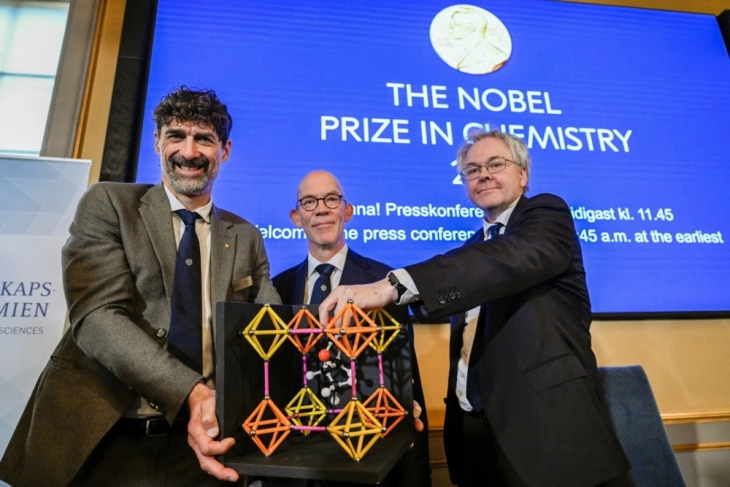
Berlin, 8 October 2025 (dpa/MIA) - The Nobel Prize in Chemistry has been awarded to Susumu Kitagawa, Richard Robson and Omar M Yaghi "for the development of metal-organic frameworks," the Royal Swedish Academy of Sciences said on Wednesday.
The researchers created frameworks with large spaces through which gases and other chemicals can flow, allowing for the harvesting of water from desert air, carbon capture or toxic gas storage, for example.
Kitagawa, 74, of Kyoto University in Japan, Robson, 88, a Briton working at the University of Melbourne, and Yaghi, 60, a Jordanian working at the University of California, Berkeley, "have developed a new form of molecular architecture," the academy said.
Thanks to the trio's discoveries, chemists have been able to design tens of thousands of such compounds, some of which could help solve some of humanity's greatest challenges, it added.
"In their constructions, metal ions function as cornerstones that are linked by long organic (carbon-based) molecules. Together, the metal ions and molecules are organised to form crystals that contain large cavities," the academy said in a statement.
"These porous materials are called metal–organic frameworks (MOF). By varying the building blocks used in the MOFs, chemists can design them to capture and store specific substances."
The frameworks can also drive chemical reactions or conduct electricity, it further explained.
"Metal–organic frameworks have enormous potential, bringing previously unforeseen opportunities for custom-made materials with new functions," said Heiner Linke, chair of the Nobel Committee for Chemistry.
They could be applied, for example, to separate harmful chemicals form water or to degrade pharmaceutical traces in the environment.
Award is a great honour
Kitagawa said he was very surprised when he was contacted by the secretary general of the Royal Swedish Academy of Sciences, Hans Ellegren, about the award.
"I'm deeply honoured and delighted that my long-standing research has been recognized. Thank you very much!" he told Ellegren.
The secretary general said all three prize winners were "rather glad" when they were told the news, eliciting laughter in the hall with his understatement.
"Of course this is a very staggering moment for someone to get a call like this. They were really happy," Ellegren added.
It began with a teaching model
It was Robson who laid the foundation for the discovery in the 1970s by building atomic models out of wooden balls for his students.
He wanted to mark where holes should be drilled in the wooden balls for the workshop, but could not choose their locations at random because atoms form chemical bonds in specific ways. This gave him an idea - but it would take more than a decade to develop it further.
Over time, Kitagawa and Yaghi created a foundation for Robson's visions, individually making several groundbreaking discoveries between 1992 and 2003.
Highly endowed prize
The trio share a prize of 11 million Swedish kronor ($1.17 million).
Since 1901, the Nobel Prize in Chemistry has been awarded to 195 different researchers, two of whom have received it twice.
Last year, the chemistry prize went to three protein researchers: David Baker of the US and the British-based scientists Demis Hassabis and John Jumper.
This year's Nobel Prize announcements began with the award for medicine, which was given to Mary E Brunkow, Fred Ramsdell and Shimon Sakaguchi for their groundbreaking research on the immune system.
On Tuesday, the Nobel Prize in Physics was awarded to quantum researchers John Clarke, Michel H Devoret and John M Martinis "for the discovery of macroscopic quantum mechanical tunnelling and energy quantisation in an electric circuit."
The chemistry prize is followed by the Nobel Prize in Literature on Thursday, the Nobel Peace Prize on Friday, and concludes with the economic sciences award on Monday. The economics award is the only Nobel not established in the will of Alfred Nobel, the inventor of dynamite.
The awards ceremony is scheduled, as is tradition, for December 10, the anniversary of Nobel's death.
Photo: EPA


