New education financing methodology to focus on quality and inclusivity
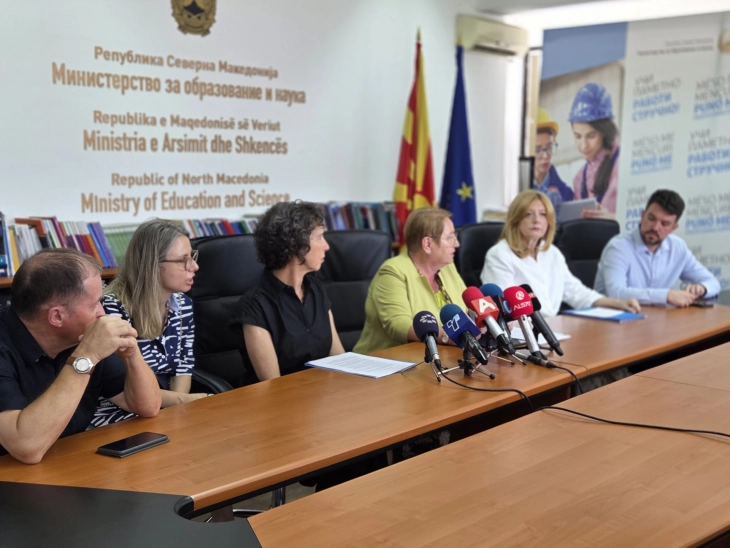
Skopje, 13 August 2025 (MIA) - The Government of the Republic of North Macedonia has adopted a new financing methodology for primary and secondary education which, as of January 1, 2026, will enable a distribution of funds in line with the real cost of education per student. The new formula foresees a fairer distribution of funds for primary and secondary education, with support for students with special educational needs, those who have classes in minority languages and support for the development of professions experiencing shortages, as well as the optimization of the school network and the introduction of single-shift work.
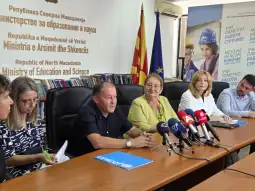
At a press conference Wednesday, Minister of Education and Science Vesna Janevska said the change in the formulas for calculating block grants was necessary since, she said, the existing formulas don’t provide efficiency in financing.
At present, according to Janevska, as much as 90 percent of the funds received by municipalities are used for paying wages and overhead costs of schools, which is significantly above the EU average of 70 percent. The Minister added that block grants have been growing, but mostly just to cover the growth of wages, and not for the development of schools or improvement of teaching quality.
She clarified that the new formula for financing primary education consists of two components – a basic and a variable one.
“The basic one will cover the standardized per-student expenses, which we determined stands at Mden 112.747 annually. This includes the wages and contributions of employees, their further professionalization and the school’s overhead costs. This component takes into account the degree of development of schools, which is calculated with a coefficient ranging from 0,75 to 2,55. So, more developed schools will receive a smaller amount, while the less developed schools will receive a greater amount in order to accelerate their development. The variable component will consist of expenses for the transportation of students, support for students with special educational needs, for students learning in Turkish, Bosnian, and Serbian, and students who attend classes in satellite schools,” the Minister said.
The per-student cost in secondary education has been set to Mden 103.589 annually.
Janevska highlighted the schools that offer programs in fields with staff shortages and development potential, such as agriculture, mechanical engineering, electrical engineering, transport, and veterinary science will receive a higher amount. Like for primary education, the variable cost depends on students with special educational needs and those who attend classes in Turkish and Serbian.
“The new formula, based on the real per-student education cost, enables fair financing in both primary and secondary education, with a special focus on vocational schools that have greater needs for space, equipment and materials. It will enable an optimization of the school network, improvement of the conditions for teachers and students, as well as a gradual implementation of single-shift work, especially outside of Skopje, with the goal of rational use of resources and investments where they are most needed,” Janevska said.
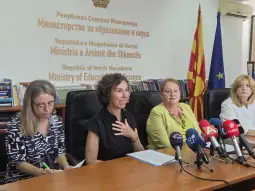
Welcoming the adoption of the new methodology, UNICEF’s Representative in the Country, Lesley Miller, said it represents a strategic shift toward a more inclusive and effective education system.
“These reforms are not merely technical adjustments; they mark a strategic shift toward a more inclusive and effective education system. By allocating resources more fairly and efficiently, they will enhance quality teaching and promote further equity,” Miller said.
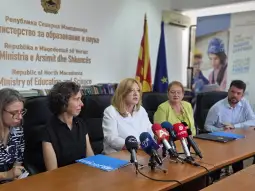
According to World Bank senior education specialist Bojana Naceva, the new methodology encourages transparency and accountability in public finance spending.
“The increase in funding for vocational education and training through the new financing formula, along with the growing interest of companies in participating in the educational process, are important prerequisites for improving the quality of vocational education and training. Only through cooperation between institutions and the private sector can we create vocational education that provides young people with better employment opportunities,” said Kurt Wüthrich leader of the Education for Employment project funded by the Swiss Embassy.
Association for Research and Analysis (ZMAI) executive director Viktor Mitevski said from the very beginning, the process has been guided by the highest principles of inclusiveness, transparency, and open dialogue.
“The Ministry of Education and Science, as the lead institution in the process, brought together the experience of civil servants who have been familiar with this issue for decades and the expertise of more than twenty experts from all relevant fields, engaged by the World Bank and UNICEF through ZMAI, resulting in high-quality solutions for Macedonian education,” Mitevski said.
Training sessions will be held for municipal administrations and school staff over the implementation of the new methodology, with an adjustment period also planned for the schools.
Photo: Ministry of Education and Science


