Murtezani: Our responsibility is to ensure constitutional amendments are final bilateral condition
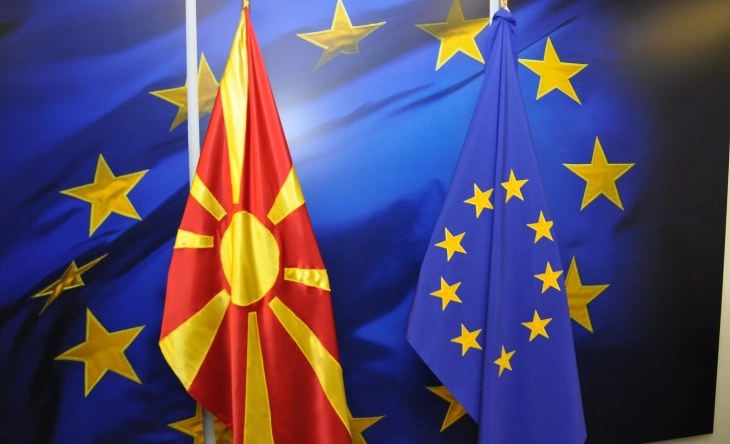
Skopje, 19 May 2025 (MIA) – Minister of European Affairs Orhan Murtezani reiterated the government’s position in regard to EU integration, stating that it remains committed to the proposal for constitutional amendments with delayed implementation and that the EU integration process should be based on values rather than bilateral issues.
“It is clear that there is no way to avoid constitutional amendments, but it is our responsibility to ensure that these amendments represent the final bilateral condition. We have no objection if all member states have additional requirements, as long as they refer to reforms and European standards and are not turned into blockades or include bilateral issues,” Murtezani said, responding to the messages conveyed by European Council President António Costa and the Prime Minister during their joint press conference in Skopje.
European Council President António Costa during his visit to Skopje, at the joint press conference with Prime Minister Hristijan Mickoski said that the EU expects the country to fulfill its commitments in order to begin accession negotiations.
Asked whether an alternative proposal is being considered besides the constitutional amendments with delayed implementation, he said that the government insists on avoiding further bilateralization of the accession process, and recalled Mickoski’s statement expressing readiness for dialogue. “For that to happen, we must first trust the EU and begin building mutual trust with the Bulgarians,” Minister Murtezani said.
Asked about the progress on adopting new laws under the Reform Agenda, which have a deadline set for June, Murtezani said delays are not expected for most of the 16 planned steps.
“Out of all 16 steps relates to legislation, delays are not expected. The Energy law has already been passed in Parliament, many other laws are in inter-ministerial consultation or public debate, and some are expected to undergo government procedure soon and be submitted to Parliament. The new Electoral Code is unlikely to be adopted within the set timeframe, as OSCE/ODIHR recommends no changes to electoral legislation shortly before elections to avoid confusion. There is also uncertainty about whether the Law on Judicial Council will be ready on time. However, these two steps are inherently more complex, requiring broader social and political consensus and more time. It is not a major issue if some reforms cannot be implemented by deadline, the grace period of 12 months will give us time to complete them,” Murtezani added.
Regarding the use of funds from the Reform and Growth Facility, Murtezani emphasized that there is no risk of the funds being blocked and that North Macedonia has already received €52 million in pre-financing, the first among Western Balkan countries to do so.
“So far, we have received only the pre-financing tranche of €52 million for reforms, with a deadline of February 2025. On March 15, a request was submitted for the release of an additional €17 million as a reward for reforms already implemented. The European Commission has 90 working days to assess the report, and we expect a response by the end of July,” Murtezani said.
He added that of the total €750 million over three years, the financing structure includes a mix of grants, budget support loans, and loans for investment projects. “All non-budget support funds will be used to finance a list of 19 projects currently awaiting European Commission approval. Once we receive the final document from the Commission, it will be made public, so citizens can see exactly how the funds will be spent,” he said.
Photo: MIA


