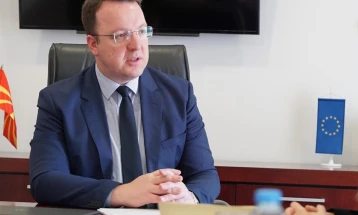
Murtezani in Berlin: Accession negotiations must be free from bilateral blockades and revisionist narratives
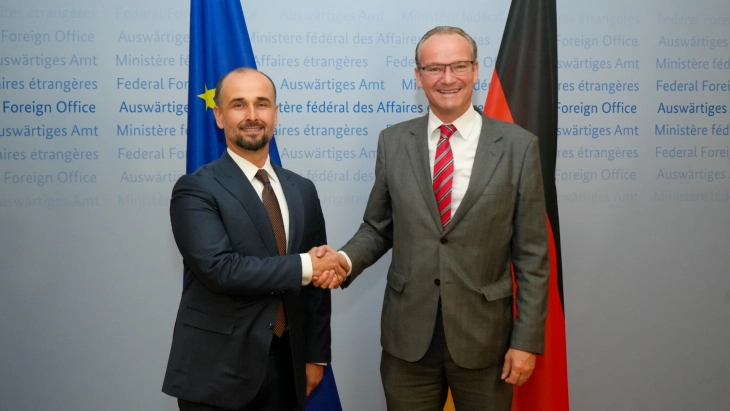
Skopje, 24 July 2025 (MIA) - Minister of European Affairs Orhan Murtezani met with Minister of State for Europe at the Federal Foreign Office, Gunther Krichbaum, in Berlin on Thursday. Murtezani pointed out that the enlargement process must be free from bilateral blockades and revisionist narratives, highlighting the need to establish effective European mechanisms for monitoring European standards and expertise, especially in the domain of historical and bilateral issues, in order to ensure fairness and predictability on the path to membership.
In this regard, interlocutors stressed the importance of strengthening European monitoring instruments as a guarantee for the credibility of the European integration process, the Ministry of European Affairs said in a press release.
Murtezani congratulated Minister Krichbaum on his recent appointment, wishing him success that will reflect positively not only on Germany, but also on Europe and the Western Balkans.
He also expressed gratitude for Germany's consistent support and friendship, underlining its important role in North Macedonia's European integration process, particularly Berlin's principled approach in protecting European values and separating bilateral issues from the accession process, as was also seen during the German EU presidency in 2020.
"Talks also focused on issues related to the European integration process, with participants jointly concluding that the transformative power of European integration can only be realized through a merit-based approach, which will provide a clear and tangible perspective for the citizens of the candidate countries," reads the press release.
Murtezani noted that the European project cannot be complete without the integration of the Western Balkans. He added that reforms, the rule of law and alignment with European values are requirements necessary for progress, but the Union must also ensure its own institutional readiness for enlargement.
He welcomed German support for gradual integration of candidate countries in the EU, by preserving the criteria and European standards, as well as providing concrete benefits for citizens during the accession process.
Murtezani and Krichbaum also discussed the current Reform Agenda of North Macedonia and the role of German institutions in the European integration process through support for structural reforms, strengthening the rule of law and good governance, as well as through the implementation of numerous Twinning and TAEX projects where Germany is often lead partner.
The two stressed the importance of sharing German experience in implementing the European acquis and in promoting the institutional capacities of North Macedonia for the use of European funds and the implementation of reforms.
Participants in the meeting exchanged views on further promoting regional cooperation through the Berlin Process, which represents a key platform in strengthening good neighbourliness, economic integration and mobility in the Western Balkans, as well as on implementing the Green Deal and the Common Regional Market.
The Ministry of European Affairs added that interlocutors highlighted the benefits of concrete initiatives and agreements reached within the Berlin Process, which promote the European spirit and the region's connection with the Union.
In addition, participants in the meeting discussed opportunities to deepen partnership in the future through intensifying cooperation in key sectors, transfering European knowledge and expertise, as well as through joint projects aimed at improving the lives of citizens and bringing European standards closer.
Photo: Ministry of European Affairs