Mucunski: We are constructive, but Macedonian language, identity and dignity are non-negotiable
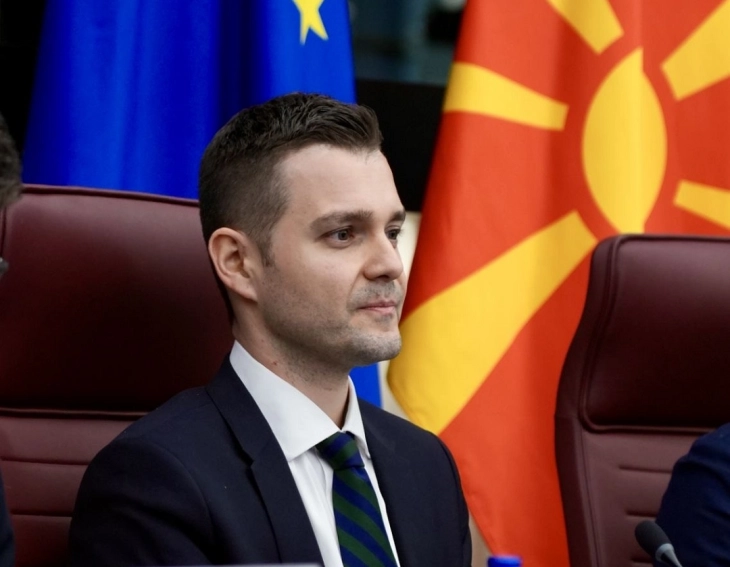
Strasbourg, 26 November 2025 (MIA) - As a country we remain committed to the implementation of our international obligations, and we will continue to be a constructive and predictable partner in the region, but issues related to the Macedonian language, identity, and the dignity of our people are not and cannot be subject of negotiations, said Minister of Foreign Affairs and Foreign Trade Timcho Mucunski in his address Wednesday at the 24th meeting of the EU-North Macedonia Joint Parliamentary Committee.
“When issues related to language, identity or national narratives turn into formal conditions within the accession process, the damage goes further than one bilateral dossier. It moves the process further away from clear legal criteria in an area where not a single candidate country can feel safe. It creates a precedent that others will be tempted to repeat and sends a message to our public that who we are can be negotiated. For us, the Macedonian language, the Macedonian identity and the dignity of our people are not and cannot be topics on the negotiating table,” Mucunski said.
According to the Foreign Minister, negotiations can be held over the rule of law, standards, policies, and the functioning of institutions. As long as this clear distinction is maintained, he said, we will protect both the enlargement process and respect for our societies.
“To be a good neighbor also means being honest with each other. The continued blocking of the next steps in our accession process by Bulgaria doesn’t only harm our nation. It also weakens the strategic credibility of the enlargement process in the entire region, and in the long-term it doesn’t serve the interests of Bulgaria either. A stable and prosperous neighbor oriented toward the EU on Bulgaria’s western border is an advantage, not a threat,” Mucunski said.
According to Mucunski, the Macedonian and Bulgarian citizens are seeking facilitated border crossing, trade, cooperation, and studying, and therefore the logic of investing in Corridor VIII should be applied in the relations between the two countries, since it has shown that they can cooperate when they choose concrete projects instead of abstract disputes, and when they build roads, railways, and energy connections instead of new complaints.
“We want relations with Bulgaria defined by shared opportunities and not by a permanent blockade. We will continue to respect our international agreements, and we are ready to enhance cooperation wherever it brings tangible benefits for our citizens in connectivity, energy, education, culture, and various other cross-border projects,” Mucunski added.
The Foreign Minister stressed that the Macedonian society is not Euroskeptic, noting that the country’s citizens believe in the European project, the rule of law, human dignity, and the market economy.
“The doubts that began to emerge are not over the idea for Europe, but over the pace and predictability of the process. We are in danger not of becoming Euroskeptics but Euro-pessimists. A society which believes in the European Union, but isn’t always convinced that the door is truly open,” Mucunski stressed.
The Minister said it is the duty of the Macedonian institutions and the EU to overcome that pessimism and show there are positive things too.
“Despite all the frustration, my country has stayed on course. Today, we are 100 percent aligned with the European Union’s common foreign and security policy, not 95, not 98, but 100 percent. Alignment itself is not easy. We stand with the European Union on Ukraine, on sanctions, and in defending the rules-based international order. The latest report of the European Commission clearly acknowledges this, and it is something we as a country are proud of,” Mucunski said.
Mucunski noted that North Macedonia was the first Western Balkan country to agree Security and Defense Partnership with the EU, which, he said, is not just a symbolic gesture, but a strategic choice to connect the country’s security architecture with that of the EU and to establish interoperability and joint resilience.
“At the same time, we are moving forward in line with the Growth Plan and the Reform Agenda. We are focused on economic growth, on keeping young people in the country, on attracting investors and investing in connectivity and digital transformation. These are not just reforms for the good of the European Union, but reforms for our citizens,” Mucunski said.
According to the Foreign Minister, harmonization with the EU’s policies and the implementation of reforms should be transformed into concrete steps forward, thereby sending a clear message to the citizens that the efforts, alignment, and commitment are truly valued.
“What we are asking is for the EU accession process to function according to its own principles, without identity issues being used as an obstacle for a country that is fully aligned with the values and policies of the EU,” Mucunski said.
Mucunski stressed that the country and its people remain firmly pro-European, believing in the Union and the values it represents.
“What we are asking in return is partnership with a very clear perspective. A process that is predictable, based on merit and comprehensible for our citizens. If we do this together, I am convinced that we can turn every form of European pessimism into European optimism, in our country, in our region, and throughout our shared European home. The time ahead can be a time of decisions and opportunities. Our country is ready to make its contribution,” Mucunski underscored.
The Joint Parliamentary Committee meeting was also addressed by Minister of European Affairs Orhan Murtezani.
Photo: MFAFT


