Mucunski: Protocol with Bulgaria is one of the most harmful documents in our history and has no legal effect
Skopje, 25 July 2025 (MIA) - Minister of Foreign Affairs and Foreign Trade, Timcho Mucunski, stated that the development of the situation regarding the initiative to assess the constitutionality and legality of the protocol from the second meeting of the joint intergovernmental commission with Bulgaria, submitted to the Constitutional Court by former DOM MP Liljana Popovska, will confirm whether constitutional amendments are the only obstacle for Bulgaria in unblocking North Macedonia's EU integration process.
“Bulgaria, in its official positions maintained so far, claims that constitutional amendments are the only issue. Unfortunately, I don’t believe that, as I follow both the rhetoric and the actions, including those in the European Parliament. Among other things, the development of this situation will serve as confirmation of whether constitutional amendments are truly the only issue, or if there is something much deeper at play. Primarily because the content of this protocol goes beyond the scope of the Good Neighbourliness Treaty, under which Bulgaria itself is obliged to support us on our path to EU integration. We’re monitoring the situation and considering different scenarios, but our priority remains EU membership, unlike those before us,” Mucunski told Kanal 5 TV Friday evening.
According to him, the so-called protocol is one of the most harmful documents in the history of our foreign policy, and in its current form, it has no legally binding effect.
“There are several reasons for that, and the Constitutional Court will probably need to weigh in, considering the procedure, how the protocol was concluded, its content, and international public law. Frankly, what my predecessor signed is disastrous and could have serious harmful consequences. But right now, it has no binding legal effect and carries no legal consequences for the state,” Mucunski said.
We have, he noted, a case before the Constitutional Court, which must remain independent and provide its opinion. However, there are elements, aspects, and details within it, some of which do not align with the values of the 21st century or those of the European Union.
Mucunski stated that our relations with Sofia should not be measured by this type of issue, but should instead be progressive, future-oriented, and focused on finding solutions.
“We expect Sofia to finally move beyond 19th-century rhetoric. An EU member state cannot constantly refer to human rights standards while denying rights tied to self-identification, our interpretation of national history, our language, and other elements that define our identity as a people. That is a basic human right. Our bilateral relations should be directed toward finding solutions to all these challenges and, looking ahead, moving the country toward the EU,” Mucunski said.
He stated that there is still no response from the Bulgarian side regarding Prime Minister Hristijan Mickoski’s proposal to the European Parliament for a joint resolution guaranteeing the Macedonian identity and language.
There has been no formal communication with his Bulgarian counterpart Georg Georgiev, but he said that there will likely be more opportunities to meet after the summer holidays.
“We are open to discussion. All meetings so far have been initiated by us. It is essential that we meet, that we have open dialogue, and that we seek solutions. We understand that we are the country seeking to start EU accession talks, and from that perspective, the urgency of finding a solution lies with us. That is the context in which the Prime Minister’s initiative should be viewed. We are witnessing a clear, evident, and unequivocal denial of our identity and language. It is a fact that an EU member state is denying the Macedonian identity and, through that denial, is creating an obstacle. This is one of the initiatives stemming from our proactive approach to finding a way to overcome that obstacle, which could have far-reaching consequences,” Mucunski said.
Mucunski urged for a rational approach and focus on what can bring unity, while expressing regret over what he described as extremely negative rhetoric from Sofia, rhetoric he said is also present in the opposition.
“SDSM, whether consciously or unconsciously, has adopted Bulgaria’s rhetoric. Whether this is intentional or not is something they should answer,” Mucunski said.
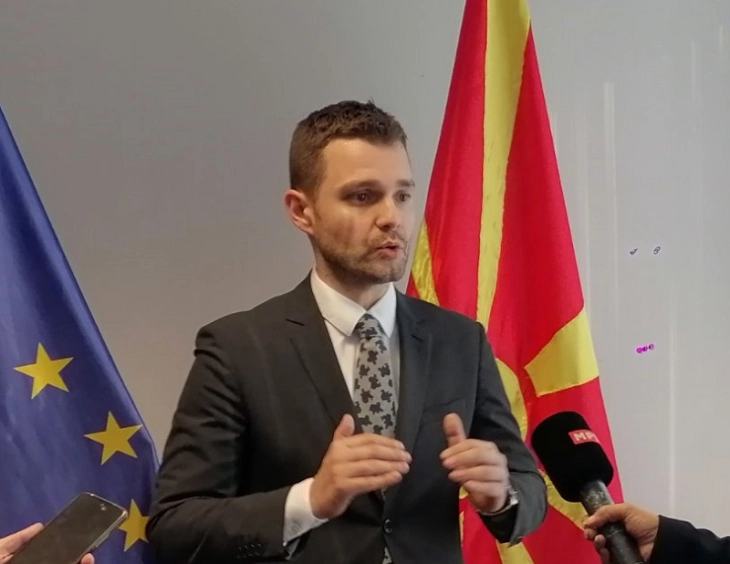
Photo: MIA archive