Minister Dimitrieska-Kochoska meets IMF representatives
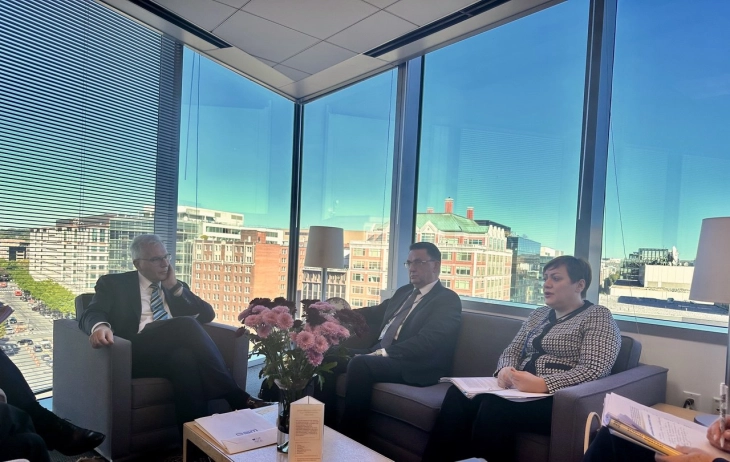
Skopje, 17 October 2025 (MIA) – The Government remains committed to maintaining macroeconomic stability and improving economic performance to achieve higher and sustainable rates of economic growth. Key priorities also include reforms in public finance management and preserving fiscal discipline to ensure ongoing fiscal consolidation, stressed Minister of Finance Gordana Dimitrieska-Kochoska at her meeting with representatives of the International Monetary Fund.
In Washington, the Minister met with Deputy Managing Director Bo Li, as well as Executive Director Jeroen Clicq, Deputy Executive Directors Marnix van Rij and Vladyslav Rashkovan, Director of the IMF’s European Department Alfred Kammer, and IMF Mission Chief for the country Nick Gigineishvili. The Governor of the National Bank, Trajko Slaveski, also participated in the meeting.
“Positive economic trends that began in the second half of last year continue into 2025. GDP growth over the last four quarters, from Q2 2024 to Q2 2025, has hovered around and above 3 percent. The State Statistical Office recently reported GDP growth of 3 percent for 2024. Stimulating economic growth through infrastructure investment and maintaining a significant level of capital expenditures in public finance remains a priority,” the Minister said.
Dimitrieska-Kochoska noted that the country’s economic stabilization is supported by disciplined fiscal policy.
“We remain committed to maintaining fiscal stability through fiscal consolidation and strengthening discipline in public finance management. Measures to reduce the informal economy and improve tax and revenue collection, both centrally and locally, will play a key role. The fiscal consolidation process is already underway, with medium-term projections showing a reduction in the deficit from 3.5 percent of GDP in 2026 to 2.8 percent in 2029,” the Minister stressed.
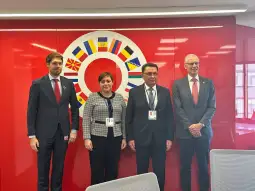
Dimitrieska-Kochoska also touched upon the country’s accession process to the Single Euro Payments Area (SEPA), which offers significant benefits to Macedonian citizens and businesses by enabling euro transactions with EU countries in a simpler, faster, and cheaper way.
During the meeting, she noted that preparations are underway for the 2026 budget, which maintains the continuity of fiscal consolidation policies and promotes economic growth.
The Minister also stressed that work is being done to implement reforms outlined in the Budget Law, as well as reforms related to the European Commission’s Growth Plan.
Photo: Finance Ministry


