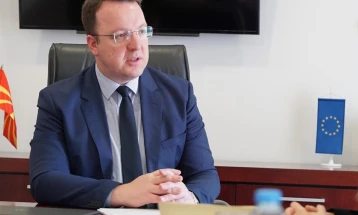
Mickoski to ABNA-SE: News agencies report on truth, shape public memory, keep democracy alive
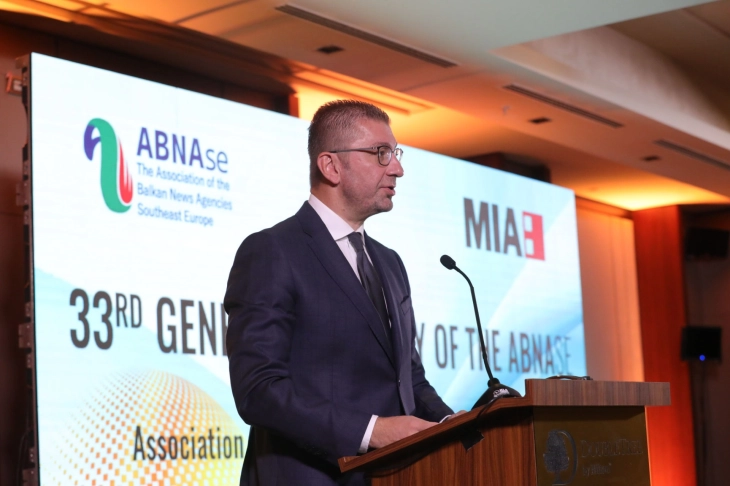
Skopje, 3 September 2025 (MIA) – News agencies write "the front page of truth every day," said Prime Minister Hristijan Mickoski at the opening of the 33rd General Assembly of ABNA-SE, the Association of the Balkan News Agencies-Southeast Europe, taking place in Skopje.
"Your job is not to merely report on the news but also to shape public memory, build trust and keep democracy alive. More than ever, the media today are the pillars of democratic societies," he said, adding that the media "inform, inspire, unite and create a climate fostering prosperity."
In his opening remarks at the regional news agencies' annual meeting, Mickoski said the media encouraged public debate. He said they also explained reforms to the public in times of economic and social challenges, "when citizens are looking for security and hope."
"Our state firmly holds the view that there is no democratic society without free media. Freedom of speech is a fundamental value and we are determined to promote it and guarantee a space where every journalist can freely ask questions, investigate and publish without any pressures or fear," the prime minister said.
"The truth has to be more important than any political or economic power," he stressed.
But in the era of social networks and digital media, he said, disinformation spreads like a virus.
"Our government encourages debate. We should set an example so we can make sure our young generations use critical thinking in recognizing and analyzing information sources," Mickoski said.
The Balkans and Southeast Europe had been long synonymous with divisions and conflicts but regional media today, he said, had the duty to serve as bridges between countries, promoting cooperation and prosperity.
"When our citizens read positive news from our neighborhood, prejudice is torn down and friendships are built," Mickoski said.
He said disinformation and baseless criticism were the biggest challenges facing the media and democracy itself.
"The difference between constructive criticism and disinformation is as big as the difference between democracy and manipulation," the prime minister said.
He said his government would not shut down critics but would not let lies become the norm. This is why they invested in media literacy and encouraged professional journalism, he added.
"The government is firmly committed to being a partner to the media," he said, pointing to ongoing efforts to improve media independence laws and public service digitization.
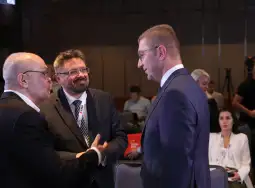
Ahead of the start of ABNA-SE's 33rd General Assembly, MIA's general director Darko Janevski opened a conference titled "Establishing Truth in Journalism."
"The issue of truth in journalism -- a problem and a task that have existed since the very beginnings of our profession, beautiful for some, and bloody hard for others," Janevski said.
He added that journalism, nonetheless, provided "extraordinary pleasure when the results are successful in the end."
"This is why the duty of contemporary journalism," Janevski said, "is not only to inform but also to find out the truth, to expose lies and offer all of this to citizens so it can raise their awareness and improve their lives. We need to put in some more effort. We need to be braver. Yes, this carries the risk of making mistakes, but is there a profession without any risk of mistakes?"
It is an old rule, Janevski said, that the journalist's work is done when the information is based on at least two sources. Rare are the cases when a journalist includes a personal opinion and knowledge, he said, which "requires a lot of effort, decades of professional advancement, similar to doctors who need to learn new methods and practices their entire lives."
"Yes, a journalist needs to report, to relay information, but in these times of social media, members of the public do not necessarily need journalists to get their information. This changes the journalist's role, which becomes more investigative and fact-finding," he said.
"The way of informing has changed, too. It is not enough to merely relay the information but it is increasingly more important to succeed in imbuing your way of informing with a little art, charm, intelligence and, especially important, emotion, feelings," Janevski said.
He said journalists were not experts in all areas or scientists but this should not stop them from researching instead of simply reporting statements. Otherwise, he said, the media was likely to be manipulated and manipulate the public in turn.
"This does not mean we should be rushing. This does not mean that we should not be fact-checking. This does not mean we should not be informing. But, as I said, the times have changed," Janevski said, pointing out that journalists needed to seek the truth.
"And it is not easy to come by. Because sometimes someone's fate will depend on our truth. Just as lies based on disinformation can threaten someone's fate. None of us want this and this is the greatness of this profession of ours," Janevski said.
Top representatives of ABNA-SE member news agencies are participating in the 33rd General Assembly organized by MIA in Skopje, following the 32nd General Assembly organized in 2024 by Anadolu Agency in Istanbul.
ABNA-SE's founding assembly was held in Thessaloniki in June 1995. Its seat is in Sofia and it was registered as a non-profit association in Bulgaria in 2022. In addition to MIA, members are Albania’s ATA, Bosnia and Hercegovina’s FENA, Bulgaria’s BTA, Croatia’s HINA, Cyprus’s CNA, Greece’s ANA-MPA, Italy’s ANSA, Kosovo’s KosovaPress, Montenegro’s MINA, Romania’s Agerpress and Turkiye’s Anadolu Agency. mr/
Фото: МИА