Mickoski: Crime must not pay off, stolen assets must be confiscated and given back to people
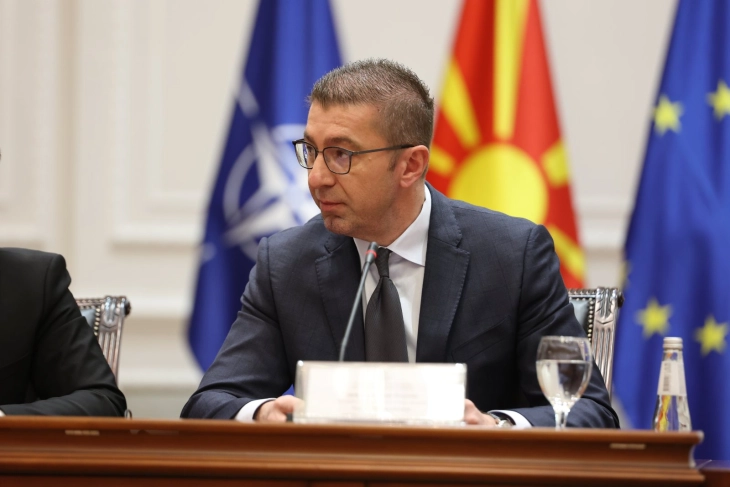
Skopje, 2 February 2026 (MIA) - Today we are laying the foundations of a system in which justice is not a declaration but a practice, in which fighting corruption is not a political slogan but a state policy, in which institutions work in the citizens' interest not to protect individuals. Our commitment in the fight against corruption and crime is clear but the struggle must finish with confiscation of criminal assets, because crime must not pay off and stolen assets must be given back to the people, said Prime Minister Hristijan Mickoski in the opening remarks of the constitutive session of the National Council for Financial Investigations and Asset Confiscation on Monday.
PM Mickoski said the Council is not a formality but a clear and unequivocal message that the state is finally standing firm in the fight against crime and corruption.
"This Government started the fight against crime and corruption with deeds, not declarations. More than 50 high-level corruption cases are being processed at this moment. Cases that had been covered up, delayed or ignored for years. This is not the end but the beginning. We expect new cases to open, with thorough investigations and results that will bring back the citizens' trust in the state and the institutions. Let me be clear: there is no selective justice, no one is protected, no one is untouchable," said Mickoski.
The PM said that the struggle's success requires strengthening of the judiciary and the prosecution, because "a strong, independent and professional judiciary and prosecution can bring efficient justice".
"The struggle does not end with criminal proceedings, it must finish with confiscation of criminal assets, because crime must not pay off and stolen assets must be given back to the people. That is why we are setting up these mechanisms such as the Council. Confiscation of criminal assets is not a simple step, it is a multidimensional and complex process that includes several intertwined stages that involve multiple institutions," said Mickoski.
According to him, the 2025-2028 strategy for asset confiscation defines three priority areas of action.
"First, finding, identifying and monitoring criminal assets in the country and abroad, through international cooperation and contemporary mechanisms for financial investigations. Second, temporary asset confiscation in line with the law, without room for manipulation, delay or abuse. And third, efficient management of confiscated assets, including their reuse for societal purposes," said Mickoski.
He added that the Council, under the leadership of the Deputy PM for good governance policies, will play a key role in coordination, oversight and strategic streamlining of these processes.
"I expect you to show professionalism, courage and integrity, but results first and foremost. Today, we are laying the foundations of a system in which justice is not a declaration but a practice, in which fighting corruption is not a political slogan but a state policy, in which institutions work in the citizens' interest not to protect individuals. This is a fight for a country governed by the rule of law, a fight for trust, a fight for the citizens' dignity," said Mickoski.
Deputy PM Arben Fetai said the constitutive session of the National Council is a turning point in the fight against organized crime and corruption.
"This Council is not set up for the sake of adding another structure but to set a political direction and create interagency cooperation where implementation was fragmented. This Council is a direct response to a clear institutional commitment - the need for concrete results through strong coordination and continued political oversight," said Fetai.
He said the National Strategy and its action plan offer a clear framework, in line with European standards.
"The foundations have been laid but the next stage requires political will and more investments. Therefore, the Council's role is not to replace existing institutions but to ensure those institutions act in line with the clearly defined goals. Our role in this Council aims to define clear priorities, remove systemic obstacles and seek results," said Fetai.
As its chair, Fetai believes the Council is a key forum for "transition from institutional cacophony to institutional action".
Photo: Screenshot


