Meeting of European Capitals of Culture representatives, Skopje 2028 as a lasting process that encourages economic growth
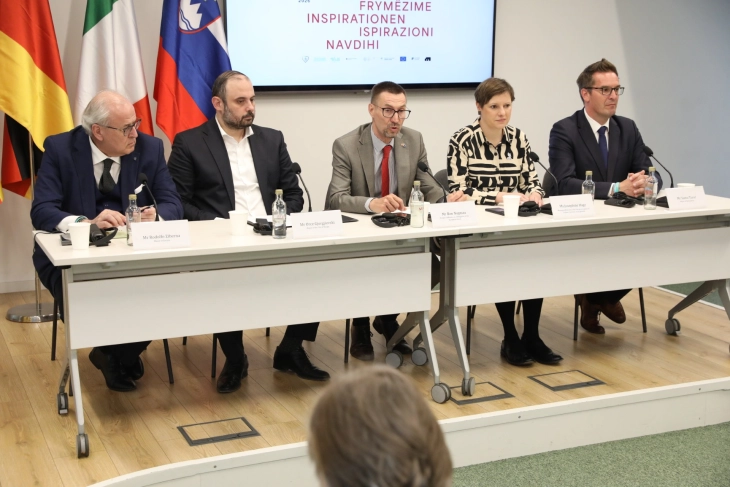
Skopje, 15 April 2026 (MIA) - Representatives of the local authorities from Chemnitz (Germany), Gorizia (Italy), and Nova Gorica (Slovenia) were in Skopje on Wednesday as part of a series of activities dedicated to exchanging experiences related to the title of European Capital of Culture, which the City of Skopje will hold in 2028
The Deputy Head of the European Union’s Delegation in Skopje, Ben Nupnau, Skopje Mayor Orce Gjorgjievski, the mayors of Nova Gorica and Gorizia Samo Turel and Rodolfo Ziberna, and a representative of Chemnitz, the 2025 European Capital of Culture, Josephine Hage, addressed an event in Europe House as part of the activities.
“As Mayor of Skopje, I am hosting three of my colleagues. They all have experience with cities that were capitals of culture, something that awaits us in 2028. One of the first challenges since I became mayor around five months ago, was precisely this process, which was stagnating. Thanks to the good team, the Ministry of Culture, the Government’s support, and of course, above all, EU Ambassador [Michalis] Rokas and the European Delegation, we already gradually overcame the challenges and are currently at a stage where serious preparations are underway,” Gjorgjievski said.
The Skopje Mayor said the project would bring the city’s inhabitants together and boost the number of tourists.
“This is a multiethnic city and the only way we can unite the citizens is either through culture or sport. This is a real opportunity to bring the entire population together through culture here in Skopje,” Gjorgjievski said, adding that several infrastructure projects are set to be realized as part of the process including the reconstruction of the Skopje Fortress, the Old Bazaar, and the Skopje Aqueduct which he said would be transformed into an open-air stage attractive both to the local population and tourists.
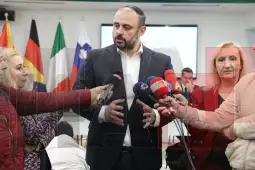
Gjorgjievski said the Skopje Central Post Office building will be one of the most significant buildings which, he said, will be transformed into a youth hub and a symbol of Skopje as the European Capital of Culture.
The Mayor added that socially responsible companies are aiding some projects, including a project for the illumination of the Stone Bridge, funded through the Macedonia–Türkiye Chamber of Commerce (MATTO).
"For about twenty years it has not been illuminated as it should, even though it is one of the main symbols of the capital. Socially responsible companies will also take part in the reconstruction of the Skopje Fortress. The project for a city cinema is also being funded through MATTO. It is already under procedure. We have dedicated funds from the city's budget. I believe the tender procedure has been announced, if I am not mistaken, or will be in the coming days, for the reconstruction of cultural facilities. One of these will be the ‘Milenium’ cinema, which I hope will be operational by September," Gjorgjievski said.

In his address, Nupnau said the European Capital of Culture title brings lasting cultural, economic, and strategic benefits.
“The cities usually secure funds, attract investments, create interest and attention for the program and the city as a destination. As a result, they have a significant rise in the number of tourists, which, of course, contributes to the improvement of the city’s reputation. The cities also manage to renovate cultural spots, create new cultural places, and provide support for local artists. This is also the plan for Skopje. As we said before, these are all lasting aspects that strengthen the cultural ecosystem,” Nupnau said.

The Mayor of Nova Gorica, Samo Turel, said that alongside his friend, the Mayor of Gorizia, Rodolfo Ziberna, as the first cross-border European Capitals of Culture, they operated under the motto “GO! Borderless”.
Our region went through a very difficult 20th century. We experienced all kinds of devastating wars that swept through our two cities, through our communities, where the border, established after World War II, practically divided the communities into two different countries, literally separating relatives and friends, and in one instance even cutting a cemetery in half. So even the dead were not allowed to rest in peace. Yet despite all this, we managed to write a history that takes into account this part, but mainly focuses on the future,” Turel said.
Turel urged the authorities in Skopje to try to plan what will remain after 2028, because, he said, that is one of the most important goals and focuses of the entire project.
“In my view, the European Capital of Culture is not just a project, not something realized in a single year, but a process. And once that process begins, it must last for many, many decades in the future, because from our experience we can tell you that culture truly is a tool that drives development, that stimulates economic growth. But, most importantly, it connects people, enables new friendships, and strengthens old ones,” Turel underscored.
As part of the event, a technical workshop was held where representatives of the 2025 European Capitals of Culture shared their experiences and best practices with the organizational team of “Skopje 2028”.
The event will conclude with the opening of the exhibition “Inspiration” at the Museum of the City of Skopje, featuring photographs from the European Capitals of Culture for 2025. The exhibition will be open to the public, free of charge, from April 15 to 26.
Photo: MIA


