Macedonian institutions at beginner level of effectively addressing foreign interference: study
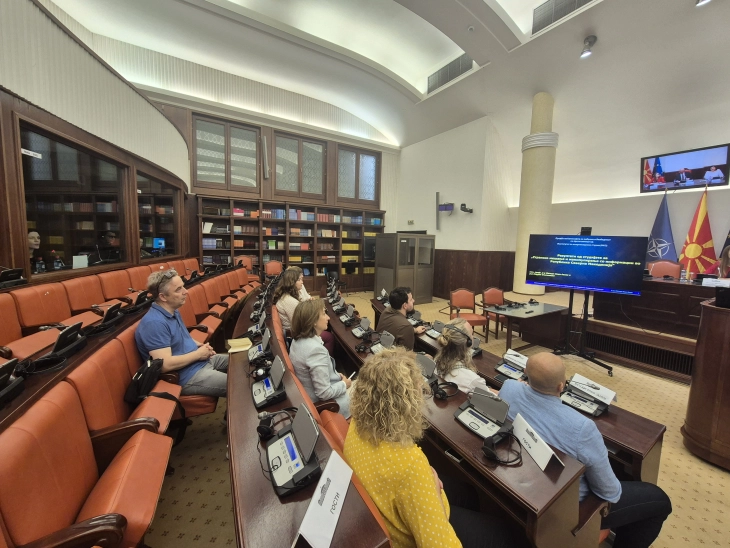
Skopje, 11 June 2025 (MIA) - Serious institutional and legal weaknesses in addressing coordinated disinformation campaigns driven by foreign state and non-state actors, the lack of strategic coordination, nonfunctional legal mechanisms, a vulnerable media space, and a low level of media literacy make the country susceptible to hybrid threats and manipulative narratives, conclude two studies by the Institute for Communication Studies.
The two studies presented Wednesday are “Foreign Interference and Information Manipulation in the Republic of North Macedonia” by Metodi Hadji-Janev and Marijan Stoilkovski and “Addressing Foreign Information Manipulation in the Context of European Regulations” by Konrad Bleyer-Simon, Research Associate at the Centre for Media Pluralism and Media Freedom (European University Institute) and the European Digital Media Observatory (EDMO).

University professor Hadji-Janev said the Macedonian institutions are at the beginner level of effectively addressing these challenges. Social alternative media are generally the most vulnerable channel from which these challenges arise and are ideal for manipulation.
“When it comes to cybercrime, there is a low level of awareness in Macedonia. The state’s capacity to address this issue is inadequate. There are problems with governance. Cyberspace is mainly dominated by IT experts, with very few experts from other fields such as law and security,” Hadji-Janev said.
The recommendations from Hadji-Janev's study point to several measures: establishing a national center for monitoring and analysis, depoliticizing the public administration, improving crisis communication mechanisms, implementing regulatory legal measures or revising existing laws, and filling the identified vacuum.

“As well as strengthening the oversight of online platforms; integrating European and NATO recommendations for combating disinformation; enhancing media resilience and transparency; supporting the development of independent fact-checking centers; increasing transparency in media operations; advancing public service and independent media through the promotion of professional journalism; maintaining and improving media and information literacy; supporting public campaigns against disinformation and encouraging investigative and academic analysis; deepening the partnership with NATO and the EU; strengthening organizations’ ties with international institutions; and developing regional mechanisms for exchanging information,” Hadji-Janev stressed.

During the presentation of his study, Konrad Bleyer-Simon stressed that the country registers one to five attacks annually. He highlighted that the most important aspect is that measures for countering foreign interference and information manipulation should be proposed by independent agencies.
“Foreign interference and information manipulation also includes hybrid warfare, which is why cooperation among institutions from various sectors, from a defense, security and media aspect, is necessary. Social media platforms also play a significant role in amplifying disinformation, since they operate based on algorithmic ranking, favoring the spread of low-quality content that creates divisions. They are creating a model in which people can quickly produce low-quality content, and now they can also use artificial intelligence for this purpose. When content causes divisions, it will be more widely shared, keeping users engaged on the platform for longer periods,” Bleyer-Simon said.
MP Pavle Arsoski, who chairs Parliament’s Committee on Defense and Security, stressed that Macedonia, as a geostrategically important country in the Balkans, a NATO member and EU candidate member, is exposed to these threats which require coordination and integrated action.

“The manipulation of information poses a threat that directly impacts democratic processes, public trust in institutions, and overall stability. It is a hybrid form of threat that does not only manifest through traditional security channels but also infiltrates societal values, media, education, and political discourse,” Arsoski said.
Aleksandra Temenugova from the Institute for Communication Studies said recognizing and tackling foreign interference and information manipulation requires institutional maturity and societal resilience.
“Our focus is to elevate the discussion on malicious and deliberate manipulation of information by external actors – state or non-state actors – within the public discourse. Our goal is to collectively highlight the harmful consequences of these sophisticated tactics and techniques, which are difficult to recognize yet skillfully infiltrate public spaces through culture, religion, business, and ethnic relations. However, we cannot achieve this alone,” Temenugova said.
The meeting was organized as part of the project "Tracking, Exposing, and Countering Hidden Foreign Manipulations and Interferences," implemented by the Institute for Communication Studies and financially supported by the British Embassy in Skopje.
Photo: Institute for Communication Studies


