Macedonia needs 56 years to reach European living standard average: research
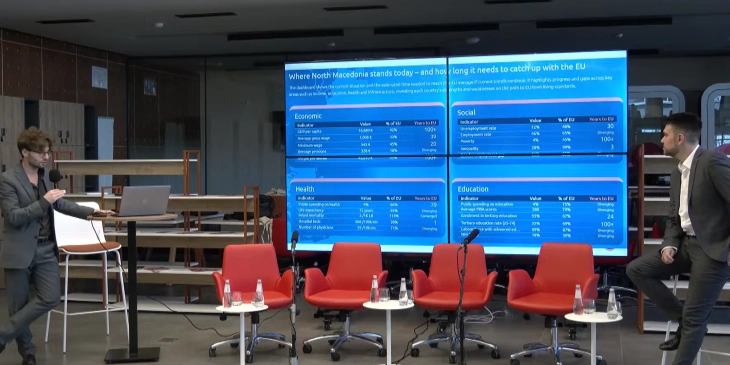
Skopje, 20 October 2025 (MIA) - Macedonia needs 56 years to reach the European average regarding the standard of life and living conditions, shows a report developed by eight organizations from the Western Balkans, focused on the convergence of countries in the area with the EU.
Nevertheless, there are many factors that can accelerate this process, but this requires the implementation of key reforms that will produce results, primarily in the citizens' daily lives.
"It seems that the number is rather pessimistic but there are many factors that can speed up this process, and this is the message we should focus on as a society. Several scenarios were made during the research, including the length of the period in case we join the European Union, have access to the market and the European funds, along with institutional support. All scenarios, especially in key areas - economy, social policy and digitalization - give us a clear picture that situation will change a lot if we are full-fledged members or have access to the European funds," said Viktor Mitevski, executive director of the Association for Research and Analyses (ZMAI), one of the project's eight participating organizations.
Mitevski said the country needs to focus on increasing productivity, invest in smarter social transfers directed at activation, as well as investments in digitalization and infrastructure.
According to him, wage increase can impact the economic trends and growth but it must be accompanied by a rise in productivity.
"Productivity growth can be achieved only by having qualified staff and technological investments by the state and the private sector. Increasing salaries without any added value in the society can only be counterproductive, although economic parameters show there is room for wage increase in the current circumstances," said Mitevski.
Report data show that the gross wage in the country stands at about EUR 1,000, a third of the EU average wage, meaning it would need 40 years to reach the EU average. In regional terms, Serbia has the highest wage at about EUR 1,150, followed by Bosnia and Herzegovina and Montenegro, while Macedonia is slightly ahead of Kosovo and Albania.
The country's GDP per capita is equivalent to 42 percent of the EU average but the growth rate is slower compared to EU member-states.
When it comes to education, the country is moving away from the EU in four of the six indicators, including state investments in education and PISA, while progress is made in the sectors of healthcare and digitalization.
"We are not anti-EU. The report was compiled so that we see where we stand and what we should do in order to improve. The idea is to see whether the Balkans is making any progress, to show us the positives and negatives, and to give politicians a direction to follow," said Branimir Jovanovikj of the Vienna Institute for International Economic Studies.
The report on the Western Balkans convergence with the EU is a result of a one-year activity by the participating organizations.
Photo: Screenshot


