Karadjov denies claims that Bulgaria refuses to construct railways, is waiting for draft-proposal to be signed
Skopje, 2 May 2025 (MIA) – Bulgarian Deputy Prime Minister and Transport Minister Grozdan Karadjov has denied claims by his Macedonian counterpart Aleksandar Nikoloski that Bulgaria hasn’t done anything involving the building of a rail connection between the two countries as part of Corridor 8.
“We’ve sent an agreement, but where is Nikoloski to sign it? While Nikoloski is talking about it, the train passed through Pernik, through Radomir and has arrived in Kyustendil before arriving at the last stop in Gyueshevo to wait for the Macedonian train,” Karadjov said in an interview with BNT TV, reported the news agency BGNES.
Bulgaria, Karadjov revealed, has projected 90 percent of a brand-new line between Radimir and Gyueshevo to allow trains to be steered at 160 kilometres per hour. “In 2032 when trains are driven at 160 kilometres per hour, I’ll ask the other side whether there is a tunnel or not,” said Karadjov adding that Nikolovski “has been telling Macedonian bedtime stories”.
Earlier this week, Transport Minister Nikoloski said it is evident that Bulgaria doesn’t want to build the railway, adding over 15 letters have been sent to Bulgaria over the construction of the railway and not a single one has been answered.
“It’s a fair thing to meet and to tell us that. By avoiding to meet with us, it says a lot about the fate of the project. We have been doing things in practice, they have been doing things in theory,” Nikoloski said in an interview with 360 Stepeni show, aired on MRT 1.
Nikoloski confirmed the government has received a draft-agreement on joint construction, sent by Bulgaria, saying it has been since discussed by government members at a session. A working body, comprised of the ministers of transport and finances and the head of the Railways public enterprise, has been set up.
Asked whether the document contains something disputable, Nikoloski said there is, noting that’s why officials from both countries need to meet and discuss matters.
He reiterated the government’s position that it refused to invest in a railway that ends in a tunnel. According to him, the problem is the fact that Bulgaria had decided not to reconstruct the rail from Sofia to Pernik, i.e., from Pernik to Gyueshevo in the second stage.
On January 15, the Bulgarian government sent a draft-agreement to North Macedonia over the preparation, construction and operation of a cross-border railway tunnel connecting the two countries.
The proposal of the Bulgarian state is that the two governments undertake specific and clear commitments for the implementation of the cross-border railway tunnel, which is a key element of Corridor 8.
With the signing of the document prepared by the Ministry of Transport and Communications of the Republic of Bulgaria, the technical, financial, legal and organizational issues related to the construction of the tunnel will be agreed, which shall be in accordance with the European and national legislation of both countries.
According to the proposal, the parties will agree which of them will be responsible for the construction of the cross-border facility, for the public procurements and the supervision of the construction. It is envisaged that the railway infrastructure managers of the Republic of Bulgaria and the Republic of North Macedonia will create joint working groups for the preparation of the necessary documentation for the tender procedures.
Macedonian and Bulgarian officials so far have held two meetings to discuss the third section of the railway toward Bulgaria. The first meeting was held in Brussels on October 16, 2024, when the officials agreed to hold regular high-level dialogue and to form a joint working group on Corridor 8. The second one was held in Sofia on October 31, 2024 after which the Macedonian officials announced that their arguments had been accepted – a joint project on not constructing a tunnel leading nowhere, Bulgaria to finish its section of the railway and the price of the whole project to be revised.
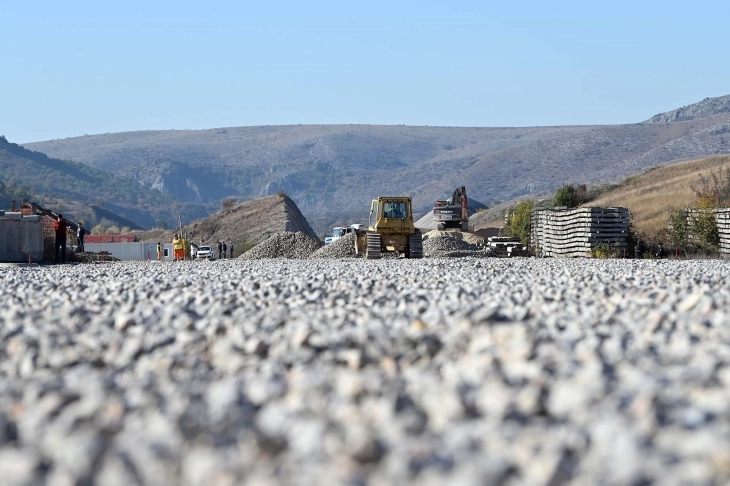
After three decades since the start of construction works, the first section of a 31-km railway toward Bulgaria was opened. 27.3 percent of the second section, from Kumanovo to Kriva Palanka, has been completed so far. The 34-km railway should be completed by 2026.
MIA file photo


