Kambovski: National identity and language cannot be subject to bilateral disputes
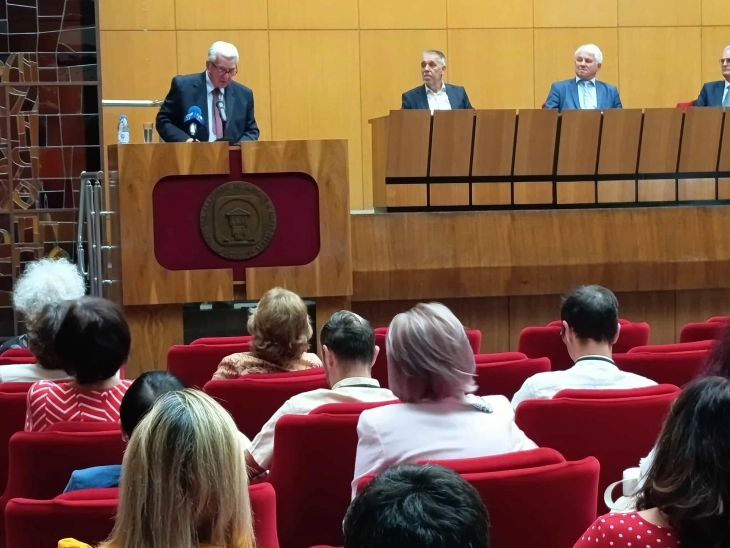
Skopje, 15 September 2025 (MIA) – Issues related to identity, even in cases of bilateral disputes, should not be used as vetoes or conditions for EU membership. Instead, they should be approached with goodwill, integrity and mutual support, resolved through dialogue, cultural and scientific exchanges and cooperation, to build bridges of friendship and understanding among nations. Science and art must play a role in this. We need to create a climate in which politicians can also build these bridges of cooperation, academician Vlado Kambovski said Monday at the 13th Congress of International Association for Southeast European Studies (AIESEE).
In his address at the Congress held at the Macedonian Academy of Sciences and Arts (MANU), Kambovski noted that the issue of national identities, languages, and culture cannot be subject to bilateral disputes or ideologically differing approaches, because, as he noted, they involve elementary, fundamental human values.
“The right to self-determination of individuals and peoples is a natural right, and you cannot debate it or place it within the framework of formal agreements between states, whether you recognize it or not,” Kambovski said.
According to him, Macedonia and Bulgaria are approaching the dispute in the wrong way, using only one channel – the political one – instead of also using other channels such as science and culture.
“We must work persistently and seek communication-scientific, cultural, and otherwise-to resolve issues face to face. Right now, we are entrenched on opposite sides, discussing these matters poorly, relying solely on the political channel while neglecting other channels. If other channels were used, recognizing that the scientific community both here and in Bulgaria must follow its established rules, which is the truth, then both sides could advocate for what is true. Science should not be politicized or used as a tool for achieving particular objectives. Disputes over language, origins, and related issues should be left to science for discussion. There are no questions outside the realm of science; differing views have always existed, and disputes continue for centuries over specific scientific questions,” Kambovski noted.
He reminded that the EU has offered support through the Growth Plan for the Western Balkans, and we must seize that opportunity.
“We need to speed up reforms aligned with the Copenhagen criteria and to have strong arguments on our side. While we can point to which criteria we have fulfilled, our case is not yet convincing enough. Partisanship, high levels of corruption, a culture of impunity, and the lack of democratic dialogue all undermine our position. All of this must be raised to the necessary level to strengthen our position for tomorrow, to create an implicit obligation for the other side to stand with us, to support us. Otherwise, if we remain passive, we will only provide additional arguments for Bulgaria or any other country to use a veto or other obstacles tomorrow on our EU path,” Kambovski said.
Referring to Southeast Europe (SEE), he pointed out the need for greater cooperation, particularly in the fields of culture, science, and knowledge, in order to relax existing tensions, as he emphasized.
“As a region, we should link enlargement primarily by developing relations in culture, science, and knowledge, thereby easing the tensions that exist between individual states and unresolved issues: there are ongoing problems in improving relations between Kosovo and Serbia, the fragmentation of Bosnia and Herzegovina, and the veto by one member state, Bulgaria, over the Republic of Macedonia. Issues related to identity, even in cases of bilateral disputes, should not be used as vetoes or conditions for EU membership. Instead, they should be approached with goodwill, integrity and mutual support, resolved through dialogue, cultural and scientific exchanges and cooperation, to build bridges of friendship and understanding among nations. Science and art must play a role in this. We need to create a climate in which politicians can also build these bridges of cooperation. The issue of national identities, languages, and culture cannot be subject to bilateral disputes or ideologically differing approaches, because, as he noted, they involve elementary, fundamental human values. The right to self-determination of individuals and peoples is a natural right, and you cannot debate it or place it within the framework of formal agreements between states, whether you recognize it or not,” Kambovski said.
Academician Kambovski believes that the policy of enlargement is currently influenced by two key factors. The first, he explained, is enlargement understood as a continuation of Europe’s commitment to develop its foundations as a community (rule of law, security, etc.), and the second is to position itself within the new world order according to geopolitical developments.
At the opening of the Congress, the Vice-President of MANU, Vitomir Mitevski, also spoke. He stated that at a time when the world is undergoing major transformation and significant economic and political changes, the region must maintain its common ties.
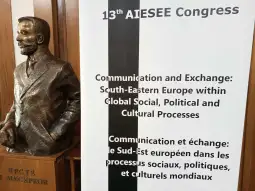
Founded in 1963 and based in Paris, the International Association for Southeast European Studies (AIESEE) operates under UNESCO’s patronage, with all Southeast European countries represented through their national committees. AIESEE congresses are held every five years, and this year Skopje is hosting for the first time. The 13th Congress will run from September 15 to 19, organized by the Macedonian National Committee of AIESEE at MANU.
Photo: MIA


