Health Ministry, UNFPA regional forum: Cervical cancer prevention requires HPV vaccination, PAP test and screening
Skopje, 1 October 2025 (MIA) – HPV vaccination, regular PAP tests and screening can prevent cervical cancer or help detect it early. From 2017 until 2023, 2,630 women in Macedonia were diagnosed with cervical cancer in Macedonia with 39 percent of those being under 50, according to the My Appointment National Digital System. One woman dies from cervical cancer every week, and three are diagnosed with the disease. Cervical cancer is the second most deadly cancer among women of reproductive age in Eastern Europe and Central Asia.
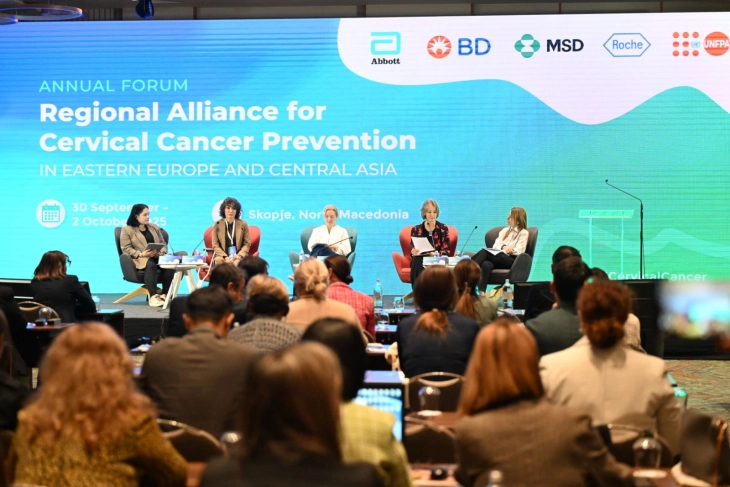
These are some of the findings presented at the 5th annual forum of the Regional Alliance for Cervical Cancer Prevention in Eastern Europe and Central Asia, taking place in Skopje and organized by UNFPA, the United Nations sexual and reproductive health agency, in cooperation with the Ministry of Health.
More than 90 per cent of cases are preventable through well-organized cervical screenings, pre-cancer treatment and HPV vaccination programmes against HPV, the virus that causes most types of cervical cancers. However, 32,000 women are still diagnosed with cervical cancer in the region every year, and 16,000 die. According to UNFPA, 50 to 60 women in North Macedonia die of cervical cancer annually and around 170 are diagnosed. Cervical cancer takes a high emotional, social, and financial toll on women, their families and national health systems.
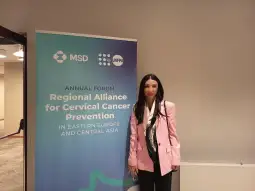
Speaking to MIA, Irena Aleksioska Papastiev, president of the National Commission on Early Detection and Prevention against Cervical Cancer and director of the Clinic of Gynaecology, said that according to the European recommendations to improve screening, a pilot study on HPV-based screening has been conducted and initial findings, which were presented at the Skopje event, show that strengthening and improving HPV-based cervical cancer screening is justified, but it requires support from both the Ministry and the government.
“What I can proudly say is that since May 2024, we’ve been administering nine-valent vaccine and it is primary prevention. The best thing is prevention rather than cure and it has been approved for both girls and boys, who can be vaccinated starting from 12 years old until 19. It is part of the national program. Vaccine coverage in the region is already good, around 60 per cent,” said doctor Aleksioska Papestiev.
Citing findings from a recent study, 2,630 patients were diagnosed with cervical cancer from 2017 until 2023.
“A peak was recorded in 2018 with 440 patients being diagnosed with cervical cancer. Some 330 were diagnosed in 2023. What is causing concern is that 39 per cent of the patients are under 50, according to data from the National Digital System. It means that it is being diagnosed the most among women of reproductive age,” she stated.
What is also concerning, noted the doctor, is that cervical cancer is diagnosed in most women in advanced stage when opportunities for treatment are limited.
“The Commission for Early Cervical Cancer Detection and Prevention aims to strengthen the screening method that is currently based on PAP tests. Every woman aged 24-60 has the right to free PAP test once every three years. However, interest is below 30 per cent of those women who should undergo screening,” said Aleksioska Papestiev.
The Regional Alliance for Cervical Cancer Prevention in Eastern Europe and Central Asia today kicked off its 5th annual forum in Skopje, North Macedonia. Hosted by UNFPA, the United Nations sexual and reproductive health agency, in cooperation with the Ministry of Health of North Macedonia, the three-day event brings together more than 100 delegates from across the region, including representatives from governments, public health institutions, academia, civil society and the private sector. The forum aims to build on five years of progress and accelerate collective efforts to eliminate cervical cancer.

"We are here today with a singular, powerful vision: the elimination of cervical cancer as a public health threat in our region. In a time where proven medical interventions are increasingly being questioned, it is more important than ever that we unite, reinforce trust in health institutions, and accelerate action. The eradication of cervical cancer is within reach, but we must improve access to vaccination, expand cost-effective screening, and ensure timely treatment, so that no woman has to die unnecessarily,” Florence Bauer, UNFPA Regional Director for Eastern Europe and Central Asia, told the forum. She has been paying a days-long visit to Skopje.
November 17, 2025 will mark World Cervical Cancer Elimination Day. According to her, it will serve as a strong reminder of the commitments to strengthening our collective action.
Significant progress in eliminating cervical cancer has been made in recent years with support from the Regional Alliance. The goal, according o UNFPA, is to meet the WHO targets - 90 percent of girls to be vaccinated by the age of 15, 70 percent of women to be screened, and 90 percent of infected women to receive treatment.

The Regional Alliance adopted a "Call to Action" in 2023, which includes prioritizing prevention - scaling up vaccination programmes for HPV and ensuring universal access to effective screening; building national capacities - strengthening institutional capabilities and developing local expertise to sustain prevention efforts, and increasing access and affordability - fostering partnerships with the private sector to reduce cost and access barriers for life-saving technologies and products.
The Regional Alliance was launched by the UNFPA Regional Office for Eastern Europe and Central Asia in 2021. It is a regional coordination body that brings together policymakers, medical experts, private sector companies and international organizations to cooperate, share knowledge and implement the UNFPA Regional Strategy to Eliminate Cervical Cancer as a Public Health Problem in the region in line with the Global strategy to accelerate the elimination of cervical cancer as a public health problem.
Photo: MIA/UNFPA


