Gov’t this year to focus on long-term anti-pollution measures, Nuredini tells MIA
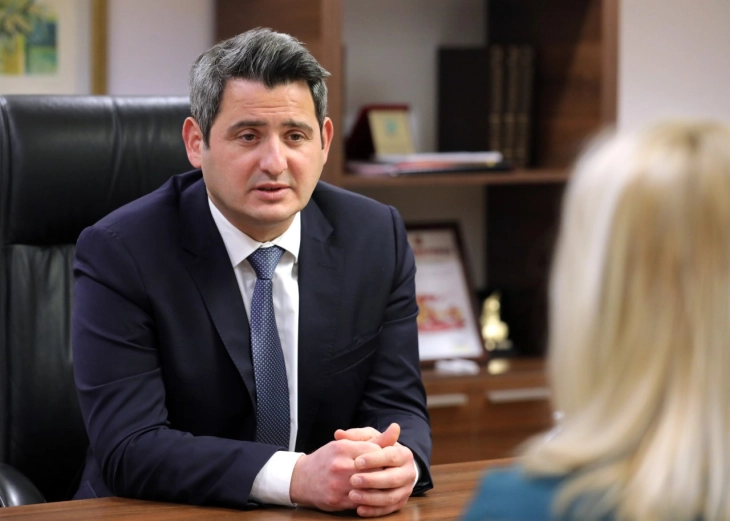
Skopje, 15 January 2023 (MIA) – I expect the government in 2023 to focus on long-term anti-pollution measures, including the construction of a gas pipeline, because the problem can be solved only with the introduction of gasification as soon as possible. Additional activities include the subsidies of the Economy Ministry awarded to stimulate the use of renewable energy sources. But, I expect this year to focus also more on the transport sector as a source of pollution, Minister of Environment and Physical Planning Naser Nuredini says.
In an interview with MIA, Nuredini touches upon the 2022 European Commission report noting they are committed to meeting the planned policies from the ambitious national contribution to the Paris Accords, the third two-year report on climate change and the long-term climate action strategy and action plan, envisaging transition from coal to clean and renewable energy sources, building of a prosperous economy on sustainable and climate-resilient tracks for development, improving of the competitiveness and promotion of social cohesion through an action to fight against climate change and its impact.
According to you, what marked 2022 regarding the measures of the Environment Ministry taken to improve this sphere?
Despite the numerous challenges throughout 2022, we’d managed to improve things in several areas of environmental protection. I’d mention the cleaning of the landfill within OHIS from the lindane’s isomers, which for decades put at risk the public health being a hazardous waste. Couple of months ago, the Ministry of Environment and Physical Planning set aside some three million denars to invest in a research of the Pelenica site to be established whether and how much the soil and underground waters have been contaminated there after finding out that the OHIS’s historical waste had been thrown there.
I’d also mention the progress in the construction of the Chebren hydropower station, which I consider to be the main battery for providing electricity this country needs. After 13 failed attempts, we finally managed to issue a tender and we received a serious bid for the construction of Chebren hydropower station. Chebren will be considered as a basic balancer for providing electricity from own renewable energy sources.
As regards nature, in 2022 a serious progress was made in declaring and re-declaring protected areas with the percentage of protected areas rising by 13.9 percent. I also consider it a great success the negotiations to find a strategic investor for the development of the Popova Shapka Ski Center, which presented its plans for this strategic project at a press conference at the end of the year. As I often like to say, we don’t aim at turning our natural values into museums, we aim at protecting the natural beauty by establishing a sustainable management and socio-economic development, which would be beneficial for both the country and the local communities.
And of course, I have to mention the projects for the construction and rehabilitation of the infrastructure for water supply, collection and treatment of waste water in all municipalities across the country.
The non-governmental organizations have called the 2023 budget “devastating” given the threats facing the environment. Are you satisfied with the planned funding? Will it satisfy your needs and defined goals?
This recent period has been overwhelmed by challenges, two consecutive global crises – the heath crisis followed by the energy crisis – which required plenty of wisdom, patience and creativity from us, the government, in order to distribute the funds responsibly and adequately so as to justify the public’s trust all the while allowing economic development and protecting the environment. One can never have enough money for environmental protection, especially after having inherited serious hotspots, which require a lot of funds. I’m satisfied we’ve introduced systemic approach. In order to deal with hotspots, we amended the law on the environment, regulating a methodology according to which a certain problem can be declared hotspot, which has never been done before. It has also paved the way for accessing donors and finding money.
Speaking of the funds to be invested in the environment in 2023, I’d like to bust several prejudices. The whole of last year, being aware that the funds are limited, we made efforts to find additional financing sources. The largest capital infrastructural projects, which also cost a lot of money we couldn’t secure from the central budget, have been secured through donor funds and lines of credits. Also, programs of the other ministries include financing for projects in the sphere of environmental protection.
Last year, you went on many trips abroad where you also had many meetings. What’s the benefit from these meetings? How much money have been transferred to the Environment Ministry thanks to these meetings?
That’s right, I’d had many trips abroad last year, and as part of those trips I held many meetings with high officials of the countries and the international organizations in order to present the country’s commitment to the environment and to secure their support, both financial and expert-wise. In order to get support, you should ask for it, which means to use every possible opportunity for lobbying. We’re all aware that in order to meet the European environment standards, it’s not enough to adopt good legislation, but we also need to invest a lot in a series of major infrastructural projects, without which our joining the EU is unimaginable. For example, a water treatment station in the capital. I’ve already said that we’ve been working hard to secure as much money as possible through our partner organizations and donors. EUR 126 million was provided from a European Investment Bank loan to construct a water treatment station in the City of Skopje.
Also, we expect to be awarded a grant from the Western Balkans Investment Framework (WBIF) estimated at EUR 72 million and we need to decide whether to use them to reduce the loan or to increase the investment. Over EUR 110 million is secured through the IPA2 program, which are considered donor funds. I will also mention the European Investment Bank support at EUR 50 million intended for the municipalities for the construction of water supply networks, water treatment plants and additional EUR 55 million from the EBRD for introducing a regional waste management system. This is the way we’re securing financing for all municipalities in the country.
A nine-million Swiss franc donation is secured through the Swiss government. Additional 11 million Swiss francs are secured for an underground water project. Regarding nature protection, we have provided financing for several international donors, such as PONT, the Global Conservation Fund (GFC), etc. This is financing that through projects will be intended for the citizens to improve infrastructure and protect the environment.
The 2023 budget includes 352 million for the Environment Investment Program, to be exact, funding for support to the municipalities. Some of it came from the compensation for the use of biodegradable bags and some from the compensation from the registration of vehicles. How this financing will be spent exactly?
A progress has been made in the Environment Investment Program 2023. This year, it will be projected for support of the municipalities. 2023 sees notable increase in the funding. From 98 million in 2022 to 352.000.000 denars. Of those, 120 million came from the compensation from the use of biodegradable bags and the rest from the compensation from registration of vehicles.
These funds will be intended, first and foremost, to support the municipalities to prepare paperwork and implement capital infrastructural projects for water supply, waste water management as well as for regional waste management systems and support for primary selection of households.
Last year, funds were also set aside for the investment program. How were these funds distributed to be awarded by the municipalities?
Using funds from the Environment Investment Program 2022, the Environment Ministry financed the municipalities to prepare technical paperwork for infrastructural projects, construction of sewage networks and waste water treatment plants, as well as air quality management plans at local level and cadasters of air polluters. From the 2021 program, completed in 2022, six air pollution cadasters were financed as well as four plans. Four more air pollution cadasters at local level were financed from the 2022 program as well as six local plans.
Under the 2021 ambient air law, the municipalities now have more obligations and they are tasked with preparing plans to prevent air pollution and measures according to the conditions in the municipalities, which should be enforced during alarming air pollution.
The program also supports projects of civil associations and research papers.
The European Commission in its last year’s report said North Macedonia should increase significantly its green transition ambitions, especially in the context of the Western Balkan Green Agenda. What is planned for next year as a response to this recommendation?
The economic and energy crisis gripping the world has taught us how strong is the necessity of a country to be energy independent and economically stable, which is enhancing our ambitions to fulfill the green transition as part of the Green Agenda. Our country is committed to decarbonized future after signing the Sofia declaration for the Western Balkan Green Agenda. We are also one of the signatories of the Paris Agreement. We continue to be committed to meeting the policies of the ambitious national contribution to the Paris Accords, the third two-year report on climate change and the long-term climate action strategy and action plan, envisaging transition from coal to clean and renewable energy sources, building of a prosperous economy on sustainable and climate-resilient tracks for development, improving of the competitiveness and promotion of social cohesion through an action to fight against climate change and its impact.
We’re focused on diversifying our own sources for supplying and investing in renewable energy. A huge endeavor will be the project for the construction of one of the largest hydropower plans in the region, Chebren. We’re also creating conditions for the private companies to invest in green energy.
According to the new law on climate change, expected to be passed soon, carbon price will be introduced, initially as a transitional solution before it is aligned with the EU ETS rules by 20230. We aim to accelerate decarbonization and also to avoid paying the EU carbon tax for import, which the bloc is planning to introduce as of 2026. In this context, we’re aligning with the Western Balkan countries.
We also remain committed to sustainable growth and alleviating and resilience to climate change and aligning and implementing the European Green Deal as well as to regional cooperation in implementing the Sofia declaration and its action plan.
We’re not underestimating the climate change adjustment component, being one of the most vulnerable regions. It requires preparation and implementation of strategies for climate adaptation to increase resilience through climate protection of investments and to provide better integration of adjustment toward climate change to reduce the risk from disasters.
We have to resume our work and leadership to meet all these national, regional and international targets and goals by securing favorable environment and better governance.
The EC also said the country should increase its efforts to reduce air pollution, one of the burning issues the country has been facing. What concrete steps will you take this year in order to prevent in the next heating season the consequences we’ve been facing year after year?
When it comes to air pollution, we have to join forces at all levels to curb the pollution sources. To solve this problem requires years-long program and work to deal with the pollution sources. In this regard, it is being invested from the budgets of almost all ministries, first and foremost in changing the energy efficiency of the premises of the ministries and institutions, in changing the way we heat with more ecological, more enhanced controls of industrial capacities holding A and B integrated permits, by changing public transportation and introducing eco-friendly transportation, and so on.
I expect the government in 2023 to focus on long-term anti-pollution measures, including the construction of a gas pipeline, because the problem can be solved only with the introduction of gasification as soon as possible. Additional activities include the subsidies of the Economy Ministry awarded to stimulate the use of renewable energy sources. But, I expect this year to focus also more on the transport sector as a source of pollution.
I will propose to the government to review the possibility to ban import of vehicles under the EURO 5 standard, accelerate the procedure for passing bylaws for eco-labelling of vehicles as well as the possibility for subsidizing or introducing beneficial tax for electric, hybrid and plug-in vehicles.
On the other hand, according to the 2021 changes to the ambient air law and the increased obligations of the municipalities, we’ll work to increase the capacities of the local self-government, support the preparation of plans for curbing air pollution and their capability to apply the envisaged measures. We’re already financially supporting the preparation of 10 plans and 10 air pollution cadasters in local level.
In the works is also a campaign to raise public awareness for the quality of air we all breathe and for changing the lifestyle playing a role in cleaner environment and support to sustainable green economy.
Simona Mitrovska
Translated by Bisera Altiparmakova
Photos by Frosina Naskovikj


