Formal primary education introduced for children undergoing long-term hospital treatment
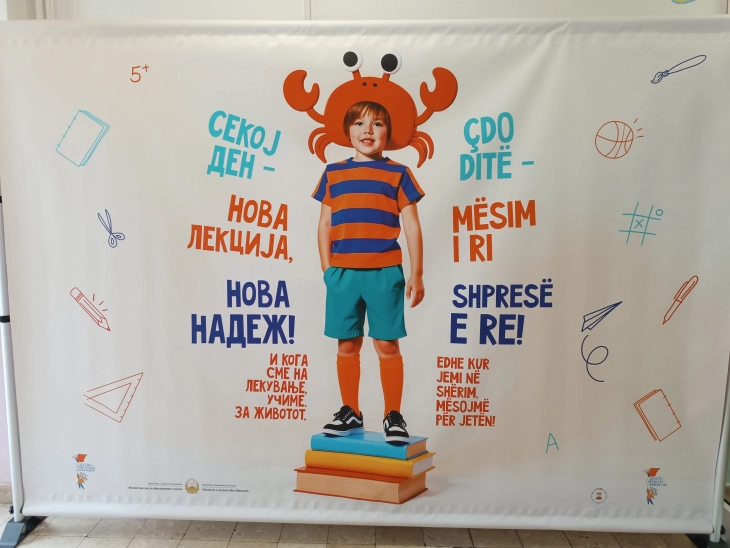
Skopje, 6 August 2025 (MIA) - Formal primary education in hospital conditions has been introduced for children undergoing long-term treatment at Skopje's University Clinic for Children's Diseases, announced Minister of Education and Science Vesna Janevska, Minister of Health Azir Aliu and Marija Vuk, president of the SANO non-governmental organization created by parents and friends of children being treated for cancer.
The primary education for children at the Clinic will be introduced by the Ministry of Education and Science with the support of the civil sector (SANO).
“Amendments have been made to laws and by laws, and schools where children undergoing treatment at the Clinic are enrolled need to include them in classes starting in September – either directly, meaning online during class hours, or through asynchronous communication (with the teacher delivering materials to the student, assigning tasks and evaluating knowledge). The teacher may also organize individual lessons for the student using a digital tool,” said speakers at an event Wednesday at the Clinic, stressing that the entire process will depend on the child’s medical condition.
The goal is to ensure the children don’t experience setbacks in their education and are able to resocialize more easily and return to school and their peers after completing the treatment. Speakers emphasized that no child should be deprived of education simply because they are undergoing treatment and that illness does not mean isolation, interruption or being forgotten. Training is underway to prepare teachers for effective remote work with children undergoing treatment.
The head of the University Clinic for Children's Diseases, Rexhep Memedi, underscored that education is not just a means for learning, but also a key tool for emotional stability and preserving children’s self-confidence.
“Including hospitalized children in formal education means a lot for their health, as good mental well-being in these young patients makes the long journey of treatment much easier and more motivating,” Memedi said, adding that the medical staff at the Clinic will do its utmost to help the children overcome their illness, and then tackle numbers and letters.
Health Minister Azir Aliu stressed that the patient is at the heart of healthcare.
“As a Ministry of Health, we are charged with creating an infrastructure that will be compatible with the needs for remote learning. On the other hand, the Ministry of Education will create the methodology and materials that the children will have to tackle,” Aliu said.
Education Minister Vesna Janevska said that until now serious oversight and discrimination had been committed against these children. “Today,” she added, “with a good project and a systemic solution, it is being shown that this is not an unsolvable problem”.
“This process will be constantly improved. What is significant is that, at this moment, a certain number of teachers who have students here, are already receiving training so they are equipped to start working with them on September 1,” the Minister said, thanking all the participants in the project.
Marija Vuk, president of the SANO NGO, said the project represents a historic step and thanked for the support.
In answer to a journalist’s question, Clinic head Memedi said around 20 children are currently undergoing long-term treatment. Typically, for children with malignant diseases, treatment sometimes lasts up to two years, he said, depending on the specific pathology. The children are required to stay at the Clinic continuously during the first six months.
Photo: MIA


