Foreign press on the Ilinden Uprising: “The Goal of the Macedonians is an autonomous and independent Macedonia”
Skopje, 2 August 2025, (MIA)
Written by: Slobodan IVANOV
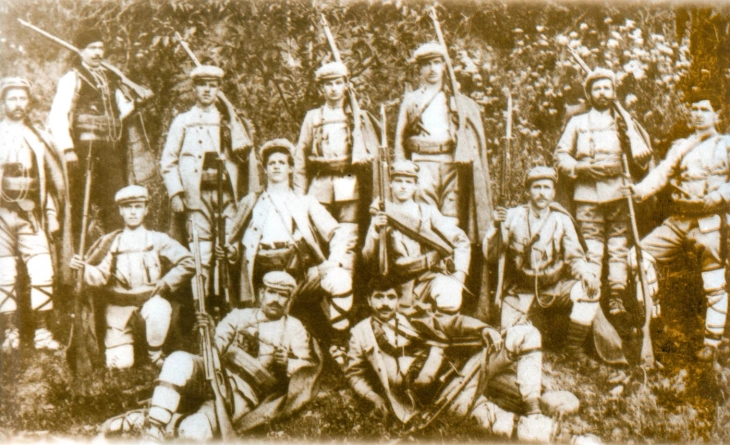
In August 1903, and in the months that followed, newspapers around the world reported on the Ilinden Uprising. In fact, during, before, and after the uprising, articles appeared in every corner of the globe. We begin with The New York Times...
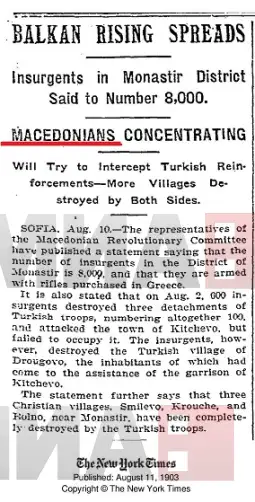
On August 11, 1903, the American newspaper reported that “Macedonians concentrating” in the Bitola Vilayet. The article noted that the “Macedonian Revolutionary Committee” had stated there were 8,000 insurgents in the Bitola district (i.e. Vilayet) alone; 600 of them — aided by inhabitants of Drugovo — defeated Turkish troops near the town of Kichevo, though they failed to take the town. It also reported that Turkish troops had destroyed the villages of Smilevo, Krushje, and Bolno near Bitola.
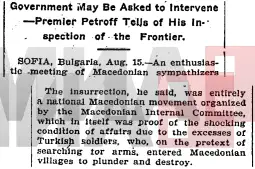
The Macedonian Revolutionary Organization (MRO, at the time VMORO), as a secret and illegal organization, was referred to by various names in the foreign press. In the following example, the Prime Minister of Bulgaria, Racho Petrov, refers to it as the “Macedonian Internal Committee,” according to The New York Times of August 16.
The Bulgarian Prime Minister noted that “the insurrection was entirely a national Macedonian movement, organized by the ‘Macedonian Internal Committee.’” According to the source, this was also reflected in the brutality of the events, during which Turkish soldiers plundered and destroyed Macedonian villages. This statement by the Bulgarian official is cited in other Western newspapers as well.
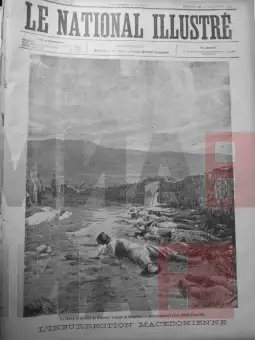
The French newspaper Le National Illustré also published photographs and testimonies from the “Macedonian Uprising” in September 1903.
Further on, the British newspaper The Daily News writes about the complex geopolitical situation, which is, of course, also linked to Macedonia. The article states:
“This is a dark cloud, from the midst of which come the cries of massacred men and women, and the turmoil of a struggle in which neither protection is asked nor given. There are many sides in the conflict - Bulgarians, Macedonians, Serbs, Albanians, Greeks, and Turks.”
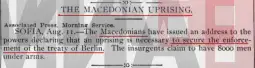
The Macedonian uprising was even reported in Hawaii. The news about 8,000 insurgents on August 11 was carried by The Hawaiian Star, published in the capital of the future island state of the United States. The article adds that the Macedonians demand guaranteed enforcement of the treaty of Berlin, including human rights and greater autonomy.
Likewise, the Hawaiian newspaper Hilo Tribune wrote several months earlier that the aim of the Macedonians is autonomy.
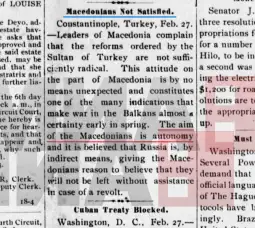
On the other hand, the Ljubljana newspaper Rdeči Prapor on August 21, 1903, spoke of an independent Macedonia, emphasizing the fanatical determination of the Macedonian people to achieve their set goal.
“Obviously, the revolution is spreading in Macedonia. Turkey is absolutely incapable of suppressing it. On the 2nd of this month, the insurgents proclaimed the revolution and emphasized that they will use dynamite in their fight and that they will stand by their word... Is there no peaceful way to achieve independence and freedom for Macedonia? ... We continue to see the hardships of the Macedonian population: In the past 10 years, over 100,000 Macedonians have been imprisoned... The Turks, on the other hand, complain that the Macedonians are ruthless,” the Slovenian newspaper writes.
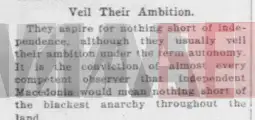
The Washington Times correspondent in Sofia, H.R. Chamberlain, reported even before the Ilinden Uprising that the goal of the Macedonian revolution is independence, not autonomy. Among other things, he wrote:
“They aspire for nothing short of independence, although they usually veil their ambition under the term autonomy. It is the conviction of almost every competent observer that independent Macedonia would mean nothing short of the blackest anarchy throughout the land.”
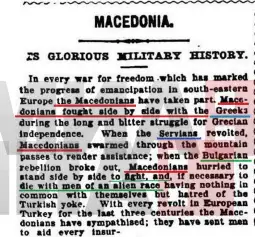
Next comes the article “Macedonia – Its Glorious Military History,” published in the Australian newspaper The World’s News in October 1903. For the journalist in Sydney, the Macedonians of that time were the descendants of their namesakes – the ancient Macedonians – and ethnically (“racially”) distinct from the Bulgarians, Serbs, and Greeks.
“In every war for freedom which has marked the progress of emancipation in south-eastern Europe the Macedonians have taken part. Macedonians fought side by side with the Greeks, during the long and bitter struggle for Grecian independence. When the Serbians revolted, Macedonian swarmed through the mountains passes to render assistance; when the Bulgarian rebellion broke out, Macedonians hurried to stand side by side to fight, and if necessary to die with of an alien race having nothing in common with themselves but hatred of the Turkish yoke. With every revolt in European Turkey for the last three centuries the Macedonians have sympathized; they have sent men to aid every insurrection that gave the least promise of success. Greeks, Serbians, Bulgarians and even Armenians are their debtors, but the Macedonians themselves (says an American writer), though aiding others to freedom, are still under the rule of the savage power which for nearly 1000 years has blighted the fairest portions of two continents,” reads the article.
The article further states that the Macedonians are a free, brave, liberty-loving people, they have for ages been subjected to the most odious, the most detestable, the most exasperating form of tyranny known to the world outside the limits of the Turkish Empire.
“A political despotism is bad enough, a religious despotism is well-nigh tolerable, yet the Turkish rule combine both. A great English writer once said, in substance, that men could makeshift to live under the rule of tyrant or debauchee but human nature could not endure a busybody. The Turkish Government is that of a debauchee – tyrant, exercised by busybodies, so persistent, so meddlesome, so troublesome in the supervision of the daily affairs of life as to make existence itself an unendurable burden. The Macedonians were not always the slaves of surrounding and more powerful nations. The Serbians look proudly back to the days when there was a Serbian Empire, the Bulgarians to the ages when Bulgaria ruled most of the territory once comprised in European Turkey; the Greeks to the golden age when the little peninsula gave to the world its art, its letters, its science, and philosophy. Macedonia, too, has a glorious past, for plains and valleys, from the mountain slopes and crags of the country now comprised of the vilayets of Salonica and Monastir came the men who marched to certain victory under Alexander the Great,” the author underlines.
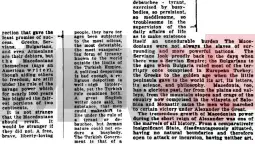
The Sydney newspaper goes on to discuss Alexander the Great and ancient Macedonia as one of the legends of world history.
“From a comparatively insignificant State, disadvantageously situated, having so natural boundaries and therefore open to attack or incursion’ having neither art, science nor letters, Macedonia became the Power of the world in a time so short and under circumstances so extraordinary that the story reads like a chapter from an Oriental fairy tale,” reads the article.
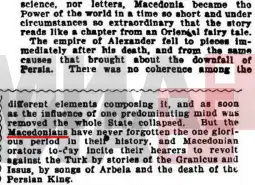
The author, however, explains that even millennia after the rapid fall of Alexander’s Macedonian empire - due to conflicts among the rulers and successors—more than 2,000 years after the collapse of that Macedonian state, the Macedonian people still have capable ideologues and leaders in the form of the organizer of the Macedonian revolution - VMRO - and other Macedonian intellectuals and orators.
“But, the Macedonians have never forgotten the one glorious period in their history, and Macedonian orators to-day incite their hearers to revolt against the Turk by stories of the Granicus and Issus, by songs of Arbela and the death of the Persian King,” the article ends.
This is only a small part of the thousands of articles, reports, and news stories about Macedonia and the Ilinden Uprising that were published around the world.
Photo: Facebook – public posts, online archives of the mentioned newspapers