EU’s ambition to strengthen geopolitical positions begins in Western Balkans, says Deputy FM
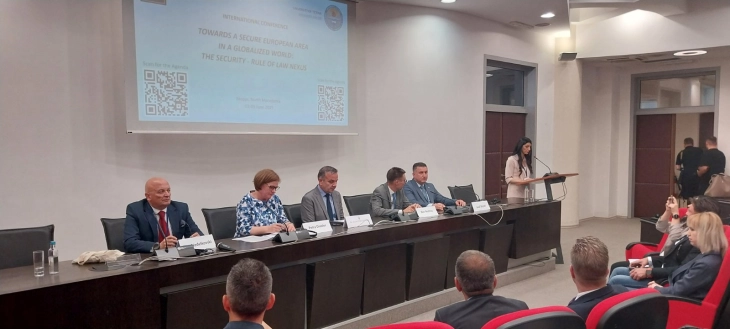
Skopje, 2 June 2025 (MIA) - The European Union’s policies toward the Western Balkan region are a litmus test of its ambition to become a more effective global stakeholder, said Deputy Minister of Foreign Affairs and Foreign Trade Zoran Dimitrovski in his address Monday at a conference on the topic “Towards a Secure Euro-Atlantic Zone in a Globalized World: The Link between Security and the Rule of Law” organized by the “St. Kliment Ohridski” University – Bitola and the State University in Tetovo.
“The EU’s ambition to strengthen its geopolitical and geoeconomic position and become a more effective global stakeholder is timely and necessary. We need a strong and united EU that stands firmly in defense of the rule-based international order. But we firmly believe that these aspirations begin here, in the Western Balkans, a region that looks at the EU with hope and a determination to join. It is a region which is already deeply integrated in areas such as trade, investments, energy connectivity, and foreign and security policy. That is precisely why the EU’s policies toward the region are a litmus test of its global ambition. Not only is it strategic, but also a geopolitical imperative for the EU to act decisively here,” Dimitrovski said.
The Deputy Minister stressed the country is aware it has a lot more work to do before it meets the required European standards.
“There are no shortcuts, and a lot of challenges lie ahead of us still, but we are determined to work hard on improving every area. That is precisely why we need the EU integration process, not as a goal but as a guide and support for our accelerated transformation in accordance with the shared European values,” Dimitrovski said.
German Ambassador Petra Drexler highlighted the importance of the trans-Atlantic partnership in the context of the security challenges, but also the EU’s readiness to significantly boost defense spending to protect peace and security on the content.
“From a European and German perspective, we firmly believe in this partnership, since freedom, prosperity and security are our shared goals. If we want to achieve these goals we need a strong Europe, united and fully determined and capable for action and for solidarity with Ukraine, for European security and a shared future with a strong trans-Atlantic alliance,” Drexler said.
EU Delegation Deputy Head of Mission, Ben Nupnau, highlighted the importance of the rule of law, the fight against organized crime and corruption, as well as the role of the Euro-integrations in preserving democracies.
“The security of the Euro-Atlantic area isn’t achieved only through weapons and partnership, but also through legitimate institutions, functional courts and trust in the institutions who enforce the law in line with the rule of law and who serve the citizens. With its continued support from the EU, North Macedonia is progressing toward this goal in a tangible way through the modernization of police forces, border security, and achieving digital resilience. These reforms are an investment not only in national security, but also a strategic contribution toward the joint vision for a more secure and more democratic Europe, with North Macedonia as an integral part as well,” Nupnau said.
The goal of the two-day conference is to encourage a constructive dialogue among representatives of the academic community, institutions, experts, and civil society on the complex relationship between security and the rule of law. It aims to explore how these two pillars can mutually reinforce each other in the pursuit of a stable and resilient Euro-Atlantic region.
Photo: MIA


