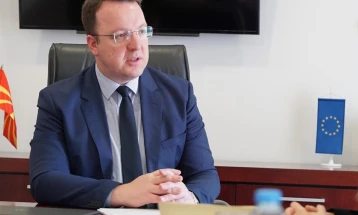
European process developments more than stagnation - it is injustice, Toshkovski tells IBNA
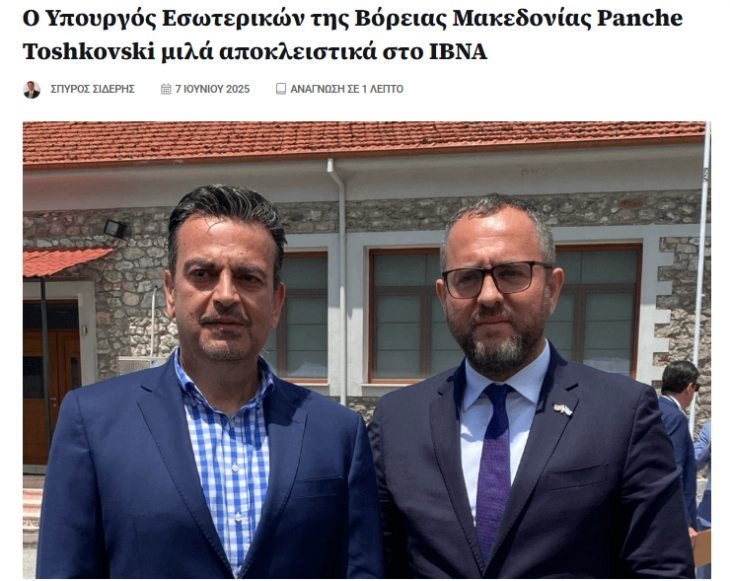
Athens, 7 June 2025 (MIA) - What is happening with the European process is more than stagnation - it is injustice. The European idea cannot be reduced to bilateral blackmail, says Minister of Interior Panche Toshkovski in an interview with the Independent Balkan News Agency (IBNA), MIA reports from Athens.
Minister Toshkovski, who attended the ceremony for reopening of the Markova Noga - Lemos crossing at the Greece-North Macedonia border, refers to the political and symbolic importance of the relaunch of the connection, cooperation with Greece, his country's European prospects, the issue of migration, and the stability of the government majority after the withdrawal of the Alliance for Albanians from the governing coalition.
"The reopening of the Markova Noga - Lemos border crossing is more than an infrastructure project, it is a symbol of maturity, responsibility and European perspective. It proves that we can build our future on the basis of common interests that bring our countries closer to Europe. For the Prespa region, this means new energy - economic, touristic and cultural. Local communities on both sides gain a new opportunity for development, while the states demonstrate maturity and vision. This crossing will not only unite the two states; it will unite people, histories, nature and the future - making it a true European example of cross-border cooperation," says Toshkovski.
He says that despite political turbulence of the past, police cooperation between the two countries is at a very high level.
"The Ministries of Interior maintain active, continuous and practically oriented communication, especially in the exchange of information, joint operational actions and in dealing with cross-border threats. In the coming period we intend to intensify the dialogue with the Greek side to formulate viable solutions that will speed up the transit at the Bogorodica-Evzoni border crossing, which is the main transport axis not only for our citizens, but also for tourists and transport operators from all over the region. Rapid and efficient crossing is a matter of economy, security and the implementation of European integration in practice," says Toshkovski.
On the issue of migration, the MoI says that North Macedonia is on one of the main migration routes to Europe and therefore is has a serious role to play in meeting the challenge.
"Although we are not an EU Member State, we are acting as a real partner - professionally, responsibly and with respect for regional security. There is operational communication with the Greek authorities, particularly in the exchange of information and coordination of actions. However, the pressure is mainly exerted within our own territory, where our forces act as the front line. And I can say with certainty that they are doing so successfully. The police of North Macedonia protect Europe's southern border on a daily basis. This is our essential contribution to European values - not in words, but in practice, with measurable results," says Toshkovski.
Regarding the country's EU prospects, Toshkovski says what is happening with the European process is more than stagnation - it is injustice.
"The European idea cannot be reduced to bilateral blackmail. As a government, we continue to work for reforms, the rule of law, the fight against corruption - not because someone is forcing it on us, but because our society needs it. But at the same time, we will clearly and decently say “enough is enough”. The time has come for Europe to answer the question honestly: is the Western Balkans really part of its future? If so, then the doors must be opened with respect and partnership, not with new demands and conditions," notes Toshkovski.
He adds that VMRO-DPMNE's positions on the Prespa Agreement are well known and do not change from one day to the next but when it comes to governing the country, responsibility trumps emotion.
"As a government, we are fully aware of the international obligations that must be met, primarily to protect the country from new crises and blockages. This means that regardless of our personal or political positions, we will act institutionally, with dignity and with the clear objective of stability, prosperity and the European future of our citizens," says Toshkovski.
On the latest developments in the ruling coalition, the MoI says the government is stable, with a clear parliamentary majority and a strong mandate from the people.
"Political coalitions are part of the normal democratic dynamic - they come and go. But the state course must remain stable and clear. For us, the most important thing is the trust of our citizens and our obligations to them. Institutions are working, reforms continue, and the security and stability of the country remain our top priority. There is no time for politically calculated moves. There is a duty to deliver results - and that is what we are doing," underlines Minister Toshkovski in the IBNA interview.
Photo: Screenshot