European Parliament's Committee on Foreign Affairs adopts Waitz report referencing Macedonian language and identity
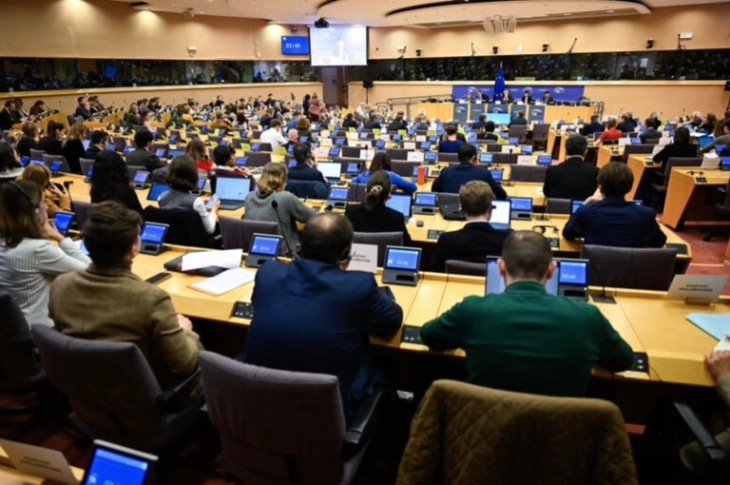
Brussels, 24 June 2025 (MIA) - The European Parliament Committee on Foreign Affairs (AFET) adopted Tuesday the draft-report on the country prepared by Austrian MEP Thomas Waitz with 40 votes in favor, 19 against and 10 abstentions.
After the vote, a Bulgarian MEP said they would propose supplementing the report with a “minority opinion”.
The parliamentary group of the European People’s Party previously submitted a fast-tracked amendment to insert the word “present-day” before “Macedonian language and identity” in the report. However, based on the rules of procedure, the amendment was not put to a vote because at least six MEPs from the AFET committee opposed the proposal. The rules state that an amendment will not be put to a vote if at least five MEPs object to it.
Ahead of the vote, AFET members rejected several amendments submitted by Bulgarian MEPs.
According to MIA’s Brussels correspondent, after the adoption of the document, Waitz, who is the European Parliament’s rapporteur for North Macedonia, said he was proud of the hard work that went into finding compromises so that the “well-balanced report” could be adopted with a broad political majority.
“The EU must stand united with its neighbours in the challenging geopolitical landscape we face. North Macedonia belongs in the EU. After 20 years of negotiations, we must keep up the current good momentum to further advance the enlargement process,” Waitz stressed in a written statement after the vote.
At the beginning of the session, the Chair of AFET, David McAllister, condemned the accusations directed in recent weeks at Waitz regarding the drafting of the report, pointing out that it is standard practice for the rapporteur to be in contact with representatives of the country that is subject to the report.
At the beginning of June, Bulgarian MEP Stanislav Stoyanov from the nationalist party Revival accused Waitz of holding “unreported meetings” with Macedonian officials during the drafting of the report, violating the rules of transparency of the European Parliament, and, according to the MEP, creating a “compromised and biased” report.
In the report, AFET welcomes the country’s commitment to the EU integration process, encouraging it to continue with the reforms despite the political challenges and public frustration and urges the Macedonian authorities to implement the constitutional amendments, strengthen the rule of law and the fight against corruption.
The report underlines that EU accession is ultimately a matter of political will – both in enacting reforms and adopting constitutional amendments. MEPs call on all political parties in North Macedonia to engage in constructive dialogue to reach the required consensus, “which would strengthen the country’s multi-ethnic character and accelerate EU progress”.
In the document, the MEPs welcome the EU’s new Reform and Growth Facility which is expected to provide EUR 750 million in grants and loans to the country, while also commending the country on its “ambitious reform agenda”.
They urge a strong focus on reform implementation, particularly in public administration, governance, the rule of law, and anti-corruption. Noting “worsening trends in high-level corruption and low public trust in the judiciary”, they call for stronger judicial independence, more accountability, and adequate resources for oversight bodies.
The MEPs also warn that political polarisation remains a key obstacle to reform and call for cross-party cooperation and the inclusive revision of the Electoral Code, based on OSCE/ODIHR and Venice Commission recommendations.
They also stress the importance of safeguarding future elections from malign foreign influence and disinformation. The MEPs voice concern over foreign interference, especially from Russia and China, and warn of growing risks linked to opaque financial flows and coercive investments.
The report urges continued reform to ensure an independent and resilient media landscape, aligned with the European Media Freedom Act, and calls for modernising a merit-based, depoliticised public administration.
Following its adoption by AFET, the report now needs to be approved at a plenary session of the European Parliament. The next plenary session is scheduled to take place from July 7 to 10 in Strasbourg.
MIA file photo