EU, NATO leaders back Warsaw as Russia denies drone attack on Poland
Warsaw, 10 September 2025 (dpa/MIA) - European leaders have expressed full support for Poland after Warsaw reported it destroyed more than a dozen Russian drones over its airspace early on Wednesday, sparking fears of an escalation of the war in Ukraine.
The incident marks the first time Russian drones have been shot down over NATO territory and could signify a major turning point in the Western military alliance's response to the increasing threat posed by Moscow.
Russia has denied any responsibility for the violation of Poland's airspace, with the Defence Ministry announcing on Telegram that "there were no plans to target infrastructure in Poland."
But European governments were in little doubt that the incursion - which came amid a heavy Russian attack on western Ukraine and drew a response from NATO air defences in Poland - represented a deliberate provocation from Moscow.
"The German government condemns the aggressive Russian conduct in the strongest possible terms," said Chancellor Friedrich Merz, describing the overnight events as the latest in a long series of Russian actions in the Baltic Sea region and on NATO's eastern flank.
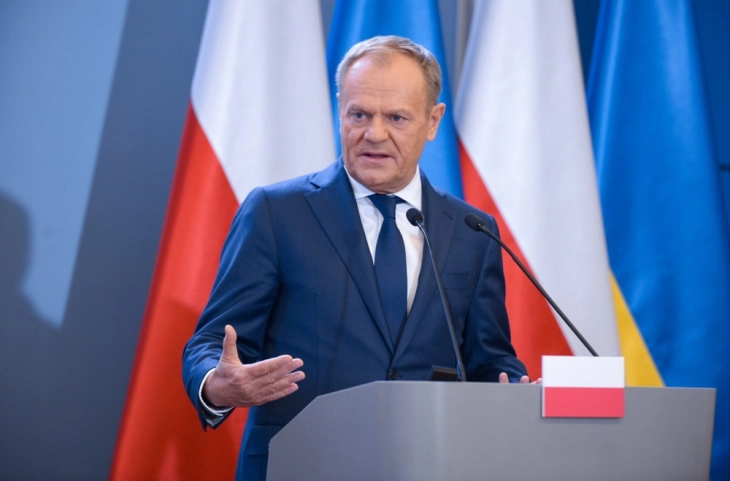
Polish Prime Minister Donald Tusk has invoked Article 4 of the NATO treaty, which provides for consultations if a member state feels its territorial integrity, political independence or security is threatened.
"This is the first time in this war that they did not come from Ukraine due to errors or minor Russian provocations," Tusk told the Polish parliament as he outlined at least 19 violations of Polish airspace over several hours.
"For the first time, a significant portion of the drones came directly from Belarus," he added. "We expect significantly more support in defending Polish airspace."
Poland summons Russian envoy as Moscow issues denials
Polish Foreign Minister Radosław Sikorski called the incident "an unprecedented attack not only on Polish territory, but also on NATO territory."
The chargé d’affaires of the Russian Embassy was summoned on Wednesday afternoon to the Foreign Ministry in Warsaw, where he was handed a note of protest, Sikorski told reporters.
The Russian diplomat denied the drones were even Russian. "If there had been an admission of guilt, that would have been progress, but we would prefer it if the Russians did not send any drones," Sikorski said.
He dismissed the possibility of an accidental violation. "In the case of 19 drones, it is highly unlikely that it was a coincidence," he said.
Poland’s air defence and security systems "functioned well," the minister noted. "Everyone did their part. This is an enemy that is brutally attacking our neighbours, so I’m not going to lie and say it couldn’t get any worse."
Sikorski added that the incident mirrored what "our neighbours in Ukraine experience almost every night on a larger, tragic scale."
The Kremlin is yet to comment directly on the allegations, with spokesman Dmitry Peskov saying that the Defence Ministry should be approached for information on the issue.
The ministry subsequently said it was willing to discuss the matter with its Polish counterparts.
Peskov meanwhile said that EU and NATO leaders "accuse Russia of provocations on a daily basis, mostly without attempting to provide any arguments to support their claims."
Ukrainian President Volodymyr Zelensky called for "a strong response."
"Moscow always pushes the boundaries of what is possible, and if it does not encounter a strong reaction, it remains at the new level of escalation," Zelensky posted on the social media platform X.
European leaders back Warsaw
Warsaw's allies and EU officials were quick to issue their support on Wednesday.
The bloc's chief diplomat, Kaja Kallas, said the incident was "the most serious European airspace violation by Russia since the war began, and indications suggest it was intentional, not accidental."
European Commission President Ursula von der Leyen called the incursion "reckless and unprecedented." In a major speech to the European Parliament in Strasbourg, she advocated building a "drone wall" to improve air defence on NATO's eastern flank as "the foundation of a credible defence."
NATO Secretary General Mark Rutte said the alliance was carrying out a "full assessment."
"Whether it was intentionally or not, it is absolutely reckless, it is absolutely dangerous," Rutte said.
"Stop violating allied airspace and know that we stand ready, that we are vigilant, and that we will defend every inch of NATO territory," he said in a message directed at Russian President Vladimir Putin.
French President Emmanuel Macron called the incident "simply unacceptable," while even Hungary's Viktor Orbán - a noted Putin sympathizer - expressed his country's "full solidarity" with Poland, without condemning Moscow.
A notable exception to the widespread public backing for Warsaw came from US President Donald Trump, who issued a cryptic message on his Truth Social platform.
"What's with Russia violating Poland's airspace with drones? Here we go!", Trump wrote.
Germany's Merz was more direct, accusing Russia of having "endangered human lives in a country that is part of NATO and the EU," while Defence Minister Boris Pistorius described the incursion as a "provocation against the whole of NATO."
"These drones were clearly deliberately set on this course," Pistorius said in Berlin. "To fly to Ukraine, they would not have had to fly this route."
Rutte confirms joint NATO response
Poland is a key political and military ally of Ukraine, which has been under attack by Russia for more than three and a half years.
The country also serves as a crucial logistics hub for Western military aid to Kiev and sees itself as under threat from Russia, prompting significant military upgrades.
In recent weeks, several drones have entered Polish airspace and crashed, with no casualties reported, but Tusk said the latest violations were a clear departure from previous incursions.
Polish authorities said late on Wednesday that parts and debris from more than a dozen drones have been recovered. Many were Iranian-made Shahed drones, according to the EU.
Along with the Polish Air Force, several NATO members were involved in downing the drones, Rutte said. This included the use of Polish F-16 fighter jets, Dutch F-35 jets, Italian planes, and German Patriot air-defence systems.
"Our air defences were activated and successfully ensured the defence of NATO territory, as they are designed to do," he said, commending the pilots involved in the operation.
NATO ambassadors discussed the situation following Poland's request for consultations, the secretary general said.
"We will closely monitor the situation along our eastern flank, he stressed, and NATO air defences continue to be ready.
Despite the triggering of Article 4, it is considered highly unlikely by military experts that Poland will request military assistance under Article 5 of the NATO treaty.
Photo: EPA