Drexler: More predictable and credible EU enlargement process needed, greater flexibility in decision-making
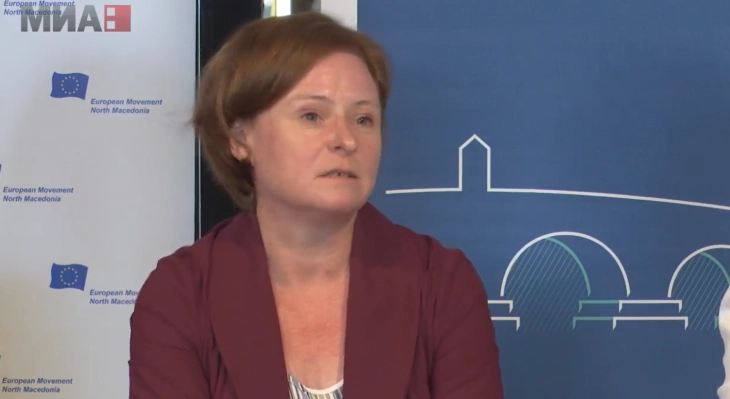
Skopje, 28 May 2025 (MIA) - The European Union’s enlargement process needs to have greater predictability, to be more dynamic and more credible. It is also necessary for the Union’s decision-making process to become more flexible, German Ambassador Petra Drexler said Wednesday at the panel discussion “Shaping the Future - EU Integration as Path Forward for North Macedonia” organized by Konrad Adenauer Foundation (KAS) in cooperation with the European Movement in the Republic of North Macedonia and the Wilfried Martens Centre for European Studies to mark Europe Day and the 25th anniversary of active engagement of KAS in the country.
According to the Ambassador, recent geopolitical developments have raised the issue of changing the way in which the EU makes decisions due to the need for greater unity and integration in order to tackle challenges and threats more efficiency.
“We are all aware about the development of the geopolitical situation in the field of security, democracy, the challenges and threats that our societies are facing. It is time for Europe to start looking after itself. We are aware of this, but we must show greater responsibility and the question isn’t whether, but how we will do this. And we will have to take a look at the way we undertake activities and adopt decision. So, we will have to be certain and capable of making swift decisions and taking swift actions. That is precisely why the new coalition agreement for the new German Government states that this will be a priority for us, to secure an accelerated decision-making process within the EU, while also taking into account each individual country and its interests. Our strength lies in our unity and we are aware of this,” Drexler said.
The Ambassador stressed that making decisions with a qualified majority is not a novelty for the EU, noting that the Council adopts 80 percent of regulations with a qualified majority, but still, she said, there are decisions such as those related to the common foreign and security policy which require unanimity.
“We need to take the national interests of the member states into account, and we also need to find a way to retain this principle of unanimity while also introducing more flexible ways of making decisions,” Drexler said.


