Croatian President Milanović invites Pope Leo XIV to visit Croatia, expects visit to happen
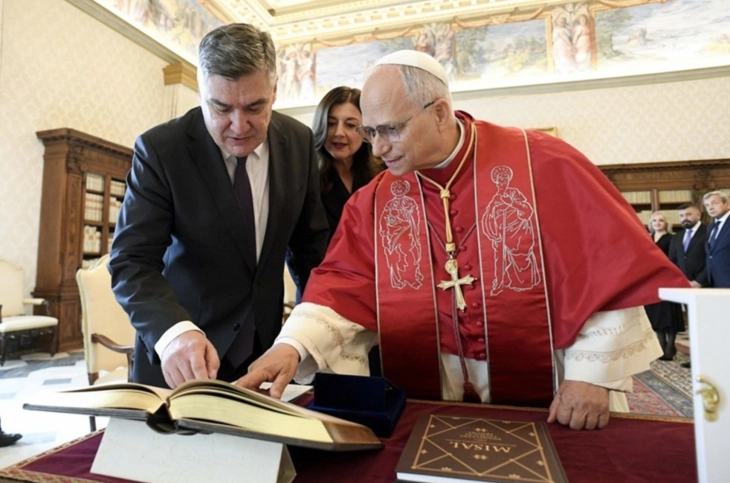
Zagreb, 31 October 2025 (Hina/MIA) — Croatian President Zoran Milanović has invited Pope Leo XIV, who received him Friday in a private audience, to visit Croatia. President Milanović said he expected the visit to take place, considering that Pope Francis did not visit the country during his pontificate.
"Yes, of course, he was formally invited to come to Croatia," Milanović told reporters after his private audience and meetings with Vatican diplomats.
His predecessor, Pope Francis, whom Milanović met in 2021, also received an invitation but never visited Croatia.
Asked how he knew that this pope would visit, Milanović said his view was based on his own assessment.
He described the meeting as "a pleasant conversation" and said "there was no talk of politics at all."
"Usually such topics are raised from the other side, but that did not happen this time," he said.
"It seems to me that this is a pope who will not engage in politics in the way some of his predecessors occasionally did in certain situations, which I don't consider wrong but I think he is different. I don't think he will allow himself to be drawn into such matters or to draw others in. That's also my assessment," the president told reporters.
As for his meeting with Secretary of State Pietro Parolin, Milanović said he could not share details.
He added that the burning issues of Ukraine and Gaza were not discussed, but that the talks did touch on the position of Croats in Bosnia and Herzegovina, while "the canonisation of Cardinal Stepinac was not mentioned at all."
Asked whether he thought Pope Leo would declare Stepinac a saint, Milanović said that was "an internal matter of the Church."
Speaking about Bosnia and Herzegovina, he repeated that "we still have a situation where one majority people elects the representative of another people, and this has happened four times so far. These are four serious breaches of the rules, and unless it is prevented, it will continue. It is contrary to the law, it cannot be that way, but it goes on."
Continuing on Bosnia and Herzegovina, he said that cooperation with the US administration might be needed on that issue but asked, "what does Bosnia and Herzegovina have to do with the United States?"
"This is Europe, and an ancient Croatian homeland, though not exclusively Croatian. It's a matter for Europe to deal with," Milanović stressed.
The United States recently lifted sanctions on former Republika Srpska president Milorad Dodik, a group of his associates and members of his immediate family.
The UN Security Council was expected to discuss the situation in Bosnia and Herzegovina at its Friday session in New York, and media have reported that High Representative Christian Schmidt may be leaving his post.
BiH Foreign Minister Elmedin Konaković said Thursday that the closure of the Office of the High Representative, which has been active in the country since 1996, was being considered, calling such a move "a disastrous decision."
Asked whether Kosovo was discussed, Milanović reiterated that the Vatican has not recognized Kosovo, saying that the Holy See "is very conservative on such matters," just as five EU member states have not recognized it, "each for their own reasons."
"That shows that countries act in their own interests, which isn't necessarily a bad thing, as long as they are not malicious or invasive," Milanović said, adding that he advocates the recognition of Kosovo wherever he can. "I don't do it to spite Serbia or Serbs, it's simply a matter of reality."
Milanović, who also met Pope Benedict XVI while serving as prime minister, said he received "a symbolic, beautiful gift" from Pope Leo XIV, while he presented the Pope with the Missal according to the Law of the Roman Court from 1483, the first printed Croatian book.
The incunabulum, published only 28 years after the Gutenberg Bible, is the first European book not printed in Latin script but in the Croatian language and Glagolitic script.


