Bozhinovska: Single-supplier dependency a thing of the past, future belongs to diversified, sustainable, secure energy solutions
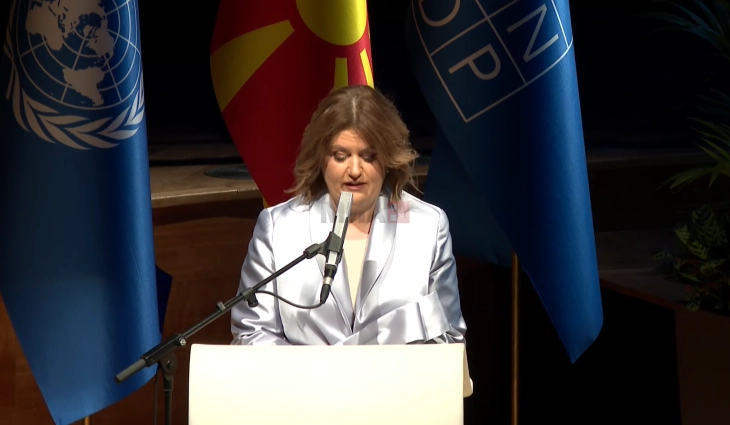
Skopje, 28 October 2025 (MIA) - Energy transition is not only a technological, but a social process that requires courage to change habits, vision to make long-term decisions, and readiness to invest in solutions that may not bring immediate results but will create a safer and more sustainable future for generations to come, Minister of Energy, Mining and Mineral Resources Sanja Bozhinovska said in her opening remarks at the 14th International Forum on Energy for Sustainable Development (IFESD-14) titled "From Goals to Action: Powering the Future with Sustainable Energy", taking place in Skopje on October 28-30.
According to Bozhinovska, over the next three days the country will be the centre of the global energy dialogue.
"Energy resilience today means the ability of the system to adapt and continue to function even in conditions of global uncertainty. Single-source dependency or single-supplier dependency is a thing of the past, the future belongs to diversified, sustainable, secure energy solutions," the Minister noted.
She stressed that single-source dependency is a major risk.
"In this new era, technology and artificial intelligence are our allies, not a threat. They can help us forecast demand, optimize consumption and improve energy accessibility. But, energy must be used wisely, with a focus on people, not just machines," said Bozhinovska.
Energy transition, she pointed out, is not a race between countries.
"It is a shared journey. No country, no matter how big, can tackle climate challenges alone. But together we can build safer, more resilient and cleaner systems. Our role as ministers and leaders is to create the conditions for this transition to be fair, sustainable and inclusive, and to ensure that no one is left behind," the Minister noted.
The Government, she added, is building the interconnector with Greece and Serbia as an investment that will provide direct supply to thousands of households and industries, but will also help Europe for better connectivity and security of gas supply. She underlined that the Government is also working on modernizing the transmission network, investing in digitalization and energy storage.
"This country has potential, the potential of people who are not afraid to work, of institutions that want to prove themselves and of a generation that does not want to wait, but to create. And that is the essence of this conference - from words to action," said Bozhinovska.
UNDP Resident Representative Armen Grigoryan said this year's forum comes at a time of escalated global challenges, from intensifying climate impacts to economic uncertainty and evolving geopolitical dynamics.
"In this context, we must also recognize that energy security and climate resilience are two sides of the same coin. We must move from commitments to concrete implementation and concrete steps. Sustainable energy stands as a cornerstone of our collective sustainable future," Grigoryan said, adding that around the world, the UNDP is deeply engaged in advancing this agenda.
The UNDP, he noted, is aiming to provide more than 500 million people globally with access to sustainable, affordable and reliable energy.
"To achieve this, UNDP builds strong partnerships, regional cooperation is our multiplier that drives systemic change. This forum is a vital platform for that purpose. Together with the Energy Community, we can accelerate the market coupling, invest in crossborder storage, turning interdependence into strength. The key question before us is how we can accelerate a just energy transition, one that ensures sustainability, inclusivity and prosperity for all. First, market development is essential," said Grigoryan.
He pointed out that decentralized energy systems are no longer optional, but strategic and bring resilience, lower costs and energy independence.
"It is in this line with the bold targets of the Government of North Macedonia, phasing out coal plants and scaling renewables under the just transition roadmap. We must harness digital intelligence using data and artificial intelligence to plan, analyse and implement evidence based energy policies and projects. Digital platforms enable real time monitoring, predictive maintenance and flexibility in markets, making energy systems more efficient, resilient and transparent," Grigoryan noted.
He said the forum will showcase how digital innovation turns complexity into opportunity, pointing out that we must never forget that the people, and only people, drive the transition.
United Nations Under-Secretary-General and Executive Secretary of UNECE, Tatiana Molcean, said today we stand at a crossroads when it comes to multilateralism in energy.
"The global energy transition represents not only a historic opportunity for sustainable development, but also a profound responsibility. We must build resilient energy systems that ensure a secure, affordable and environmentally sustainable supply of energy. Over the next three days, this forum will span across many aspects of the energy transition - from facilitating the scaling up of e-mobility to ensuring a just transition that leaves no one behind, from sustainable development of critical energy transition minerals to closing the gap in finance and much more. The time for action is now. This is our collective responsibility. Our goal here, from the UN side, from all the partners is really to provide those practical solutions for sharing national and regional strategies to accelerate clean energy deployment, showcasing innovative technologies and solutions from international organizations, the private sector, and academia, and presenting financing mechanisms and partnerships to expand investment," said Molcean.
She stressed that none of us will succeed if we work in isolation.
"To be successful, we must engage with affected stakeholders, assess socio-economic impacts and understand the comprehensive effects of policy choices. I am very pleased that our sister regional commissions and UNDP extensively engage with us and I applaud and encourage this cross-cutting dialogue among different experts and policy-makers, not only from this region but from around the world. This serves as a model for how we can most effectively address cross-sectoral challenges with limited time and resources," Molcean pointed out.
She stressed that leveraging expertise and resources across the UN system will only become more important as the UN80 Initiative transforms the way of working of the United Nations.
"This initiative will have an impact on all of us, on organizations, but most of all on how we support you, our member states. It is critical therefore that we understand, through discussions, through engagement, your priorities, including this week, this dialogue, so that we can most effectively and efficiently meet your needs to deliver a just energy transition. The challenges before us are immense, but so are the opportunities. UNECE is here alongside the UN partners to help ensure that energy is not only a driver of just transition and economic growth, but also a catalyst for sustainability and resilience," said Molcean.
The Forum will focus on energy transition, technology and markets, energy production, and cooperation to ensure energy security.
Photo: MIA


