Artemis II crew 'happy and healthy' back on Earth
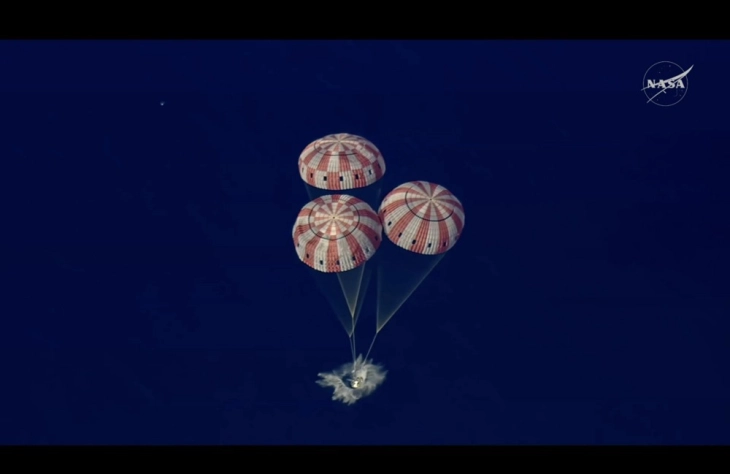
Washington, 11 April 2026 (dpa/MIA) - The first humans to travel near the moon in more than 50 years have returned safely to Earth after about 10 days in space.
The four Artemis II astronauts aboard the Orion capsule - US astronauts Christina Koch, Victor Glover and Reid Wiseman, along with Canadian Jeremy Hansen - landed in the Pacific near San Diego as planned at 5:07 pm on Friday (0007 GMT Saturday), the US space agency NASA said.
After the "textbook" splashdown, specialist teams from NASA and the US Department of Defense helped the astronauts out of the capsule and then took them by helicopter to a special ship.
NASA chief Jared Isaacman personally welcomed the crew and congratulated them on what he called a "truly historic achievement." The astronauts waved and smiled at the cameras and gave thumbs up.
NASA said the crew was "healthy and happy." They are now to undergo medical examinations before being taken back to Houston.
Trump: Landing was 'perfect'
US President Donald Trump described the lunar mission as "spectacular" and the landing as "perfect" on his Truth Social platform.
Canadian Prime Minister Mark Carney welcomed the crew home and congratulated them on a "historic feat" in a post on X.
The landing was a complex manoeuvre in which the capsule at times reached speeds of up to about 38,400 kilometres per hour, subjecting the astronauts to extreme physical strain.
A special shield protected the astronauts from the extreme heat to which the capsule was exposed during re-entry into Earth's atmosphere.
Communication with mission control was scheduled to cut out for around six minutes. The capsule then slowed with the help of parachutes before coming down in the Pacific.
First lunar flyby in over 50 years
The four Artemis II astronauts blasted off last week aboard the Space Launch System rocket from Cape Canaveral, Florida.
The historic mission traced a figure-of-eight trajectory around Earth and the moon, covering more than 2.3 million kilometres.
The four travelled farther from Earth than any humans before, surpassing the Apollo 13 record set in 1970. At its most distant point, the spacecraft reached about 406,771 kilometres from Earth and came within roughly 6,545 kilometres of the moon's surface. No landing was planned.
During their flyby, the astronauts observed the moon for around seven hours, including views of the far side that have never before been seen. The crew also witnessed a solar eclipse from Orion's perspective, with the moon passing in front of the sun.
The United States remains the only country to have put humans on the moon, with 12 astronauts walking on its surface during the Apollo missions between 1969 and 1972. The first was Neil Armstrong in 1969, and the last was Eugene Cernan in 1972.
The Artemis mission aims to return humans to the moon and establish a US base there, paving the way for missions to Mars, amid intensifying global competition for military, commercial and scientific advantage in space.
Photo: epa