Aliu: AI application in medicine helps improve diagnostics, telemedicine project in pilot phase
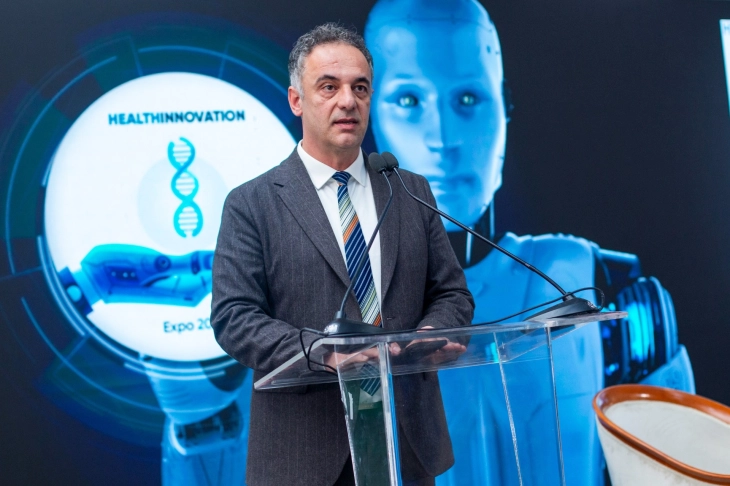
Skopje, 8 November 2025 (MIA) - The application of AI has great potential to improve diagnostics, personalized medicine, the discovery of new drugs and molecules that will allow for certain diseases to be treated much better with fewer side effects. It will also help reduce the time that doctors and medical staff spend on administrative work. These are some of the conclusions from this year's edition of HEALTH INNOVATION EXPO 2025, taking place in Skopje on Saturday and Sunday.
Participants in Saturday's event pointed out that AI should be integrated with medical staff and doctors to provide added value, i.e. additional ability and skill to medical personnel in providing better healthcare to the patients themselves, rather than replace them.
Minister of Health, Azir Aliu, stressed that digital transformation in the healthcare system is not simple, because, he noted, "the ecosystem in every country is complicated."
"Digital transformation in the healthcare system is not simple, because the ecosystem, as in every country, is complicated. Switching from one process to another requires digitalization of processes, then training and a joint approach of both private and state institutions, so that the digital transformation is not just scanning and digitizing documents, but it brings automated and digitized processes to healthcare," he said.
The Minister pointed out that in order to have algorithms that process and alert about a process in healthcare, there must be an integrated system that draws data from every healthcare institution in the country.
"This was our first step - mapping healthcare institutions in terms of infrastructure, human capacities and services they offer. One of the data is already publicly available on our website, and you already have data on healthcare institutions processed by our system. Very soon, probably in a week or two, we will have a press conference on the human capacities in the country, which we have clustered into doctors, nurses, technical staff. Based on that human resources data, we will need to define and map what type of protocols we will define, related to digital processes in healthcare. Furthermore, all algorithms related to AI will be tools that will help on a daily basis both for medical staff and for doctors, but also for patients. They are tools that achieve interaction between the healthcare system and the patient and the purpose of those tools is not to replace a doctor with a machine or an algorithm, but for them to be tools that will help and bring healthcare services that will be in real time, more precise and accessible from every point. In fact, healthcare should be closer to citizens, instead of citizens running around healthcare institutions," he said.
Aliu added that work is already underway on a pilot project in two cities - Debar and Delchevo – on telemedicine. He pointed out that work is also underway on amendments to 12 laws related to healthcare.
"We are currently working on amending 12 laws - the Law on Health Care will include a chapter on digital transformation of healthcare, because at the moment we do not have defined protocols for offering healthcare services via telemedicine or through digital tools. All healthcare institutions have been notified by the Ministry of Health. Technically, the gate is open, so we have a two-way communication between our system and the healthcare system. The idea is that the state should create protocols and rules, while all healthcare institutions in the state should follow and adapt to those protocols and rules, and we have done that – we have created standards and protocols for communication between institutions, and this is in accordance with European standards. We must create a healthcare system that will be centralized and regarding which we will have a clear health picture for each of our citizens, regardless of whether they receive healthcare services from a private or state healthcare institution," Minister Aliu said.
Aliu stressed that doctors should not fear that AI will take their place in healthcare facilities.

Professor Orce Simov said the application of AI and digital transformation in healthcare has great potential in improving diagnostics and personalized medicine, but also in the discovery of new drugs and molecules that will allow for certain diseases to be treated much better with fewer side effects.
"It also has the potential to reduce the time that doctors and medical staff spend on administrative work. Many studies show that by 2030 the world will lack about 18 million health workers, of which at least 5 million will be doctors. In the near and even medium future, I see the role of digital transformation, especially AI, integrated together with medical staff and doctors, and it will provide added value, i.e. additional ability and skill to medical staff in providing better health care to the patients themselves, rather than replace them," said Simov.

Doctor Aleksandar Manolev also stressed that doctors should not fear the application of AI in healthcare. He pointed out that doctors should have greater control in the use of AI.
"On the contrary. World practice is slowly showing that in a good part of the medical sectors there is relief. Of course, there will be a great deal of caution, we must have greater control in the use of what is ChatGPT, AI. We should not fear that. We should think more about improving it, because if we run away from the discussion in that direction, then we will have many more mistakes. The idea of medicine is to reduce the doctor's error through the use of AI, among other things, to make improvements in the implementation of diagnostic and therapeutic protocols. I am in favour of that, but with a great deal of caution and use of all these parameters," Manolev said.
The Health Innovation Expo 2025 is organized by the Chamber of Private Healthcare of Macedonia. The fair features experts, companies and institutions who will present innovative solutions through public forums and lectures.
The Chamber notes that the first Expo edition puts emphasis on technological innovations with a focus on the development and proper application of AI, which will undoubtedly contribute to facilitating everyday clinical practice and complement digitalization in healthcare. The focus on these technologies is an excellent opportunity for all interested companies to present their solutions and technological achievements - through public forums with the participation of experts and institutions, as well as through classic fair exposition, the Chamber pointed out, adding that they expect a quality offer intended for more than 5,500 private healthcare institutions, over 30,000 healthcare workers in private healthcare and over 33,000 employees in the public healthcare sector.
Photo: MIA


