Albanian writer Odise Plaku: Art cannot turn into political propaganda
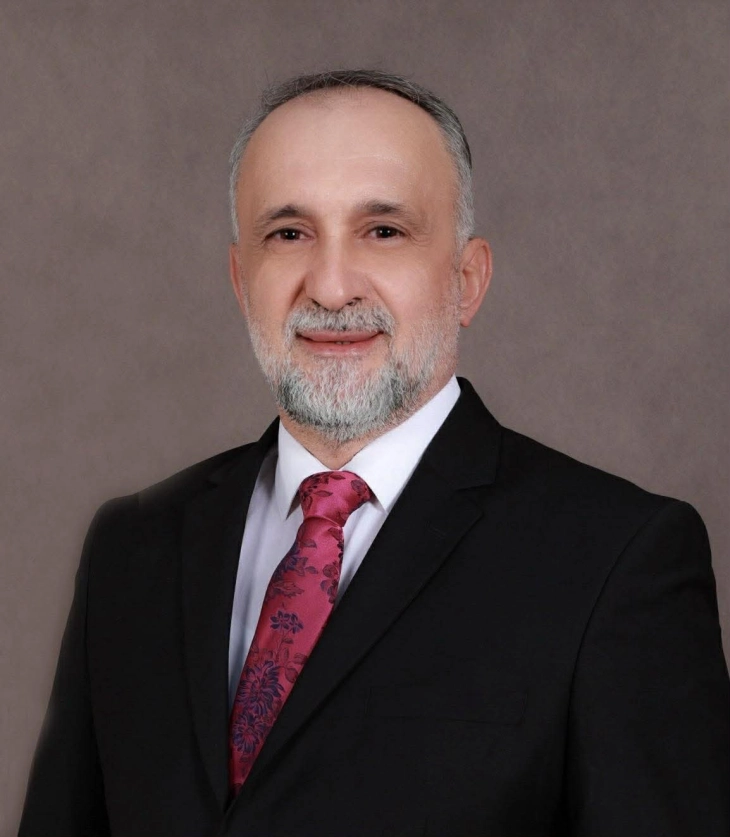
Tirana, 26 January 2026 (MIA) — Odise Plaku is a renowned Albanian writer, poet and playwright with a rich and varied oeuvre. He is the author of over 25 books for children and adults and 20 theater plays, including comedies and monodramas. Critics have said his writing features a strong artistic sensitivity and is deeply focused on social issues, approaching them with honesty and courage.
Plaku is the winner of many poetry competitions. He has been translated into several languages and published internationally. His best known and most acclaimed works are "Amber Alert" and the monodrama "Engjëjt" ("Angels"), which have caused strong emotions and debate about the sensitive topics they treat, revealing the power of art to influence reality and raise social awareness.
In addition to his creative work, Plaku is also involved in state institutions and currently serves as the head of the Albanian Parliament's publications department.
When did you first feel that writing was your calling?
Let me, first of all, extend my sincere thanks for inviting me to do this interview with MIA.
As for my beginnings as a writer, it was from an early age that my teachers noticed my writing talent and nurtured and supported me to continue my passion for writing. I vividly remember when, at the age of 10, two of my poems were published in a literary magazine. Over time, writing became a space where I could ask, wonder and communicate with others in the way I knew how.
How did your childhood in Fier shape your artistic sensibility?
To be honest, my childhood was spent in a small industrial town known for oil processing, Balş, a town with a diverse artistic and cultural life, where I spent a lot of time and it strongly influenced and shaped me culturally. My adult life in the city of Fier taught me to observe, listen and distinguish the small and large dramas of life, which later became an organic part of my writing.
I was lucky to work in television in Fier for years, which got me a professional background and later served me in my creative journey. Journalism, for me, remains one of my most significant life stages because I created strong connections with people but also acquired spiritual wealth.
What inspires you the most? Your personal experiences or social reality?
My inspiration is a mix of personal experiences and social reality. What I personally experience and feel is often my starting point, but writing only makes sense when it is connected to what is happening around us. Social reality gives dimension to the work, and personal experience gives it sincerity and emotional depth. For me, these two sources are not mutually exclusive but constantly complement each other.
You write poetry, fiction and drama. Which genre gives you the most freedom?
Each genre offers me a different freedom and corresponds to a specific expression. Poetry allows me to be more intimate and focused on language and feeling, fiction gives me a broader space for expression, and drama challenges me through its dialogue and direct clash of ideas. In drama, perhaps, I feel the freest because the words immediately confront the audience and come to life through the body, voice and human conflict.
How would you describe your own writing style?
As direct, restrained and built on the tension between the realistic and the poetic. I am interested in language devoid of excess — of the unnecessary — while still being full of meaning as well as in constructing situations that leave room for reflection and questions rather than canned responses.
How much does reality, versus fiction, dominate your works?
Reality and fiction are closely intertwined in my works and it is hard to separate them. Reality often serves as a starting point — some situation, an event or a social condition — and fiction gives me the freedom to deepen it, transform it and take it beyond the obvious. I am not interested in directly reproducing reality, but in revealing the emotional and human truth hidden within.
Do you believe writers have a moral responsibility to society?
Yes, I believe writers have a moral responsibility to society, but not in the sense of instruction or propaganda. They have a responsibility to honesty, to the truth, to the courage to broach difficult topics and to the refusal of remaining silent in the face of injustice. Literature, for me, is an act of conscience and freedom, which aims to raising questions and empathy instead of imposing views.
Your plays often deal with difficult and sensitive topics. Why is theater such an important medium for these messages?
Theater makes it possible for serious and sensitive topics to reach people in an immediate, direct way. On stage, words come to life through movement and emotions, and this makes the experience closer to life. The audience is not just a listener, but becomes part of the situation, experiencing the event in real time. This creates a kind of emotional and moral dialogue, which can rarely be achieved in fiction or poetry with the same intensity.
Your play “Amber Alert” caused strong reactions. How do you deal with the emotional burden of topics like this one?
I deal with difficult and emotionally charged topics by maintaining the necessary creative distance, but never losing sensitivity. I try not to sensationalize events, but to remain honest and attentive to human pain. At the same time, I have to remember art is not only a reflection of pain but also a way to invite discussion and raise awareness. If I feel the topic is weighing me down, I take a step back, refocus my energy and process it in a way that does not exhaust me but makes me more attentive.
How do you see the state of contemporary Albanian theater these days?
As dynamic and full of challenges, but also full of potential. For me, this is a time when art and theaters strive to preserve their identity while at the same time try to present contemporary reality and collaborate with the public in new ways. This is a challenging time, but also exciting because it makes room for development, experimentation and a broader dialogue with society and the world.
Your works often speak about painful social issues. Can literature bring about change?
Yes, literature can bring about change, but not in an immediate and visible way, as a law or policy can. It inspires change at the level of consciousness, influencing the way people think, understand and perceive reality.
In my works, I try to present the audience with an uncompromising image of what is happening, trying not to dull down the pain but not to glorify it either. When readers or viewers are confronted with a painful story, it gives them information as well as emotions, empathy, questions and sometimes, a sense of responsibility.
How does your work in state institutions influence your writing?
My work in state institutions provides me with situations, tensions and moral dilemmas that interest me as a writer.
At the same time, I try to keep my creativity independent so literature does not turn into propaganda or an official voice. Working in an institution teaches me discipline, but also makes me careful about how I use the power of words. Its deep impact is the ability to see reality in many layers and not treat it as simple, but as a complex human structure.
Where is the line between art and politics?
It is a thin line. Art should raise questions and give freedom of interpretation. Politics aims to impose ideas. When art turns into propaganda, it loses its independence. I believe a piece of writing can be critical, but it always has to maintain its integrity and honesty.
Do you write in a disciplined way or does inspiration strike spontaneously?
My work is a combination of both. Inspiration often comes to me spontaneously, but to turn make it last, I need discipline. Without discipline, an idea remains just an impulse; without inspiration, routine becomes dry. So, for me, writing is a process that begins with a feeling, but ends with dedicated effort and commitment.
What do you do when you experience writer's block?
I try not to fight it directly because that often only makes it harder. I usually take a step back: I read, walk, listen to music or watch a TV show or movie that inspires me. Sometimes it helps to write something small, without any pretension, just to get into the rhythm. When I feel more at peace, I go back to the project with a new perspective. For me, the block is part of the process, not a permanent obstacle.
Are any of your works special to you?
Yes, there are two works that feel closest to my heart — "Angels" and "Amber Alert." Both were well received by the audience. I am not saying this only because of the acclaim they garnered but because through them I experienced and processed some deep emotions. These works connected me to the pain from and worry about a reality that cannot be ignored and made me be more honest and careful in treating these sensitive topics. Both works brought to me the feeling that art can be a window into what we often try to hide.
What is your current job?
I am currently the head of the Parliamentary Publications Department at the Albanian parliament. In this position, I am involved in the processing and coordination of official publications, making sure the information is clear, accurate and valuable both for the institution and for the public. This job requires attention to detail and sensitivity to the importance of words and documents.
At the same time, I continue my creative endeavors, looking for spaces to write and follow art projects. For me, both dimensions — the institutional and the artistic — are part of the same effort to understand and describe reality.
What would you like readers or viewers to take away from your works?
I would like readers or viewers to take with them a sense of responsibility and reflection. I do not want to give them prepackaged answers, but to open a window where they can stop, think and ask. In my works, I strive to encourage a deeper connection with reality and with people — to not see pain as something distant, but as something that affects everyone. Ultimately, I would like to give them the feeling that art can be a way to better understand ourselves and society and not to remain silent when something is wrong.
If you had to describe the role of art today in one sentence, what would it be?
The role of art today is to make us face reality with honesty, to stir our conscience and to remind us we cannot remain silent in the face of pain and injustice.
You have collaborated with your Macedonian colleagues and with cultural institutions, but how satisfied are you with these collaborations?
At the moment, the level of collaboration with my colleagues from Macedonia has been limited to several poetry readings held in Tetovo, Kumanovo and Skopje as well as at the Albanian festival in Debar, where I was invited to be a member of the jury and where an Albanian language play of mine was performed. I have not had any specific collaborations with Macedonian colleagues, despite several individual attempts I have made as a playwright. I would like — in the way my works have been performed in Greece, Montenegro, Kosovo, etc. — to collaborate with my colleagues from North Macedonia. Art collaborations are bridges of friendship and I particularly appreciate Balkan friendship.
Branka D. Najdovska


