Survey: Young people in North Macedonia divided over country’s EU perspective

Brussels, 10 November 2025 (MIA) - The majority of young people in the country view the EU positively, but nearly half do not believe that the country will ever become a member of the Union, confirming the growing Euroscepticism among young people in EU candidate countries, according to the publication “Countering Youth Euroscepticism in the Western Balkans: The Case of North Macedonia.”
“This gap between hope and reality, interest and distrust, the European idea and domestic challenges, forms the basis of youth Euroscepticism. Therefore, urgent, partnership-coordinated, and long-term action in the EU candidate countries is needed that will recognise youth as creators, not just an audience, address economic and institutional barriers, connect young people with concrete European programmes, content, and platforms and make EU communication relevant, two-way, and transparent,” the publication reads.
This publication clearly demonstrates that young people from North Macedonia - as representatives of EU candidate countries - are not passive observers but active actors seeking space, perspective, and partnership.
“Europe will not be complete without them, and the enlargement process will not succeed without their meaningful involvement,” it reads.
There is significant scope for rapid and sustainable improvement of trust among youth from candidate countries in the EU accession process, and much of the solution lies in continued cooperation and mutual partnership in implementing youth activities between national institutions and EU bodies, with clear opportunities for all young people to be involved in designing and implementing such programmes and activities.
The results of an online survey conducted at the end of June 2025, with the participation of over 1,000 young people from North Macedonia, confirm the presence of Euroscepticism among youth, varying expectations regarding EU membership, as well as a wide range of opportunities and actions that can be undertaken by national and EU institutions in collaboration with young people.
The survey is part of a broader analysis of youth attitudes towards the European Union and was conducted within the framework of cooperation between the Institute for Good Governance and Euro-Atlantic Perspectives (IDUEP Skopje), the European Centre of Excellence (ECE Brussels), and the Friedrich Naumann Foundation for Freedom, in cooperation with the student platform “Studentarija.”
According to the survey, 41% of young people in the country perceive the European Union positively, 24% express a negative attitude, while slightly more than one-third - nearly 35% -remain neutral, clearly indicating both space for proactive engagement and a lack of deeper association with EU values.
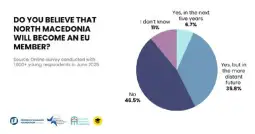
When it comes to the country’s future in the EU, the data reveal a strong degree of scepticism. Nearly half of the respondents (46.5%) do not believe that North Macedonia will ever become an EU member state. Meanwhile, 35.8% believe that membership is possible, but only in the more distant future. Merely 6.7% believe it could happen in the next five years, while the remaining 11% are undecided or have no opinion on the matter.
Corruption is convincingly identified by young people as the biggest obstacle to EU integration, selected by 84.6% of respondents. It is followed by bilateral disputes (61%) and low trust in institutions (60%) - factors that clearly show youth recognition of the domestic political environment as a key barrier to the country’s EU progress, while also expressing an expectation for concrete steps from national institutions to combat corruption as a foundation for improved living conditions and the retention of young people in the country, reads the publication.
According to the survey, young people report being adequately informed about EU values and policies. 53% chose this option, while nearly the same number stated they are very informed (22%) or somewhat informed (21.5%). A small percentage (only 3.5%) said they are not informed at all about EU values and policies.
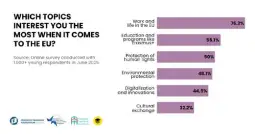
The greatest interest among youth regarding EU-related topics lies in the opportunities for work and life in the EU, selected by 76.2%. This is followed by education and youth programmes such as Erasmus+ (55.1%); in third place, human rights protection (50%).
Additional areas of interest include environmental protection (48.1%), digitalisation and innovation (44.5%), and cultural exchange (32.2%).
In response to the question, “If given the opportunity, would you like to participate in dialogue with representatives of the EU?”, a notable 41.6% said yes, indicating openness to direct communication and engagement.
However, 30.5% opted against participating in such dialogue, and a similar number (27.9%) said they are currently unsure. These results once again highlight significant space for EU-led proactive measures to stimulate dialogue with youth from EU candidate countries.
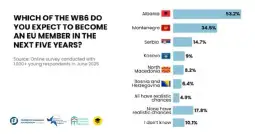
When asked which of the WB6 is most likely to become an EU member within the next five years, young respondents from North Macedonia most frequently answered Albania (53.2%), followed by Montenegro (34.5%) and Serbia (14.7%). All other countries were ranked below 10%.
Only 8.2% believe that North Macedonia will join the EU within the next five years - sending a clear signal and alarm, especially to domestic institutions and public office holders, to take tangible actions to quickly restore confidence in the European perspective and fully address the roots of Euroscepticism among youth.
“These results are a serious alarm and a call to action. If young people in EU candidate countries are not offered real opportunities, stability, and understanding, they may increasingly stop seeing the future of their country in the EU. A new, honest, and closer communication with youth is needed - strong partnerships between the EU and the EU candidate countries with youth at the centre, alongside concrete economic and democratic support that is truly broad and accessible to every young person,” stated Bojan Kordalov, communications expert and Director for Policy and Communication at the European Centre of Excellence (ECE) based in Brussels.
The survey was completed by over 1,000 young people from North Macedonia, 81.5% of whom are current undergraduate or postgraduate students. It was conducted in cooperation with the youth platform “Studentarija” and represents part of an ongoing research process that will result in a thematic policy paper, including concrete recommendations for national and EU institutions on how to effectively address Euroscepticism among young people in EU candidate countries.
According to the publication, for the country to successfully continue on its European path, it is essential to foster inclusive mechanisms that empower youth to engage in democratic life.
“This includes strengthening youth centres, formalizing participatory channels, and integrating young people into policy-making processes. EU institutions place strong emphasis on the active involvement of youth as a cornerstone of democratic resilience, social cohesion, and sustainable development. Efforts to reinforce institutional trust and combat corruption remain equally critical in addressing the root causes of public scepticism and advancing the country’s EU membership perspective,” it is stated in the publication.
The publication was launched last week in Brussels, while its Skopje promotion is scheduled for the end of the month. It is to be presented to members of Parliament, the civil and youth sectors in the country, and delivered to government institutions and officials.
Photo: Publication “Countering Youth Euroscepticism in the Western Balkans: The Case of North Macedonia”


