Dimitrovski in Trieste: Western Balkan countries an integral part of European architecture of stability

Skopje, 17 March 2026 (MIA) - Deputy Minister of Foreign Affairs and Foreign Trade Zoran Dimitrovski, who participated Tuesday at a conference in Trieste marking the 30th anniversary of the Central European Initiative (CEI) - Executive Secretariat, said that the European Union and the Western Balkan countries are interdependent, adding that security is not a one-way street. According to him, these countries are not the periphery of the continent, but an integral part of the European architecture of stability, and therefore, the integration of the Western Balkan countries is not only a political goal, but a strategic necessity for Europe as a whole.
The event was held under the auspices of the Italian Government and promoted by Antonio Tajani, Deputy Prime Minister and Minister of Foreign Affairs and International Cooperation of Italy, in consultation with Oana Țoiu, Minister of Foreign Affairs of Romania, as the CEI Presidency, the Ministry of Foreign Affairs and Foreign Trade said in a press release.
The conference, it adds, convened under the theme "Thirty years of cooperation and commitment: Turning Policy into Action", with a focus on regional connectivity, regional cooperation, and European integration as key prerequisites for the stability, security and economic development of Europe.
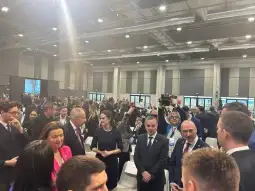
Dimitrovski pointed out that North Macedonia is fulfilling its commitments. The country is aligning legislation, fully adhering to the EU's foreign and security policy and actively contributing to regional stability.
"Reciprocal support is necessary now. It should come in the form of concrete integration measures, such as SEPA, roaming, green corridors and infrastructure development. The real facilitation of the four freedoms - capital, goods, services and people, is not a symbolic act. It is the foundation of economic convergence and improving the living standards of citizens," said Dimitrovski as cited by the Foreign Ministry.
As part of the conference, Dimitrovski met with colleagues from the participating countries, including the State Secretary for Security Policy at the Hungarian Ministry of Foreign Affairs and Trade, Péter Sztáray.
"Talks centered on the intensive cooperation that the two countries have been developing in the past period towards reaffirming strategic partnership, joint commitment to promoting dialogue and further boosting sectoral cooperation. Interlocutors particularly highlighted excellent economic ties, confirmed by the fact that Hungary is among the ten largest trading partners and investors in North Macedonia," reads the press release.
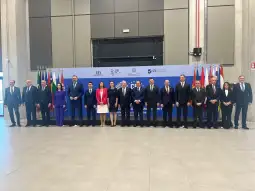
The CEI, it adds, has been a significant bridge connecting regions, institutions and policies for the past three decades. Established in 1989, it gathers 17 member states and is considered as one of the oldest and most inclusive regional initiatives on the European continent, successfully connecting EU member states with candidate countries and transforming political goals into concrete results on the ground.
Photo: Ministry of Foreign Affairs and Foreign Trade


