Strážay for MIA: North Macedonia has bitter experience with bilateral issues in EU accession process, requests can’t go on forever, EU authorities should step in

Neda DIMOVA PROKIKJ
Skopje, 30 November 2025 (MIA) - North Macedonia has a very bitter experience with the inclusion of bilateral issues into the EU integration process. You have been applying for the membership for decades already, you are tired of these processes, but I think that the momentum needs to be used, but also the governments really shouldn't give up when it comes to the implementation of important reforms. What is now threatening the enlargement process are the bilateral issues that are being introduced in the enlargement process. I think that because of the voting procedure in the EU, this is really a problem for some of the countries, including yours, and it can continue to be a problem for the EU enlargement process if the voting procedure doesn't change in the future, the director of the Slovak Foreign Policy Association (SFPA), Tomáš Strážay, told MIA in an interview.
Regarding the increasingly louder proposals for EU membership of candidate countries without full decision-making rights and the right of veto, in order to speed up the enlargement process and whether it is realistic, Strážay said he fully backs gradual accession of the candidate countries.
“Well, I would say that we can call it a gradual accession, gradual integration, or we can use other names, because several studies have been written about this process of gradual integration of the candidate countries to the European Union. I am fully supportive to this and I think that the countries should be given actually the possibilities to be integrated at different stages to the European Union in order to take part or at least have sort of a decision-making power in the European Union or at least observatory status that would enable them to actually have the direct impact on the decisions that are not only applied on them, or considering them, but the future enlarged European Union as such. So this is one of the proposals that I am really not able to forecast whether this is going to be realistic or not, but I think that the momentum is here. Even some dates have been already set up for the possible future enlargement. But on the other hand I think that the preparedness of the individual Western Balkan countries is also important. And they need to implement and do their homework,” Strážay said.
Particularly for North Macedonia, he added, who has been preparing for the process for decades.
“You are tired of these processes, but I think that the momentum needs to be used, but also the governments really shouldn't give up when it comes to the implementation of important reforms because these reforms – be it judiciary reform or anti-corruption reforms – are necessary for the future development of the country. The coin has two sides, and I think that both sides need to do their best to deliver, but the momentum on the EU side seems to be there. There are signals of course, and also proof, I would say, that the union is considering enlargement again to be a priority,” Strážay stressed.
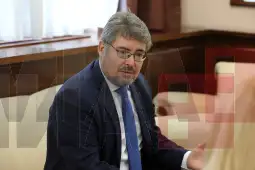
Asked about the inclusion of bilateral issues in the accession process, Strážay noted that North Macedonia had a bitter experience with bilateral issues in the EU integration process.
“You changed the name of the country. You have the Prespa agreement, several rounds of negotiations with Bulgaria and with the EU have been taking place. Now I think that it's really up to the EU authorities and other member states to convince our Bulgarian friends that Macedonia showed the will to actually somehow incorporate the conditions and the requests of the Bulgarian side. But it also has its limits. It can't go forever – the requests and the requirements. So, in this case, I think that the work hasn't been finished yet, and it's the role of the EU authorities to step in and to try to convince again the Bulgarians that actually Macedonia is on the right track,” Strážay said.
According to the SFPA director, it should also be seen whether the Macedonian authorities have chosen the proper approach to the issue. He noted that the authorities in Skopje can try to approach the Bulgarian government with a clear request to solve the situation forever.
Strážay also said it is a real problem that the future membership of any candidate needs to be approved by all EU members, with a single country the opposes the accession of the candidate being able to slow down the process or even stop it for a while.
In the interview, Strážay stressed that EU membership is perhaps the only possibility for the Western Balkan countries to develop and become prosperous and democratic countries in the future.
“Yes, the EU made some mistakes in the past. For instance, there was a time when EU integration or enlargement was not considered to be a priority, it wasn't among the priorities of the European Commission. Now the situation is different, so let's learn from our mistakes, but don't be so critical towards the EU because I think that the process of EU integration is also developing continuously. And what is now threatening the enlargement process are the bilateral issues that are being introduced in the enlargement process. I think that because of the voting procedure in the EU, this is really a problem for some of the countries, including yours, and it can continue to be a problem for the EU enlargement process if the voting procedure doesn't change in the future,” Strážay said.
Asked whether there is a preference for enlargement to the east because of the geopolitical situation and considering certain Western Balkan candidate countries, like Serbia and Montenegro, have been negotiating for more than a decade, Strážay said this isn’t the case.
“I think that it's a positive signal that the countries from Eastern Europe also have interest to join the European Union, including Ukraine and Moldova. For the moment, we just have these two countries. And I think that the EU and the officials have already said several times that the merit-based approach should be maintained, which means that also Ukraine, despite the fact that it is facing very difficult conditions regarding Russia's aggression and a full-scale war against it, should actually implement the necessary reforms. There is a report on Ukraine showing that there are some deficiencies and where the reform process should speed up. So, I don't see any preference for any of the candidate countries,” Strážay told MIA.
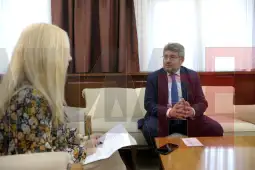
On the contrary, Strážay stressed, when the most prepared countries are mentioned, it is always either Montenegro or Albania, both from the Western Balkans.
“In order to diminish these fears, some of the EU member states actually joined the group of Friends of Western Balkans. It's an informal grouping in the EU where Slovakia also takes part, and I think that it was built upon the Austrian proposal not to forget about the Western Balkan countries and exactly the candidates that have been negotiating or trying to accede to the European Union for decades. So, I wouldn't be nervous because of this. I think that the merit-based approach would prevail. No one is really going to differentiate between the Western Balkan candidates and Eastern candidates,” Strážay said.
He noted that enlargement is a priority for Slovakia’s Government, adding that the recent official visit of Slovak President Peter Pellegrini is a signal that North Macedonia is considered a well-prepared candidate for future EU membership, and a country that Slovakia will back together with other applicants.
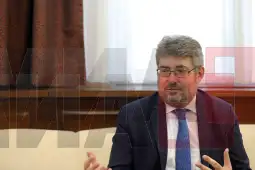
Regarding regional cooperation and whether regional economic initiatives could serve as a substitute for EU membership, Strážay said regional cooperation is really important and one of the prerequisites for EU membership of the Western Balkan countries, but they can in no way substitute the accession process.
“These are complementary processes, not that the one excludes another one and vice versa. I think that for economic development, it is very much important to increase the level of regional cooperation and the growth plan for the region provides some incentives and some possibilities to deepen the cooperation,” the Slovak expert told MIA.
He also pointed to other regional initiatives such as the Regional Cooperation Council and the Berlin Process, which, he said, had some economic impact on the region.
“The integration of the markets of the countries of the Western Balkans into the single market is an important challenge. It will bring advantages to the countries but to the European Union members as well. But maybe the first step would be to deepen regional market as it happened in Central Europe prior to the accession,” Strážay underscored.
Photo: Frosina Naskovikj


