Roundtable: Country will need 57 years to achieve gender equality at current pace

Skopje, 27 October 2025 (MIA) – Women in North Macedonia are still seen as the ones who should care for the family, while men are viewed as those who should earn income. Prejudices and stereotypes prevail, and at the current pace of closing the existing gender gap, the country will need 57 years to achieve gender equality, concluded speakers at Monday’s roundtable discussion on advancing gender equality in leadership and management organized by Women on Boards Adria (WOBA) and the European Investment Bank (EIB) at the Economic Chamber of North Macedonia.
Addressing the discussion, Minister of Energy, Mining, and Mineral Resources Sanja Bozhinovska said there are currently three women ministers in the government, five deputy ministers. The country also has a female president, and it had a female National Bank governor, Bozhinovska noted.
“In North Macedonia, we are taking concrete steps to align with the EU Directive on women in corporate boards and to strengthen the role of women in decision-making processes within public institutions and state-owned enterprises. However, we also acknowledge that transformation demands more than regulation – it demands representation, mentorship, and courage,” Bozhinovska said.
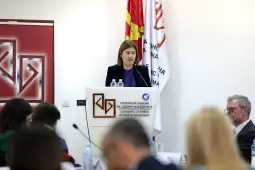
She added that this is a discussion about power – who holds it, how it is shared, and how to build systems where women are not the exception but the norm in leadership.
“As ambassador of the Women on Boards Alliance for North Macedonia, I deeply believe that gender equality is not just a matter of fairness, but a matter of progress. The data is clear: companies with diverse leadership perform better, innovate more, and build stronger trust with their communities. But we also know that laws and policies alone cannot change culture. Commitment is needed – from governments, businesses, and each of us – to open doors that have been closed for far too long,” Bozhinovska stressed.
At the roundtable it was stressed the EU’s Gender Balance on Corporate Boards Directive outlines two clear compliance pathways for listed companies: by 30 June 2026, either at least 40 percent of non-executive director seats or 33 percent of all board positions must be held by the underrepresented sex. The directive also requires annual reporting, corrective measures, and, where necessary, sanctions such as financial penalties or annulment of appointments that do not comply with the regulation.
In his address, the European Union’s Ambassador to the country, Michalis Rokas, said North Macedonia as an EU candidate country has made efforts to advance gender equality by increasing women’s participation in political and public life, but noted that implementation is still uneven.
“The recent elections showed that. Things could have been done much better, but that is our goal – to work together to advance the integration of the gender perspective. Together, we can intensify North Macedonia’s efforts to align with EU legislation on strengthening women’s leadership,” Rokas noted.
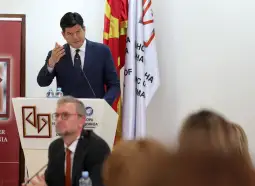
According to the Ambassador, the lack of gender-sensitive policies hinders the advancement of women.
“Training, leadership, mentorship, and gender-sensitive budgeting are needed to achieve meaningful change, and all of this requires partnership between governments, businesses, and civil society,” the EU Ambassador said.
Rokas added that political will is essential for gender equality.
“Gender equality is not just a political goal – it’s about collective progress. Women must have a seat at every decision-making table. Our societies can no longer afford to leave half of their potential untapped, that is a sign of maturity. Full participation of women in leadership across all sectors – politics, business, and civil society – is essential for building an inclusive and sustainable future. This issue is fundamentally tied to EU values. When women take on leadership roles, institutions become more transparent, accountable, and responsive to the needs of the citizens. Leadership with gender equality delivers better outcomes in the management and sustainability of businesses,” Rokas said.
Tanja Mihajlovska-Dimitrievska, WOBA’s lead ambassador for North Macedonia, said the country has the talent, but lacks the legal mechanism that will ensure that gender balanced boards are the rule, and not the exception.
“In North Macedonia, women hold only about one in five seats on the boards of listed companies, a figure that has barely changed in nearly a decade. This is not a reflection of capabilities, but of opportunities. We’re already seeing how Montenegro’s new approach, which links goals with implementation, is delivering results. The experience of European countries that have introduced legal requirements for more women on corporate boards shows clear progress not only in gender equality, but also in corporate results, resilience, and stability. For North Macedonia, this is a decisive moment, it’s time to turn principles into action,” Mihajlovska-Dimitrievska concluded.
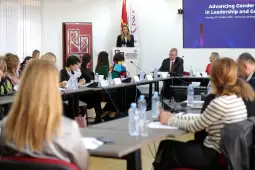
The Governor of the Central Bank of Montenegro, Irena Radović, also addressed the discussion, touching upon Montenegro’s progress in promoting gender equality in leadership.
“Leadership means building trust through integrity, ensuring stability in uncertain times, and creating space for new perspectives in management. As governor, I am committed to promoting inclusive growth and financial resilience, as well as creating opportunities for more women to participate in shaping decisions at the highest levels of economic and monetary governance,” Radović stressed.
Carmen Niethammer, senior gender specialist at the EIB, explained why the issue matters for both growth and management.
“Women’s leadership is also crucial for climate action. Companies with at least 30 percent women on their boards significantly outperform competitors in the ambition and transparency of their climate policies. When more perspectives reach decision-making bodies, companies identify risks earlier, support stronger strategies, and attract talent. At a systemic level, this leads to higher productivity and stronger economies, which is why we integrate gender aspects into our financing, advisory, and climate operations,” Niethammer said.
One of the conclusions highlighted by the roundtable was that achieving gender equality within corporate leadership structures can increase Europe’s GDP by up to EUR 3 trillion by 2050.
Photo: MIA


