Progress in therapy for people living with HIV, prevention and treatment in the focus: conference

Skopje, 1 December 2025 (MIA) – Acting according to a government decision, this year the Health Ministry for the first time conducted a multi-year supply of antiretroviral drugs, thus providing therapy until mid-2027 and at the same time, we upgraded the choice of therapy according to the latest recommendations of the World Health Organization (WHO) and the European AIDS Clinical Society (EACS). By doing so, we have strengthened the quality, continuity and health protection of all people living with HIV. Due to the limited budget, we have managed to maintain preventive services and testing services for HIV and other sexually transmitted diseases, especially for young people and the at-risk communities, Deputy Health Minister Jovica Andovski said Monday opening the HIV National Conference marking World AIDS Day (December 1).
“The Health Ministry has been continuously implementing the program on protection of the population against HIV, one of the most complex, most sensitive and most important public health issues in the country. It involves numerous stakeholders, public institutions, health institutions and 13 civil society organizations, whose capacity and expertise are crucial. The program involves prevention and treatment and it helped us provide modern, safe and quality therapy for a total of 459 people living with HIV,” said Andovski.
The Deputy Health Minister said the civil organizations in 2024 provided preventative services for 7,453 people with 1,086 tests being performed that identified eight new HIV cases. They were all assigned antiretroviral drugs, he noted.
“The Health Ministry and the government remain fully committed to the goals aimed at ending the HIV epidemic,” Andovski stated.
To reduce HIV infections, a comprehensive approach is needed, which involves the primary health protection, predictable finances, services, and to improve the workforce so as to make social and structural changes in this field, said Swiss Ambassador Christoph Sommer speaking before the conference.
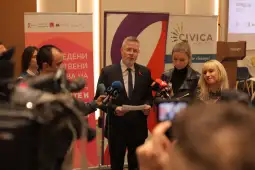
Switzerland, he noted, is a long-term partner of the civil organizations in the country through the Civica Mobilitas program.
According to Dr. Akeem Ali, World Health Organization Representative and Head of the Skopje Office, today’s conference is key in marking World AIDS Day.
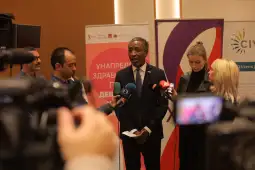
“More than 500 people live with HIV in this country. Globally and within the EU, after the Covid-19 pandemic it became evident that there is still room for actions aimed at strengthening public health in the fight against similar infections,” he said.
Ali said they supported the Health Ministry and government’s efforts in the fight against HIV and welcomed their cooperation with civil organization working in the field. Despite the progress, there is still room for more work to be done in raising awareness about the virus, he noted.
Early diagnosis, timely therapy and sustainability of preventative programs is in the focus, said Olivera Stojkvska, program manager at HERA – Association for Health Education and Research.

“We, the country, are maintaining a low level of HIV prevalence and our country has made a progress in providing therapy for people living with HIV. Data shows that 90 percent of diagnosed HIV cases receive therapy, and 95 percent of them have successful treatment or 95 percent have suppressed the virus. Our biggest challenge is early diagnosis of the virus. It is estimated that today in Macedonia there are about 700 HIV positive cases, of which 30 percent are undiagnosed. This means that every third person living with the virus does not know that they have it. All of this in a way continues the silent transmission of the virus and makes it difficult to control the epidemic,” said Stojkovska.
Andrej Senih, executive director at the Together Stronger association for support of people living with HIV said the global goal is to end the HIV epidemic by 2030.
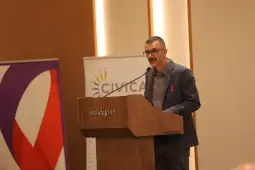 “Continued access to treatment is paramount for people living with HIV, enabling them to live healthy and normal lives and preventing further transmission of the virus. This year, for the first time, 24 months of treatment was provided, significantly reducing the risks of treatment interruption. But to truly halt the growth of the epidemic, we must invest in testing and early diagnosis, so that every newly diagnosed person can receive modern treatment immediately,” stated Senih.
The conference was held as part of the project “Improving the health rights of girls, women and vulnerable groups”, funded by the Swiss government through Civica Mobilitas program.
Photo: HERA


