Popov: Officialization of Macedonian alphabet and the Macedonian standard language not an ‘artificial construct’

Skopje, 10 October 2025 (MIA) - In his address marking 58 years since the founding of the Macedonian Academy of Sciences and Arts (MANU), its President, academician Zhivko Popov, dedicated much of his speech to the 80th anniversary of the codification of the Macedonian standard language (May 5, 1945), which he described as “one of the most important moments in affirming the centuries-long existence of the Macedonian language, culture, and identity.”
Popov highlighted the research on the Macedonian language by foreign Slavists in the 19th century, who had already recognized its “distinct individuality within the South Slavic language group,” and noted that the Macedonian language “served as a national language even before it was made official by the decision of the First Session of ASNOM.”
“We can confidently argue that the official recognition of the Macedonian alphabet and standard language is not some ‘artificial construct,’ but rather a logical outcome of the centuries-long spatial and temporal continuity of the Macedonian language and its dialects across the entire linguistic territory… However, the struggle to preserve the Macedonian language is not over, it must continue before international human rights institutions, because its official use by parts of the Macedonian people in neighboring countries has been obstructed by obligations undertaken through signed international agreements,” Popov stressed in his address.
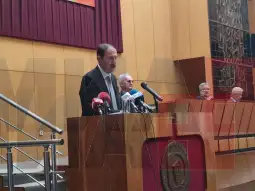 Popov emphasized the efforts of MANU’s founders, highlighting among them academicians Blazhe Koneski and Bozhidar Vidoeski, who, he said, “made a lasting contribution to preserving the tradition of the Macedonian language and securing its future through continuous nurturing, study, and affirmation in broader external contexts.”
He pointed out that for 55 years MANU has been implementing the project “Macedonian Scientific and Professional Terminology,” initiated by Koneski at the very founding of the Academy.
“It is very important that this terminology be applied in the drafting of laws and regulations in our country, but it must also be used when translating the EU acquis into Macedonian. That’s why we hope the Parliament and the Ministry of European Affairs will recognize the importance of using harmonized terminology prepared by top researchers in their fields in collaboration with leading linguists. With consistent application of the defined terms in education, in professional and scientific publications, as well as in administrative documents and everyday life, we will prevent the influx of foreign words that are not in the spirit of the Macedonian language,” Popov said.
In the year that marks 80 years since the codification of the Macedonian language, the president of MANU underscored that “it is with regret that we must note that the Macedonian language, along with Montenegrin, is the only national language in Europe without its own national or reference corpus.”
“That is a major oversight that must be corrected. Therefore, the Academy will begin work on creating such a corpus that all language researchers can use. Corpora are large collections of linguistic data and are essential for the advancement of many subdisciplines within linguistics and serve as a foundation for developing applications based on artificial intelligence. The existence of a national and reference corpus will show us the lexical richness of the Macedonian language and help us rediscover and recall the more forgotten words hidden in the works of Macedonian writers and poets. This will certainly prompt MANU to establish a national center for the digitization of the country’s cultural heritage,” Popov stressed.
These two projects, according to Popov, “will confirm Koneski’s assertion that our language is not poor, but rather that we do not know it well enough, and that a foreign word is not always more appropriate.”
However, such major projects, the head of MANU added, are not possible without support from the state and the relevant ministries.
Photo: MIA


