North Macedonia ranks 51st on Global Peace Index 2025

Skopje, 1 September 2025 (MIA) - North Macedonia is ranked 51st on the 2025 Global Peace Index (GPI), down four places compared to last year, shows the report released by the Institute for Economics & Peace (IEP).
The region of Western abd Central Europe remains the most peaceful area in the world, although it registers a mild drop of 0.57 percent compared to 2024.
In regional terms, Croatia ranks 19th, Bulgaris 29th, Greece 45th, Albania 52nd, Bosnia and Herzegovina 59th, Koisovo 63rd and Serbia 64th.
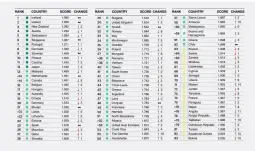
In the global context, the GPI shows that the average country score has deteriorated for 13 of the past 17 years, and has not improved on average in any year since the 2013 GPI.
The average level of country peacefulness deteriorated by 0.36 percent in the 2025 Global Peace Index. This is the sixth consecutive year that global peacefulness has deteriorated.
Iceland tops the list as the most peaceful country, followed by Ireland and New Zealand. Sudan, Ukraine and Russia find themselves on the index's opposite end.
The Global Peace Index ranks 163 independent states and territories according to their level of peacefulness, covering 99.7 percent of the world’s population. It uses 23 qualitative and quantitative indicators to measure the state of peace across three domains: the level of Societal Safety and Security; the extent of Ongoing Domestic and International Conflict; and the degree of Militarisation.
The 2025 GPI finds that global peacefulness continues to decline and that many of the leading factors that precede major conflicts are higher than they have been since the end of WWII. More countries are increasing their levels of militarisation against the backdrop of rising geopolitical tensions, increasing conflict, the breakup of traditional alliances and rising economic uncertainty.
There are currently 59 active state-based conflicts, the most since the end of WWII and three more than the prior year. Last year, 17 countries recorded over 1,000 conflict deaths. Additionally, the successful resolution of conflicts is lower than at any point in the last 50 years. Conflicts that ended in a decisive victory fell from 49 percent in the 1970s to nine percent in the 2010s, while conflicts that ended through peace agreements fell from 23 percent to four percent over the same period.
Conflicts are also becoming more internationalised, making solutions more difficult; 78 countries are engaged in a conflict beyond their borders. This increased involvement is driven by geopolitical fragmentation, increasing major power competition, and the rise in influence of middle level powers, who are becoming more active within their regions. The almost two-decade long trend of falling militarisation has also reversed, with 106 countries having deteriorated on the Militarisation domain in the past two years.
Photo: Screenshot


