National Council for European Integration calls for continuing Reform Agenda process

Skopje, 26 May 2025 (MIA) - At Monday's session of the National Council for European Integration, Minister of Digital Transformation, Stefan Andonovski, presented progress within the Reform Agenda, including key laws and policies in line with European standards, contributing to faster integration of in the European Union.
Andonovski said so far four laws have been adopted that are under the competence of the Ministry of Digital Transformation.
"On the one hand, I have a challenging task. On the other hand, it is a slightly easier task than that of other colleagues, because we are talking about really complex laws and changes in both the institutions and the public administration, as well as in the private sector, yet at the same time these are not political issues. Very often these are issues for the overall progress of Macedonian society. We are talking about amendments to four laws, i.e. adopting two completely new laws and amending two other laws. The first law that I am particularly proud of is the Law on Security of Networks and Information Systems. It stems from our first task within the Reform Agenda. That is the establishment of a comprehensive framework on cybersecurity. We have already successfully completed the first element and that was part of our first engagement. We adopted the national cybersecurity strategy fully aligned with our European and Euro-Atlantic friends in late December 2024. We are the only country that, unfortunately, has not adopted such a law in all these years. This is the first time that this legal framework for cybersecurity has been established. I expect the final phase to be ready by next week and submitted to the Government," said Andonovski.
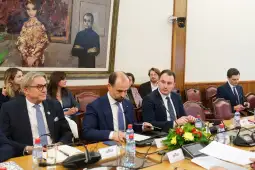
The second law, he noted, is a completely new law on electronic communications that is in line with the Code Directive of the European Union and should enable and facilitate the establishment of digital infrastructure.
"We have made additional effort to amend the Law based on the findings of the Constitutional Court so that we do not end up in a situation where a vacuum arises with annulment or repeal of provisions of the Constitutional Court related to the Law on Electronic Communications. I expect this Law to enter parliamentary procedure in early June," he said.
The Law on Electronic Documents, Electronic Identification and Trust Services will mean enabling electronic identification of citizens.
"This is really important because it will allow us to create a digital wallet, which will mean that all citizens' documents will be available in electronic format, and then introduce electronic digital signing for citizens," said Andonovski.
The fourth law is the Law on Archival Activities, which, as Andonovski said, is not about aligning exclusively with an EU directive or regulation, but rather about enabling electronic archiving.
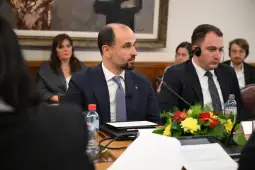
Minister of European Affairs Orhan Murtezani told the National Euro-Integration Council on Monday that the Reform Agenda 2024-2027 arising from the Growth Plan for the Western Balkans is no longer a document on paper but a daily task of institutions and a technical framework of concrete reforms in several sectors. Murtezani pointed out that North Macedonia is no longer a country that plans its European integration, it is already implementing it.
Execitive Director of the Economic Chamber, Antoni Peshev said the Ministry of Digital Transformation should continue in the direction of reforms at twice the speed, not because Macedonia needs reforms only for EU accession, but, as he noted, because the country needs reforms immediately for the functioning of the state as a functional body.
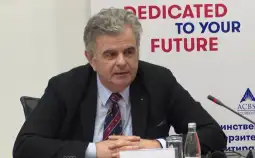
He appeals to the competent institutions in the country not to interrupt the reforms, but to multiply them, accelerate them and regulate.
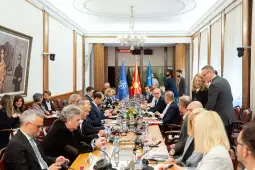
Chair of the National Council for European Integration, Venko Filipche, pointed out that the council is an excellent opportunity and platform to unite the capacities of all stakeholders in the country, not only political parties, but also the civil sector, universities, science, various foundations that participate in the process. He believes that by uniting the capacities, the European integration path can be accelerated and the quality of that process can be increased, given the expertise of all who can contribute.
"The goal is really constructive. The idea is good. I hope we will succeed in developing that platform. We have many challenges on the integration path. One of the challenges is political consensus regarding the process of constitutional amendments. I came up with a proposal for a leaders' meeting a few days ago, the idea of which was to discuss several things that I believe require an appropriate and common interpretation. First, there is part of the protocols in the French proposal, regarding the work of the history commission, the interpretation of whether or not it is a reason to stop the negotiations at a given moment, then the possibility that perhaps the work of the history commission could be upgraded with the presence of experts from other countries such as Germany, Poland and Austria who have experience in such work in their countries, and to avoid subjectivism in the work of that commission as much as possible. I will not stop being constructive in that part and in finding proposals, proposed solutions on how we could jointly unblock that part of the European integration path," said Filipche.
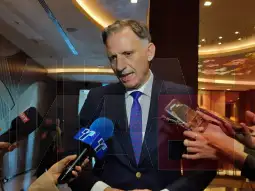
European Front MP, Ilir Demiri, thanked the Ambassadors of Poland and France for the support they give to the country on the path to the EU. According to Demiri, the process of integrating the country in the EU is blocked and there is no interest in reform progress in the country. He noted that accelerating the convergence of the economic and sociological part is in the national interest and will bring many benefits for integration in the common market and this is a significant challenge for Macedonia which requires major reform and not only structural changes.

Alliance for Albanians MP, Halil Snopche, said it is good to hear there is optimism and reforms are being implemented, laws are being prepared. He pointed out that such discussions are very necessary, but without any effect and value if "we do not open the topic and do not seriously discuss the constitutional amendments and the need for consensus".
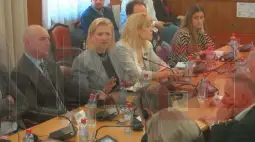
VMRO-DPMNE MP, Ivanka Vasilevska, said she was very disappointed to hear that in such a complex debate, there is a message from the opposition leader that will not only extend the agony with the history commissions, but will put new ideas on the table without seeing all the consequences, and thus destroy the dignity of Macedonian science and Macedonian scholar and researchers.

ZNAM Movement MP, Vesna Bendevska, said for them it is very important that the country becomes an equal member of the EU under equal conditions as all other countries that have become members by respecting the Copenhagen criteria.
At the beginning of the session of the National Council for European Integration, Filipche expressed regret over the absence of Justice Minister Igor Filkov, noting that he had decided not to attend the session despite being timely notified and despite being one of the key ministers responsible for the work on the Reform Agenda, very important laws in the field of justice.
VMRO-DPMNE MP Antonijo Miloshoski also criticized Minister Filkov for the absence. He pointed out that it is the obligation of ministers to attend the working activities of the Parliament.
Photo: Ministry of European Affairs/ Minister Stefan Andonovski Facebook / print screen


