Murtezani: Copenhagen criteria must remain guiding principle of enlargement

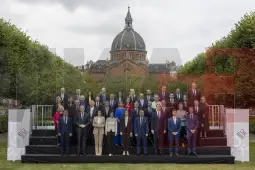
Copenhagen, 2 September 2025 (MIA) - North Macedonia is fully committed to the implementation of the Copenhagen criteria, which must remain the guiding principle of the EU enlargement process, said Minister of European Affairs Orhan Murtezani on Tuesday in Copenhagen, during his address at the informal meeting of European affairs ministers from EU member states and candidate countries.
“For us, they [the Copenhagen criteria] are not just conditions, they are the language of democracy and a guarantee that our progress will be measured by fair and objective standards, not by bilateral obstacles that do not belong to the core of the European idea,” Murtezani said during his address at the first working session of the meeting, dedicated to the importance of the Copenhagen criteria and gradual integration in accelerating the EU enlargement process.
According to the Ministry of European Affairs, Murtezani stressed that the country’s path to the Union isn’t a “technical exercise in alignment”, but a strategic necessity for the stability and security of the entire continent.
The Minister noted that more than two decades after the Thessaloniki Declaration, the region’s European perspective mustn’t remain an unfinished project, as each new delay not only undermines the Union’s credibility, but also weakens its strategic role in an increasingly uncertain geopolitical environment.
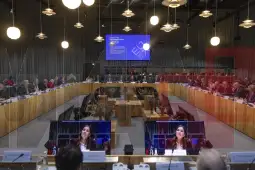
Minister Murtezani touched upon the concept of gradual integration, noting that it isn’t a substitute for full membership, but rather a bridge that preserves the credibility of the process until full membership is achieved.
He stressed that the benefits of this policy can already be felt through the participation of students in the Erasmus program, access to the Single Euro Payments Area (SEPA), and growing integration into the single market.
According to the Minister, the process must be deepened through gradual inclusion of candidate countries in the European Semester, in the rule of law mechanisms, in the Union’s agencies and programs, as well as through stronger cooperation in the area of common security and defense policy.
Murtezani also stressed that the country has confidence and clear commitment that the future of the Western Balkans lies within the European Union, stressing that the enlargement process should not be seen as a formal expansion of borders, but as the completion of the European whole, which makes the Union stronger, more stable, and more resilient.
In his address, the Minister added that the European path of the Western Balkan countries is an inseparable part of the continent’s security and credibility, and that adherence to the Copenhagen criteria remains the strongest guarantee that this path will move in the right direction.
In a statement ahead of the meeting, Murtezani said since the beginning of Russia’s invasion of Ukraine, the European Union is more interested in accepting new members.
“What we should do now is make sure that the effort we are putting in will bear fruit as soon as possible. I think that all candidate states from the Western Balkans can become EU members by 2030,” Murtezani said.
In addition to the session on EU enlargement, the meeting also included a session dedicated to strengthening the Union’s tools for the rule of law, attended only by ministers from the member states. The meeting is scheduled to conclude with a working lunch focused on the EU’s preparations for the enlargement process and the internal reforms within the bloc necessary to support it.
Photo: Ministry of European Affairs


