Mickoski on Waitz report: We overcame the first hurdle, report expected at EP plenary session between July 7 and 11

Skopje, 24 June 2025 (MIA) - Following Tuesday's adoption of MEP Thomas Waitz’s draft-report on the country by the European Parliament’s Committee on Foreign Affairs (AFET), Prime Minister Hristijan Mickoski spoke of an “intense” fight to overcome the “first hurdle”, which, he said, shouldn’t have existed, considering the statements made by certain politicians from Brussels suggesting that the Macedonian language and identity are closed issues and pose no problems.
Mickoski said the developments surrounding the report have shown that the opposite is true – that the country is still fighting for its identity and native tongue in 21st century Europe.
“We know that the struggle to overcome this first hurdle was intense, a hurdle that shouldn’t have existed in the first place if you listen to the messages from certain politicians coming from Brussels, who said that identity has never been a topic of agreements and discussions, that the language has never been a topic of agreements and discussions, that it was cemented, sealed, a closed matter. We saw that this is not the case. The Macedonian and European public saw that this is not the case, that in 21st century Europe we are still fighting for issues of identity, for our native tongue, etc.,” Mickoski said when quizzed if he thinks the report would be adopted at a plenary session considering the amendments submitted by several parliamentary groups.
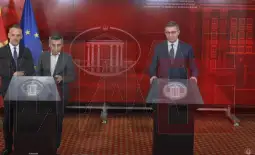
AFET adopted the draft-report on Tuesday with 40 votes in favor, 19 against and 10 abstentions. Mickoski pointed out that the report is expected to be on the agenda of a plenary session of the European Parliament between July 7 and 11.
“Yes, there will be amendments and again perhaps certain groups in the Parliament will back some amendments. These are the procedures, and you can’t stop them. But what matters is that you all saw that this is not an issue of including several hundreds of Bulgarians in our Constitution, that the issue is deeper and decades and centuries old. We will fight. I don’t know if we will succeed. We succeeded in the first step, but I don’t know if we will succeed. However, the citizens saw what we are facing and what the main topic is. This was the point,” Mickoski said.
Regarding the proposed amendments, Mickoski said it isn’t true they were put forward solely by the European People’s Party (EPP), which ruling party VMRO-DPMNE is a member of, but that it was a joint proposal by four groups in the European Parliament: “EPP, the Social Democrats, the Liberals, and the Greens”.
“Because they came to an agreement during a coordination meeting before the session. I don’t want to talk about this too much now until the job is done. I know all the details,” Mickoski said.
Quizzed if he expected the EPP to back an amendment to add the adjective “modern” before the Macedonian language in the report, Mickoski said Bulgarian MEP Andrey Kovatchev is a member of the EPP and it was logical to expect this.
“During the vote, 15 MEPs from the EPP supported the Waitz report, including AFET Chair, Mr. McAllister, three were against and two abstained – those were the Greek MEPs. This was the vote within the EPP. We have the names, we know exactly how everyone voted, what was voted on, who we spoke with, and everything that happened over the past few weeks. It’s good that we crossed this first hurdle, and it’s good that everyone saw that the point isn’t adding several hundreds of Bulgarians to the Constitution, that the point is much deeper. And I will repeat, I don’t know if we will succeed at the plenary session. We have two weeks of intense fighting ahead of us. But the world and Europe saw this. And this issue will now be raised in The Hague as well, and at all future NATO sessions. Another question that needs to be answered is whether a NATO member state is obstructing another member state’s integration, thereby undermining regional security,” Mickoski stressed.
MIA file photo


