Macedonia's reform capacities always there, EU political will needed to accelerate enlargement process, Siljanovska Davkova and Milatović tell law students

Skopje, 1 April 2026 (MIA) - Macedonia has implemented many things that the European Union asked of it, the country has always demonstrated its reform capacities but it has still not started the accession negotiations, and it has fallen into a form of political abandonment within the Union, a lack of political will to accelerate the process, said President Gordana Siljanovska Davkova and Montenegrin counterpart Jakov Milatović in a lecture dedicated to the EU integration of the Western Balkans at the Faculty of Law "Justinian I" within Skopje-based University Ss.Cyril and Methodius on Wednesday.
The two heads of state referred to the significance of Euro-integration, the benefits for countries within the accession process relating to the transformation and democratization of the society, political and geopolitical obstacles, state of play in the Union itself, and the need for integration of the Western Balkans, while agreeing that countries most often join the EU out of political rather than economic reasons, while problems of candidate-states are better solved from the inside than outside.
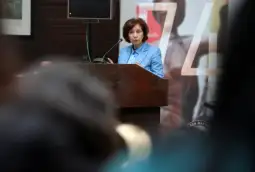
"We hold the record in constitutional changes - 36 times to date. We also hold the record, excluding Turkey, for waiting, because we received the candidate status in 2005. Back in 1992, the Badinter commission set up by the European Commission held that Macedonia and Slovenia met the conditions to be recognized by the EC. Yet, Macedonia is still waiting. In 2019, the EU almost reached consensus for us to start the negotiations alongside Albania, but Denmark and the Netherlands said 'no'. We have always demonstrated reform capacities, regardless of the party in power, and we are still showing this, considering annual reports that I analyse and compare with other candidates, barring Montenegro. Still, we have not started the accession negotiations, we have still not opened the most important Fundamentals cluster and other chapters," said President Siljanovska Davkova in her address.
The President said it is important to take into account the current environment within the EU, with the latest Civil Liberties Law Report showing that progress in the rule of law has only been recorded in two EU member-states (Lithuania and Latvia), with no progress or regression in others.
"That is why I always point to the authoritarian tendencies not only in the countries arising from socialism but in EU members as well. Wars always push these tendencies to the forefront. There is no such thing as military democracy," said Siljanovska Davkova.
_S69qjZhII/placeholder.webp?use_watermark=1 "Заедничко предавање на претседателите Сиљановска-Давкова и Милатовиќ на Правниот факултет „Јустинијан Први“")
She added that in many cases, countries join the EU out of political rather than economic reasons, although the EU project is based on the European Economic Community.
"In terms of the current conflict, we are not talking about a phenomenon of enlargement but a strategic necessity, a geopolitical need for Europe's unification, so that the EU can be competitive on the global stage, a multipolar stage that has many unpredictable factors and players," said Siljanovska Davkova.
The President noted it is equally important for the EU to integrate the Western Balkans, thus putting an end to the artificial classification of West vs. East.
_pugsqlHPk/placeholder.webp?use_watermark=1 "Заедничко предавање на претседателите Сиљановска-Давкова и Милатовиќ на Правниот факултет „Јустинијан Први“")
"We are not a problem for the Union's absorption capacity. We are located on a very specific crossroad between the East and the West. Our accession will put an end to this artificial classification that is tied to the Cold War and the preceding period," said Siljanovska Davkova.
She added that the Western Balkans' accession would complete the story, "so there is no difference between the European Union and Europe".
Siljanovska Davkova said EU's founding treaties read that the Union shall respect the national and cultural identity of all nations and states, dignity and integrity of all citizens.
_gIflDDJPh/placeholder.webp?use_watermark=1 "Заедничко предавање на претседателите Сиљановска-Давкова и Милатовиќ на Правниот факултет „Јустинијан Први“")
Montenegro President Milatović said the country has opened 33 negotiating chapters and managed to close some of the key ones - procurement, justice, fundamentals, financial control etc.
Milatović referred to four potential scenarios that candidates face on their EU path, defined by two factors - the Union's political will to receive new members and the political will of the candidate to implement the reform agenda.
The first scenario is that the candidate fails to use this process for democratic and institutional progress, and as a result, the EU does not want to admit it. The second one is when a country uses the accession process in a productive way - builds institutions, enhances its democratic standards and fights - but the EU does not show political will to accelerate the integration process.
"Your country was in such a scenario in the past. North Macedonia did many things it was required to, but the EU did not show the political will to speed up the process. This is a lose-lose scenario and subsequently, optimism in the country turned into a pessimistic narrative," noted Milatović.
The third scenario, he added, is when the candidate does not use the accession process to make progress from a democratic and institutional standpoint, but the EU has the political will for the country's progress due to geopolitical reasons, as was the case with Romania and Bulgaria.
_8Jncl2Bqg/placeholder.webp?use_watermark=1 "Заедничко предавање на претседателите Сиљановска-Давкова и Милатовиќ на Правниот факултет „Јустинијан Први“")
"This scenario is not good as well, because candidates do not fully utilize the accession process for institutional and democratic progress, not for the sake of the EU but for the sake of the stability of its own institutions and a better life for its citizens," said Milatović.
He referred to the fourth scenario as 'win-win', when both sides do their part of the job - the candidate using the accession process as something that helps it make progress in the context of its democratic and institutional maturity and economic development, while EU members reward this by full-fledged membership.
"This scenario is the best for the EU and candidates and the one I imagine for Montenegro. Therefore, we must utilize the EU accession process as a way to stimulate reforms and strengthen democracy, expecting us to join the EU as a fully ready and committed member-state. It is now of fundamental importance to use this process to the maximum," said President Milatović and added that Montenegro has set an ambitious but attainable goal - to join the EU by 2028.
Photo: MIA


