Local elections competitive but adversely affected by legal shortcomings and political polarization: international observers

Skopje, 20 October 2025 (MIA) – The 19 October local elections were competitive, providing voters with a genuine choice from a range of political alternatives, but they were negatively affected by systemic legal gaps and shortcomings, limited institutional capacity, as well as political polarization, international observers said in a statement of preliminary findings and conclusions on Monday.
According to the joint observation mission from the OSCE Office for Democratic Institutions and Human Rights (ODIHR), the Congress of Local and Regional Authorities of the Council of Europe (Congress), and the European Parliament (EP), the elections took place against a backdrop disenchantment with politics and widespread perceptions of corruption.
Head of the ODIHR Election Observation Mission, Matteo Mecacci, said while the election administration generally managed electoral preparations efficiently, inconsistencies and gaps in the election legislation, as well as limited resources and outdated infrastructure, adversely affected some aspects of its work.
"It was good to see a competitive campaign over the last weeks and a well-run and mostly peaceful election day yesterday, but gaps in election laws that weaken the work of institutions remain a concern," said Mecacci.
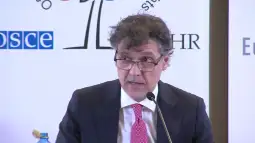
He pointed out that addressing key aspects of the electoral process which require reform - from campaign finance to equitable campaign opportunities in the media for all contestants - will continue to be the focus during the observation of the second-round contests on November 2. Mecacci noted that fundamental freedoms were respected throughout the campaign and candidates were generally able to campaign freely, but instances of misuse of public resources and reports of alleged pressure on public sector employees and intimidation of voters and opposition candidates, as well as vote buying by political parties, were also of concern.
Public funds make up a significant share of overall campaign financing, but the distribution formula significantly favoured major parliamentary parties to the exclusion of smaller parties with a parliamentary group, and offered only limited opportunities to other small parties and independent candidates, reads the statement.
Systemic gaps in the legal framework regulating campaign finance combined with the limited capacity of the country’s oversight bodies hindered effective scrutiny of campaign finance, it adds.
"The legal framework provides a technical basis for conducting democratic elections. However, it contains numerous gaps and lacks clarity in several areas, which at times has led to divergent interpretations. While the 2024 amendments to the Electoral Code addressed some previous ODIHR and Congress recommendations, most remain unaddressed. Additionally, in May 2025, the Constitutional Court repealed provisions on the number of supporting signatures for independent candidates, and parliament failed to fill the legal gap in time to complement the legal framework. Subsequently, the State Election Commission (SEC) regulated this aspect by requiring only two citizens’ signatures. While this intervention by the SEC was seen as necessary to regulate an important aspect of the electoral process, it created a precedent that potentially challenges the principle of separation of powers, contrary to OSCE commitments," the international election observation mission notes.
Head of Delegation from the Congress of the Council of Europe, Gobnait Ní Mhuimneacáin, welcomed the fact that election day was overall well-organised, noting however that the low number of women mayoral candidates and the lack of accessibility for voters with disabilities and older people remain serious concerns.
"The absence of local media, particularly outside the capital, is also a major issue, limiting coverage of local issues - which should be central to a local election campaign - and contributing to the prominence of national topics, further polarising the electoral environment," she said.
The statement notes that social media campaigning is largely unregulated, and there is no oversight authority mandated to monitor the campaign on social networks and detect disinformation or manipulative content.
Head of the EP Delegation, Marta Temido, said although European integration was not a central campaign issue, a majority of parties and communities in North Macedonia remain committed to EU membership.
"We listened to all our interlocutors with interest and attention. Although European integration was not a central campaign issue, we understand from most of them that a majority of parties and communities in North Macedonia remain committed to EU membership. We therefore suggest to the newly elected local authorities to advance their country's EU reform agenda," Temido added.
The international election observation to the local elections in North Macedonia totalled 275 observers from 40 countries, made up of 253 ODIHR experts and long- and short-term observers, 15 members and staff from the Congress, and seven parliamentarians and staff from the EP.
Photo: MIA


