Lafchiski: No direct military threat to country, security situation stable

Skopje, 7 September 2025 (MIA) - The security situation in Macedonia and the region is stable and there is no direct military threat to the country. The region is vulnerable to challenges such as disinformation, migration waves and radicalization, which requires a preventative building of resilience and continued monitoring and analysis of security risks. Even though there is no direct military threat, we need to constantly prepare and coordinate our defense measures on all levels, said Army Chief of Staff, Major-General Sashko Lafchiski, in an interview for MIA.
According to the Lafchiski, the NATO defense spending target of 5 percent by 2035, 3.5 of which would be spend on military investments and 1.5 percent on internal security, is positive for the Army and he supports it, however, he noted that it is an ambitious and challenging goal, especially for smaller countries such as Macedonia. The funds, he said, will be used for modernization, further upgrades of existing systems, improvements in command and control capacities, logistical support, combat readiness, ensuring NATO interoperability and strengthening the national defense capacities. A portion of the budget will go toward the development of logistical infrastructure, reserve forces, civil protection, as well as the defense against hybrid threats, cybersecurity, and crisis management.
In the interview, the Army Chief of Staff also provided information about combat equipment, such as the ongoing project for the procurement of light armored vehicles JLTV and Stryker, which will enhance mobility, personnel protection, and firepower, especially for the light infantry battalion group, which is NATO’s top priority. By the end of the year and the beginning of the next, the arrival of MISTRAL-3 air defense systems and short-range missiles is expected, along with BORAN 105 mm howitzers for the artillery battalion. At the same time, efforts are underway to modernize the Army’s cybersecurity and engineering capabilities.
Regarding modern warfare trends, Lafchiski said he believes that drones and unmanned systems are becoming an inevitable and integral part of modern warfware, and are used not only for reconnaissance, but also for offensive operations, logistical support, and cyber activities. This development, he said, requires changes in military doctrines and organizational structures, adding that our Army is already planning to procure these systems in order to integrate them into its capabilities.
The recruitment process for 300 professional soldiers has been temporarily halted due to the local elections, but it will resume soon. According to General Lafchiski, the Army remains attractive to candidates, which allows for the right selections to be made, although there are challenges in filling specialized positions related to modernization. He emphasized that investments in barracks infrastructure are ongoing, with a particular focus on facilities in Shtip, and plans to intensify investments across all garrisons, including Skopje, Prilep, Kumanovo, Tetovo, and Kichevo, in order to improve conditions and standards for personnel.
_WXNym7fpS/placeholder.webp?use_watermark=1 "Лафчиски - Интервју")
Below is the full interview with Army Chief of Staff, Major-General Sashko Lafchiski:
A year has passed since your term began, and there have been many challenges… implementing NATO standards, the war in Ukraine, the war in Israel, Gaza… tensions in the Middle East. Is the region threatened by this war, and how do you assess the security situation in our country?
Allow me, on my own behalf and on behalf of all members of the Army, to welcome you to the General Staff and to thank you for the opportunity to discuss current defense and security topics with a focus on the Army.
Yes, we are living in an exceptionally complex security environment, with many challenges. The war in Ukraine, a war on European soil, something that was once unimaginable. And it’s not just any war, it’s a conventional war of big proportions, enhanced by the use of new technologies and technological advancements. As a region, speaking here more in the context of the Western Balkans and Macedonia as part of it, we are exposed to the challenges that arise as a result of that war. Considering the region's susceptibility to disinformation, fake news, political influence, and the revival of old practices of tensions and conflicts between countries, all of this contributes to our vulnerability as part of this region.
Also, the situation in Israel, the war there, the conflicts in the Middle East can cause something we are very familiar with, new migration waves, which we already have experience with, then the radicalization of certain groups that often find refuge in this region and the country, all of this presents certain defense and security challenges that we need to consider carefully, to analyze them thoroughly and take concrete measures by building preventative resilience not only at the Defense Ministry, not only in the Army, but in all other state institutions. Is there a direct military threat to the country? No, there isn’t. And to answer to your question, I assess the current security situation in the country as stable, but of course it is necessary to conduct thorough analyses and monitor closely the security challenges which are coming from regions where there are wars and conflicts.
An ambitious goal was set at the last NATO summit: every member state should increase its defense spending to 5 percent of GDP by 2035. It is projected that 3.5 percent of this quota will go toward military investments, and 1.5 percent toward internal security. What is your position on this decision and what will it mean for our Army?
You know, as Army Chief of Staff, I should be pleased with this 5 percent, because it would mean a lot for defense. However, I must emphasize that it’s a very ambitious goal and will be a significant burden for the Government and the budget. Five percent for a small country like ours is truly ambitious and challenging. Even more developed countries with established defense development plans will struggle with allocating that amount. So I repeat, it will be quite challenging.
Yes, as you mentioned, 3.5 percent of that will go directly toward the development of military capabilities. This primarily refers to modernization, further upgrades of existing systems, improvements in command and control capacities, logistical support, in other words, everything that directly enhances the combat readiness of the Army, meeting not only NATO requirements but also national defense capacities. All of this contributes to increasing the interoperability and operational capability of the Army, both in the context of NATO capability targets and in strengthening national defense capacities.
As for the remaining 1.5 percent, this mainly refers to areas within the national defense domain, such as logistical infrastructure, roads, railways, etc., development of the reserve forces, civil protection, and all mechanisms related to building resilience, which I’ve already mentioned, particularly in the context of defending against hybrid threats, cybersecurity, and managing various types of crises.
_66ANkT7MJ/placeholder.webp?use_watermark=1 "Foto (8)")
Over the past 12 months, you've met with many of your NATO counterparts as well as with the chiefs of defense of Turkey and Hungary, the Vermont National Guard commander, the KFOR commander and others. Did some of these discussions focus on the latest developments in Europe and the Middle East?
Yes, I have had a few official meetings. I also met with other NATO chiefs of defense at all the conferences I attended, be they regional or as part of our NATO Military Committee duties. You are right, our discussions have focused on the current security situation. We often discuss how to improve our own national defense capacities and the NATO defense capacities with the aim of better responding to these challenges as states, as a region and as NATO. These meetings are important not only for me but also for my colleagues, I believe, given that we exchange experiences and approaches to problems and challenges facing us in developing our defense capacities. We also exchange experiences regarding what we need to do to improve our military readiness.
As defense chief of a relatively young NATO member state, I take into account the more experienced states' positive experiences and practices in developing capacities and apply or implement them at home. This is a good practice because it saves time as well as resources and achieves the required effect. Also, at our official face-to-face meetings, we plan training courses, drills and other activities related to developing defense capacities and raising our military readiness.
In Turkey, you took part in a conference on unmanned systems in future operational environments. Has warfare changed? How important are these systems for our army?
An excellent question and an obvious question. Drones and unmanned systems have become a common and integral part of warfare. Аny military operation, conflict or a crisis is unimaginable without the use of these unmanned aircraft. If until recently we used unnmanned aircraft, or drones, only for reconnaissance and surveillance, the range they now provide is much broader. They now play an enormous role in offensive tasks. They are now equipped with systems and used in offensive operations including logistics support, cyber attacks or protection from cyber attacks. Overall, unmanned aircraft have become an indispensable part of today's warfare. This implies changing our doctrines and ways of warfare as well as the place of these unmanned or automated systems in the organizational and formational structure of states.
Accordingly, our army has taken this into account. We already have plans as to how and what we need to change, both in our doctrines and in our organizational and formational structure, to integrate these systems. We also need to procure them, of course. We have already discussed this topic with the minister and these systems will be part of our army very soon.
_kxeYqBj0v/placeholder.webp?use_watermark=1 "Foto (11)")
What are the priorities aimed at modernizing the army in the coming years and which new systems and equipment are planned to be introduced by late 2025?
Modernization and equipping of the army are envisaged in two strategic documents. Namely, the 2018 strategic defense review and the long-term army development plan. Both documents achieved their values. They have to undergo certain upgrades in order to adjust to emerging treats and risks. As regards modernization and equipment, ongoing projects include equipping with JLTVs and Stryker. As regards JLTVs, two-thirds of the armoured vehicles have already arrived and a total of 29 vehicles should arrive by the end of the year together with the Strykers in order to be part of the Macedonian army. They will used by the light infantry battalion unit, which is our NATO priority. Mobility, which is crucial, will increase, protection of the personnel. They come with automated fire systems, which will significantly increase the firepower of the army and specifically the light infantry battalion unit.
By the end of the year and early next year, we expect the MISTRAL-3 air defense systems, short-range missiles, to arrive, which should boost the army’s capacities and the capabilities in terms of air defense. BORAN 105 mm howitzers are part of the artillery battalion in Prilep, which arrived together with an automated fire control system. Here we have significant progress. In parallel with modernization, we’re improving in the capacities in the field of cybersecurity, in the field of general engineering, combat engineering, combat engineering and so on.
What’s the plan in terms of the army admitting new professional solders and officers in the coming period and what measures are being taken to improve standards and conditions for army members, including salaries, accommodation and equipment?
In terms of new members, this year we’ve done a lot together with the MoD. On Army Day, we promoted 149 non-commissioned officers, sergeants and 26 second lieutenants. An ad for 300 professional soldiers has been suspended due to the local elections. We expect it to be reopened after the elections.
The army doesn’t have a problem with recruitment because it has proven to be attractive and the love of the uniform and patriotism means a lot to people. A lot of candidates are applying, which allows us to make the right selections. It will be a challenge in terms of more specialized posts involving communications information systems, especially in the modernization stage. I believe we will find a way how to find the right people.
_FQUgeN4qB/placeholder.webp?use_watermark=1 "Лафчиски - Интервју")
What’s the plan in terms of investments in the infrastructure of barracks and military facilities?
We’re investing in the infrastructure of barracks right now. The focus is on the development of the light infantry battalion, meaning that most of the projects are taking place in Shtip. We will invest this year as well as next year in all other garrisons after being agreed with the MoD, including the Skopje garrison – Ilinden, Petrovec, Chojlija – and in Prilep, Kumanovo, Tetovo and Kichevo. There will be infrastructure projects in every barracks in order to provide better conditions and higher standards for our members.
What are the plans regarding the Army’s combat readiness and exercises it will take part in?
Increasing the Army’s combat readiness is a continual process and this is my primary task. This year we focused on developing the capacities and capabilities of the light infantry battalion group, considering that it is set to be evaluated in the course of next year. It took part in one of the largest exercises in the region and Europe ‘Immediate Response 25’ at Krivolak army field. This was the first test of the light infantry battalion in an international environment, demonstrating its degree of development in the context of the NATO capability targets and in the context of interoperability with other NATO member-states. The exercise was quite a success, and a lot of lessons have been learned regarding the capacity improvement. One-third of the light infantry battalion group is currently taking part at large international exercise ‘Cyber Junction 25’ in Hohenfels, Germany, and this drill is of historic significance for us, because it is the first time that we use the whole range of weapons and equipment the unit has in possession, namely about 50 vehicles, combat and non-combat, large quantities of material-technical equipment and about 280 troops. This process includes a transfer and deployment from Shtip to Hohenfels, a phase that has been successfully completed. The exercise is expected to finish in the second half of September, followed by the unit’s return. It is part of the efforts to prepare the Army and the light infantry battalion group for next April’s evaluation by a NATO monitoring team. Completing this primary NATO capability target is very important for the Army’s credibility.
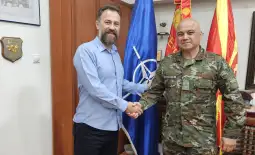
How is the Alliance integration process progressing and what are the biggest challenges in meeting the NATO standards in the Army?
Similar to the combat readiness, the NATO integration process is a daily process and task. We did not complete the integration through the 2020 accession. We meet the elementary requirements, but the process is ongoing, especially around the acceptance of the standards and their implementation in the army and defense institutions. The challenges arise from the current threats and risks – what are the needs and requirements, how to respond to these challenges, how to work with other NATO members in responding to the challenges, regional plans etc. We are part of the NATO eastern wing and provide significant support in this regard. The acceptance of standards and their implementation within the Army and institutions is all part of the NATO integration process.
Boris Kunoski
Photo: Darko Popov


