Education Minister: New national strategy must ensure digital skills and competencies to meet global changes

Skopje, 5 June 2025 (MIA) - The National Strategy is an extremely important document intended to ensure continuity and improve quality in Macedonia’s education system and educational process, as well as to develop digital skills and competencies in response to global changes, Education Minister Vesna Janevska said Thursday.
During today’s working meeting on the development of the new National Strategy for the period 2026 to 2032, Janevska explained that the document aims to improve the quality of the education system, foster digital skills, promote equity, and equip students with knowledge and competencies aligned with both the labour market and global educational shifts.
"These goals are essential for making our human capital competitive and positioning us as an equal partner globally," Janevska noted.
She underscored that the development of the National Strategy is a complex process.
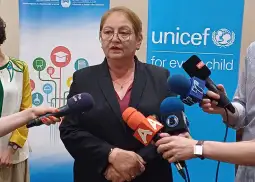
“It is a complex and lengthy process, not an easy one, but I believe in the end, we will deliver a solid product that ensures both quality and innovation in the education system. The new strategy will retain practices that have proven effective, while reworking those that fell short under the previous framework. We cannot remain stagnant, we must adjust to global demands. The goal of this document is to ensure ongoing improvement in the quality of education,” she said.
Responding to a journalist’s question on whether the new National Strategy will take into account UNICEF’s observation that primary school students in North Macedonia receive fewer classroom hours than the European average, Janevska said that optimization is needed and that a longer school day must be introduced.
“More than 150 schools are already operating in a single shift. This summer, we will launch a major initiative to build two or three additional classrooms per school. We’re starting with those schools that only require two, three, or four more classrooms. That plan is already in place and includes both Skopje and areas outside the capital,” she said.
When asked about peer violence in schools, Janevska said that the Ministry of Education and Science has implemented programs and teacher training as part of its responsibilities.
“We forward all reports we receive, but I must stress that schools are under municipal authority, and municipalities are responsible for addressing such issues. The Ministry's role is to provide support and solutions through programs,” Janevska said.
She added that the Ministry is actively involved, and the programs were developed in collaboration with international partners. “We have also provided training for teachers. Every school has a professional team to which such incidents should be reported. While the Ministry cannot track every individual case, if a case is reported to us, we will notify the appropriate institutions,” she said.
German Ambassador Petra Drexler stated that this event marks the beginning of a very important process.
"The German government supports the country, particularly in the process of EU integration, modernization, and especially in the reform of the education system. The Macedonian government has recognized the significant need for developing human capital, which is one of the key pillars for the continuation of the European integration process," Drexler said.
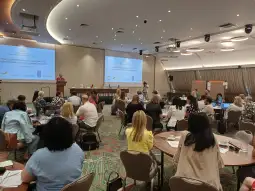
She emphasized that the development of vocational education and training is especially important, as it is one of the main elements of the new strategy addressing skill gaps, alignment of workforce demand, and economic needs.
UNICEF representative Lesley Miller said they are optimistic that this strategy will introduce innovations and ensure continuity from early childhood through the completion of secondary education.
She added that the National Strategy is an excellent opportunity for the education system to evolve and stay aligned with emerging technological developments, new trends, and artificial intelligence, helping to further enhance the entire education system.
“Most importantly, all of these efforts together will lead to better outcomes and a stronger education system,” Miller emphasized.
On the issue of extending students’ time in school, she said UNICEF is working with the Ministry of Education to optimize the school network and is examining all factors, financial and staffing, to ensure proper shift arrangements and that students stay in school for as many hours as needed.
UNDP representative Anna Chernyshova said that the event was historic.
“Today, we are attending this historic occasion marking the signing of the Memorandum of Understanding for the new Education Strategy. UNDP is proud to support this process together with its partners. Education is a foundation for international development, and in today’s rapidly evolving world of technology and artificial intelligence, it is essential for children to stay in step with these trends and developments. The link between education and employment is also important, as quality education leads to access to quality jobs, which means that young people will be more likely to stay and build their future in their own country,” Chernyshova stated.
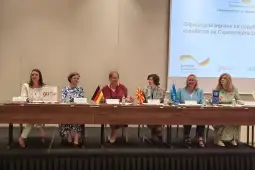
Asked about artificial intelligence, Chernyshova noted that it is a relatively new concept and that many countries are working on its integration.
“Artificial intelligence is still a relatively new concept, and many countries around the world are actively working on its implementation. Macedonia is not among top ten countries in this field. However, this only highlights the amount of work ahead of us, so we can at least introduce children to the fundamentals of AI,” she said.
Bojana Naceva, senior education specialist at the World Bank, said the new strategy will play a major role in improving inclusiveness in education.
“I want to thank the Ministry of Education and Science for including us in this process of developing the new Education Strategy, which will improve access, inclusiveness, and quality. It will be comprehensive and involve many stakeholders, creating a shared vision for the country’s education system. This is critical for building human capital, which is essential for better jobs, increased productivity, and overall economic growth,” she said.
Photo: Ministry of Education and Science


