Education minister: Joining World Skills Europe network, organizing AI courses to make work easier for teachers

Skopje, 3 July 2025 (MIA) — The country has joined World Skills Europe, an international network that promotes technical, vocational and service-oriented education and training, Minister of Education and Science Vesna Janevska said Thursday, also announcing that her ministry would be holding courses in AI use for teachers "to put it under control" in public schools and make their work easier.
Ahead of Thursday's conference on vocational education organized as part of the Swiss-supported Education for Employment in North Macedonia project, Minister Janevska said joining the World Skills Network would help the country exchange experiences with 30 other country members and reach higher standards in education.
"Secondary vocational education is no longer an alternative but the first choice of a huge number of young people," Janevska said.
Also, Janevska said, artificial intelligence could be beneficial in schools if it encouraged critical thinking.
She said AI use in schools was now "out of control", so courses were being organized for teachers to learn about using it.
"And I have to say that not only teachers but also older students are using an AI tool. AI has entered use. But it is out of control. We need to put it under control and train its users on the benefits as well as the negative consequences.
"We need to teach them to check the information they are getting and stimulate their critical thinking and analytic skills, as well as creativity, this way," she said.
According to her, AI could help teachers schedule their classes.
"For example, when schools have trouble creating class schedules," she said.
"With AI, there will be no more schedules that take three teachers days on end to make on paper or in an Excel table," Janevska said.
"Also from the aspect of costs, administration and the like, there are a lot of benefits. We can also expect better quality education," she said.
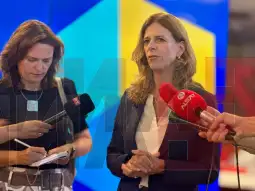
Ambassador of Switzerland Véronique Hulmann spoke to the press about her country's support of the dual vocational education reform.
She said the first reason Switzerland was supporting dual vocational training in high schools was that they had an excellent experience with the Swiss private sector contributing to the education of their future employees.
The second reason, Ambassador Hulmann said, was the true commitment and interest shown both by the government of North Macedonia and by the private sector.
The third reason, she said, was to help young people gain marketable skills that would help them find good jobs.
The E4E@mk project is implemented by Helvetas North Macedonia, the Macedonian Civic Education Center and the Economic Chamber of Macedonia with support from the Swiss Embassy and the Swiss Agency for Development and Cooperation.
The main objective of the project is to contribute toward a more gainful employment of youth (ages 15-29), including vulnerable groups, in a socially inclusive and sustainable way. mr/


