Bozhinovska: National Inventory of Public Buildings to lead to lower costs and significant savings

Skopje, 20 November 2025 (MIA) - An event held Thursday at the government launched the process for the establishment of a National Inventory of Public Buildings as a database aimed at fundamentally transforming how the state plans, invests in, and manages its public facilities.
In her address at the event, Minister of Energy, Mining, and Mineral Resources, Sanja Bozhinovska, stressed the reformative significance of the process.
“This is a reform tool that allows us to finally have an accurate and full picture of how the public sector functions through the lens of energy efficiency. For the first time, we will unite data on energy consumption, emissions, the state of the buildings, and the need for renovations,” Bozhinovska said.
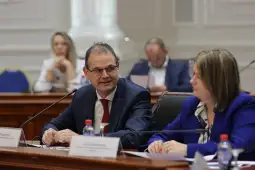
The North Macedonia country director at the German Agency for International Cooperation (GIZ), David Oberhuber, said establishing the National Inventory is not just a technical process, but an obligation to the future.
“The investors – domestic or international – finance what is measurable. This inventory will give North Macedonia a clear picture of what it needs and a strong foundation to attract funds for renovating public buildings in order to reduce energy consumption and therefore make institutions better for the citizens. GIZ remains fully committed to this cooperation,” Oberhuber said.
Professor Dame Dimitrovski from the Faculty of Mechanical Engineering in Skopje stressed the environmental and economic dimensions of the process.
“Public buildings in Macedonia are among the biggest consumers of energy and consequently a significant source of emissions – not only of CO₂, but also particulate matter that affect the air quality in our cities. Every step toward modernization and improved energy efficiency means not only fulfilling obligations to the Energy Community and international agreements but also cleaner air, healthier communities, better working conditions, and more economically sustainable public institutions,” Dimitrovski said.
According to the Ministry of Energy, Mining, and Mineral Resources, the National Inventory is a key tool for future investments. “Public buildings – hospitals, schools, administrative buildings, and cultural institutions – are among the largest energy consumers in the country. Changing how these buildings are managed is essential, as the public sector has a duty to lead by example in rational, sustainable, and responsible use of energy,” the Ministry said.
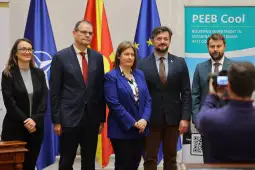
This process is part of the Partnership for Energy Efficiency in Buildings (PEEB Cool) project, funded by the Green Climate Fund, the French Development Agency (AFD), and the German Government through GIZ.
Photo: Ministry of Energy, Mining, and Mineral Resources


